

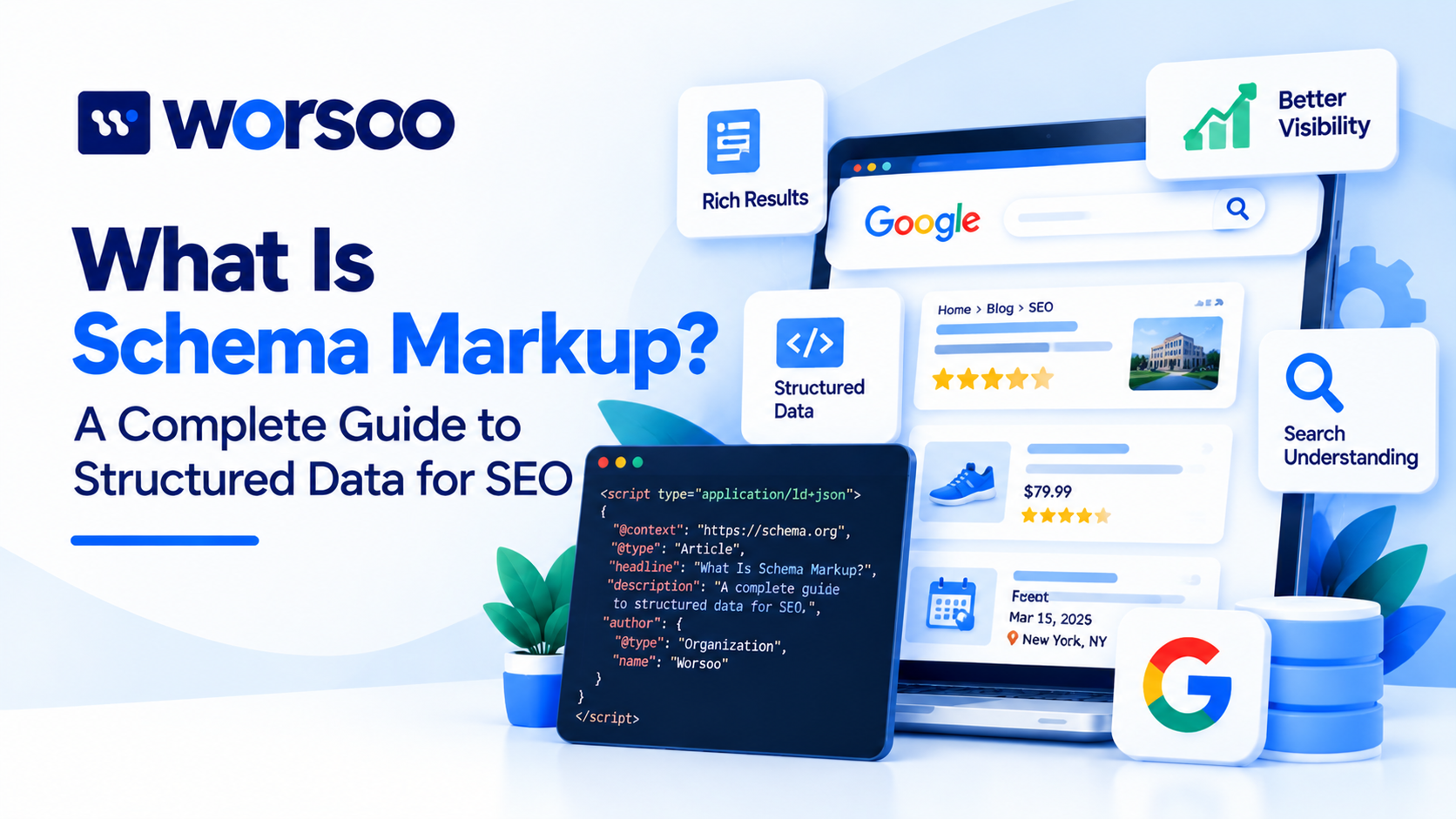
Have you ever searched Google and seen a result containing extra information such as ratings, product prices, event details, breadcrumbs, or other enhanced search features?
That additional information may be generated from structured data, commonly implemented using schema markup.
Schema markup is code added to a webpage to help search engines understand what the content represents.
Instead of asking search engines to interpret everything from ordinary text alone, structured data provides information in a standardized format.
For example, a page may contain a business name, address, telephone number, opening hours, product price, review information, or article details. Structured data can help search engines understand the meaning and relationships between those pieces of information.
Schema markup is therefore an important part of modern technical SEO, but it should not be viewed as a shortcut to higher rankings.
Adding schema does not automatically make a page rank better, and Google does not guarantee that structured data will result in a rich result.
In this guide, you will learn what schema markup is, how it works, why it matters, which schema types are useful, how to implement structured data, how to test it, and which mistakes to avoid.
What Is Schema Markup?
Schema markup is structured data that helps search engines understand the content and entities represented on a webpage.
Schema.org provides a shared vocabulary for describing different types of information on websites.
For example, structured data can describe:
- Articles
- Organizations
- Local businesses
- Products
- Events
- Recipes
- Courses
- Software applications
- People
- Reviews
- Breadcrumbs
The information is generally added to the HTML of a webpage using a supported structured-data format.
Google can then use eligible structured data to better understand the page and, for certain supported content types, potentially display enhanced search features.
You can learn more from Google’s official structured data documentation.
What Is Structured Data in SEO?
Structured data is a standardized way of communicating information about a webpage to machines.
Imagine a page contains this information:
Worsoo
SEO agency
Website optimization services
Location: [business location]
Website: Worsoo
A person can understand that this information describes a business.
Structured data can make the relationships between those pieces of information more explicit to search engines.
This is particularly useful because search engines process enormous amounts of information across millions of websites.
Structured data provides additional context that can help automated systems understand entities and relationships.
However, structured data should accurately represent visible page content. It should not be used to provide misleading information.
Schema Markup vs Structured Data: What’s the Difference?
These terms are often used interchangeably, but they are not exactly identical.
Structured data is the broader concept of organizing information in a machine-readable format.
Schema markup usually refers to using the Schema.org vocabulary to describe that information.
For example, Schema.org provides types and properties that can describe an organization, product, article, event, or other entity.
The structured data can then be implemented using a format such as JSON-LD.
How Does Schema Markup Work?
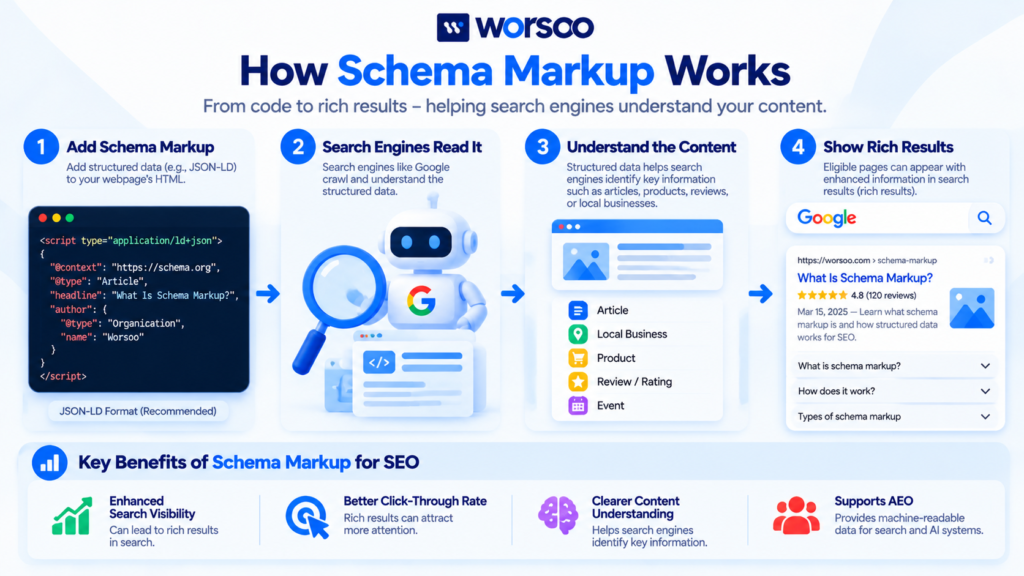
Schema markup works by providing structured information about the entities or content on a webpage.
A simplified example could describe a webpage as an article and provide information such as:
- Article headline
- Author
- Publication date
- Modification date
- Image
- Publisher
Search engines can process this information alongside the visible webpage content.
The structured data does not replace normal content.
Instead, it supplements the information already available on the page.
This distinction is important.
A website should never rely on schema markup as a substitute for useful content.
Your content should first satisfy the visitor’s needs. Structured data can then help search engines interpret relevant information about that content.
Why Is Schema Markup Important for SEO?
Schema markup can support SEO by helping search engines understand webpage content and, for eligible implementations, making pages suitable for certain enhanced search features.
There are several reasons SEO professionals use structured data.
1. It Helps Search Engines Understand Content
A webpage may contain information that has several possible interpretations.
Structured data provides additional context about what that information represents.
For example, a number on a product page might represent a price, rating, quantity, or another value.
Appropriate structured data can clarify the meaning.
2. It Can Support Rich Results
Google supports structured data for various search features.
Depending on the content type and eligibility requirements, structured data can make a page eligible for enhanced search appearances.
However, eligibility does not guarantee that Google will display a rich result.
Google decides when and how search features appear.
3. It Helps Connect Entities
Structured data can describe relationships between entities.
For example, an article can identify its author and publisher.
A local business can provide business information.
A product can provide information about the product itself.
These relationships can provide useful context for search engines.
4. It Supports Machine Understanding
Modern search increasingly involves systems that need to understand entities, relationships, and content rather than simply matching individual keywords.
Structured data provides machine-readable information that can contribute to this understanding.
This makes schema particularly relevant to technical SEO and semantic search.
Does Schema Markup Improve Google Rankings?
Schema markup does not guarantee higher Google rankings.
This is one of the most important things to understand.
Adding structured data does not mean Google will automatically move a page from position 20 to position 1.
SEO performance depends on many factors, including:
- Content relevance
- Content quality
- Search intent
- Technical accessibility
- Website authority
- Links
- Competition
- User experience
- Query context
Schema can help search engines understand content and can make pages eligible for supported search enhancements, but it should be treated as part of a wider SEO strategy.
For example, improving your technical SEO checklist may uncover crawling, indexing, or performance issues that schema alone cannot solve.
What Is JSON-LD?
JSON-LD is one of the most common formats used to implement structured data.
It stands for JavaScript Object Notation for Linked Data.
Instead of adding schema properties throughout visible HTML elements, JSON-LD is generally placed within a script element in the webpage’s HTML.
A simplified conceptual example looks like this:
{
  "@context": "https://schema.org",
  "@type": "Article",
  "headline": "Example Article"
}
The actual implementation requires appropriate properties and accurate information.
Google generally recommends JSON-LD when implementing structured data because it is easier to maintain and can be placed separately from the visible content.
For implementation details, follow Google’s JSON-LD structured data guidance.
Common Schema Types for SEO
There are many Schema.org types, but not every website needs every type.
The correct schema depends on the content and purpose of the page.
Article Schema
Article structured data can describe news articles, blog posts, and other editorial content.
Common properties can include:
- Headline
- Author
- Date published
- Date modified
- Image
- Publisher
For a content-focused website such as Worsoo, Article schema can be relevant to blog content when implemented accurately.
Organization Schema
Organization structured data can describe an organization and provide information such as:
- Name
- Logo
- Website
- Contact information
- Social profiles
It can help search engines understand the business entity represented by the website.
LocalBusiness Schema
LocalBusiness structured data can describe a local business and relevant information such as:
- Business name
- Address
- Telephone number
- Opening hours
- Geographic information
- Website
The specific properties depend on the business type.
Never add fictional business information simply to populate a schema field.
Product Schema
Product structured data can describe products and may include information such as:
- Product name
- Image
- Description
- Brand
- Offers
- Availability
- Reviews
E-commerce websites can benefit from implementing appropriate product structured data when the information is accurate and supported.
Breadcrumb Schema
Breadcrumb structured data can describe the hierarchical relationship between pages.
For example:
Home → SEO → Technical SEO → Schema Markup
This helps search engines understand the site’s content hierarchy.
It can also support eligible breadcrumb search features.
Event Schema
Event structured data can describe events such as:
- Conferences
- Concerts
- Webinars
- Sports events
- Workshops
Relevant event properties may include the event name, date, location, and event status.
FAQ Schema
FAQ structured data has historically been widely discussed in SEO, but its Google Search eligibility is much more limited than many SEO articles suggest.
Do not add FAQ schema simply because a page contains questions and answers.
Always check Google’s current structured data feature documentation to confirm which structured-data features are currently supported and what eligibility requirements apply.
Schema Markup and AEO
Schema markup can also be relevant to Answer Engine Optimization (AEO) because structured data provides machine-readable information about webpage entities and content.
However, AEO is not simply about adding schema.
If you want content to perform well across search and answer experiences, focus on:
- Clear answers
- Well-structured headings
- Accurate information
- Concise definitions
- Helpful explanations
- Relevant entities
- Strong internal linking
- Trustworthy sources
- Appropriate structured data
For example, an article answering “What is schema markup?” should provide a direct definition near the beginning instead of making readers search through several paragraphs.
This direct-answer approach also improves the experience for people using traditional search.
How to Add Schema Markup to a Website
There are several ways to implement structured data.
Method 1: Use an SEO Plugin
Many WordPress SEO plugins can automatically generate certain types of structured data.
This can be convenient for website owners who do not want to manually edit code.
However, automatic schema should still be reviewed.
Plugins can sometimes generate information that does not accurately represent a particular page.
Method 2: Add JSON-LD Manually
Developers can add JSON-LD directly to the website’s HTML.
This gives greater control over the structured data.
However, incorrect syntax or inaccurate properties can create validation problems.
Method 3: Use Custom Development
Large websites may require customized structured-data implementations.
For example, an e-commerce website with thousands of products may need structured data generated dynamically from its database.
The implementation should be scalable and should accurately reflect the visible page information.
How to Test Schema Markup
Never assume that schema works simply because code has been added.
Test it.
1. Use Google’s Rich Results Test
The Google Rich Results Test can determine whether a webpage or code snippet is eligible for supported rich-result features.
Enter the URL or code and review the results.
The tool can identify structured-data issues relevant to supported Google search features.
2. Use Schema.org Validator
The Schema.org Validator can help validate structured data against Schema.org’s vocabulary.
This can be useful when checking whether markup uses valid types and properties.
Remember that passing a Schema.org validation check does not automatically mean Google will display a rich result.
3. Monitor Google Search Console
Search Console can provide information about certain structured-data-related search features and issues when applicable.
Review relevant reports after implementing schema and monitor important pages over time.
Common Schema Markup Mistakes
Mistake 1: Adding Schema That Does Not Match the Page
Structured data should accurately describe the content.
Do not label a normal blog article as a product simply because product results appear more attractive.
Mistake 2: Using Fake Reviews
Never create artificial reviews or ratings simply to obtain enhanced search features.
Structured data should represent legitimate information.
Mistake 3: Marking Up Hidden Content
Do not add structured data for information that is not appropriately represented to users.
The markup should follow Google’s structured-data policies.
Mistake 4: Adding Every Schema Type
More schema does not automatically mean better SEO.
Only use structured data that genuinely applies to the page.
Mistake 5: Ignoring Validation Errors
If your implementation produces errors, investigate them.
Some issues may prevent eligibility for specific search features.
Mistake 6: Assuming Schema Guarantees Rich Results
Passing validation does not mean Google must display a rich result.
Search features are determined by Google’s systems.
Mistake 7: Using Outdated SEO Advice
Structured-data requirements and supported search features can change.
Always verify important implementation decisions against current Google documentation rather than relying on an old SEO tutorial.
Schema Markup Best Practices
Follow these principles when implementing structured data.
Keep Information Accurate
The information in your structured data should match the actual page.
If your business changes its address, update the relevant information rather than leaving outdated data in the markup.
Use Relevant Schema Types
Choose the schema type that accurately describes the page.
Do not select a type simply because it has more search features associated with it.
Use Supported Properties
Not every Schema.org property has SEO value.
Focus on properties that are relevant and supported by the search feature you are targeting.
Keep Your Markup Consistent
Your structured data should not contradict visible page content.
For example, if the visible page says a product costs $50 but structured data says $25, the discrepancy can create problems.
Validate Before Publishing
Test your implementation before deploying it across hundreds or thousands of pages.
A template-level error can multiply across an entire website.
Monitor After Implementation
SEO is not a set-and-forget process.
Review important pages after major website changes, plugin updates, redesigns, and template modifications.
Schema Markup and Internal Linking
Schema is only one part of a technically strong website.
Internal linking is another important component because it helps visitors and search engines discover related pages.
For example, a page about structured data can naturally connect to a technical SEO checklist when discussing technical implementation.
Readers who want to understand the wider optimization process can also explore Worsoo’s SEO audit guide.
When discussing keyword targeting, link to the guide explaining what SEO keywords are.
When discussing content relevance, readers can continue to the guide about search intent in SEO.
For off-page optimization, a relevant article about backlink profiles provides additional context.
Readers interested in technical website performance can also explore Worsoo’s Core Web Vitals guide.
These contextual links create useful connections between related SEO topics rather than adding links simply for the sake of increasing link count.
Frequently Asked Questions About Schema Markup
What is schema markup?
Schema markup is structured data that provides search engines with additional information about the content and entities represented on a webpage.
Is schema markup a ranking factor?
Schema markup itself should not be treated as a direct guarantee of higher rankings. It can help search engines understand content and may make eligible pages suitable for certain enhanced search features.
Does every website need schema markup?
Not every page needs the same schema type. Structured data should be used when it accurately represents the content and provides a legitimate purpose.
What is JSON-LD in SEO?
JSON-LD is a format commonly used to implement structured data. It allows structured information to be added separately from much of the visible HTML content.
Does schema markup guarantee rich results?
No. Even valid structured data does not guarantee that Google will display a rich result.
Can schema markup improve CTR?
Potentially, if eligible structured data contributes to an enhanced search appearance that attracts more attention. However, Google controls when supported search features are displayed, so increased CTR is not guaranteed.
How do I check if my schema markup is working?
Use Google’s Rich Results Test and the Schema.org Validator. You can also monitor relevant structured-data reports in Google Search Console.
Can I add multiple schema types to one page?
Yes, a page can contain multiple relevant structured-data entities when they accurately describe the page and its relationships. Avoid adding irrelevant or contradictory markup.
Should I add FAQ schema to every article?
No. FAQ schema should only be used when the page meets the relevant requirements and the structured data accurately represents the content. Google’s eligibility for FAQ-related rich results is limited.
How Schema Fits Into a Complete SEO Strategy
A successful SEO strategy is built from multiple connected elements.
Schema markup can help search engines understand your content, but it cannot compensate for:
- Poor content
- Slow websites
- Broken pages
- Weak internal linking
- Poor search intent alignment
- Technical accessibility problems
- Low-quality backlinks
- Poor user experience
This is why schema should be considered one component of a larger SEO framework.
Worsoo’s on-page and off-page SEO services combine different optimization areas rather than relying on a single SEO technique.
Your website’s technical foundation should also support crawling and indexing. If search engines cannot access an important page, adding structured data to that page will not solve the underlying accessibility problem.
Improve Your Website’s SEO With Worsoo
Schema markup can make your website’s content easier for search engines to interpret, but implementing it correctly requires accuracy and a clear understanding of the page being optimized.
From structured data and technical SEO to content optimization and link building, each part of your website should support the same overall search strategy.
Worsoo helps businesses improve their organic visibility through practical SEO and website optimization.
Explore Worsoo’s SEO services to learn how technical, on-page, and off-page optimization can work together.
If you need help identifying technical SEO opportunities on your website, contact Worsoo to discuss your goals.
Final Thoughts
Schema markup helps search engines understand what your webpage and its content represent.
It can provide useful machine-readable information about articles, businesses, products, events, breadcrumbs, and other entities.
But schema is not a magic ranking technique.
The best approach is to first create useful, accessible content for your audience and then add accurate structured data where it genuinely applies.
Use supported schema types, keep information consistent with the visible page, validate your implementation, and monitor the results through appropriate Google tools.
Combined with strong technical SEO, useful content, logical internal linking, and a clear understanding of search intent, structured data can become a valuable part of a long-term SEO strategy.