

Guest post outreach means contacting a website with an idea for an article you could write for its readers. The process starts with finding suitable publishers, checking their rules, and sending a clear pitch. A useful guest post gives readers something they can use and gives the editor a sound reason to publish it.
Sending more emails is easy. Finding the right people to contact takes more thought.
An editor may like your topic but already have a similar article. Another website may accept outside writers but serve the wrong audience. A third may offer paid posts with little care for what goes into them.
This guide shows you how to sort those options before you spend time writing. You will see a sample publisher list, a clear review process, and one tailored email.
What should guest post outreach achieve?
Choose a reader and a purpose first.
For an SEO agency, that might mean helping small business owners check whether their website forms work. A practical article on a business website could introduce the agency to people who need that help.
Useful goals include reaching a relevant audience, sharing a real skill, starting an editor relationship, and bringing interested visitors to a useful resource.
A backlink may be part of the result. It should not be the only reason the article exists.
Ask this before adding a website to your list:
Would I still want these readers to see my work if the link did not improve my rankings?
If the answer is no, look more closely at the fit.
For the wider process, from setting goals to measuring results, see our link building campaign guide. This article focuses on the publisher research and pitch stage.
Step 1: Define the reader and the article idea
A broad topic such as “SEO tips” is hard to pitch. It tells an editor little about what readers will learn.
Start with a short brief:
| Question | Example answer |
|---|---|
| Who is the reader? | A small service business owner |
| What problem do they have? | People visit the website but few send an inquiry |
| What will the article help them do? | Test the contact form on a phone |
| What can the writer show? | A test checklist and screenshots from a demo website |
| What makes the idea useful? | Readers can follow the checks without buying software |
This example is a proposed topic, not a claim about a real client or campaign.
The brief gives you a way to judge publishers. A website for small business owners could fit. A website about celebrity news probably would not.
You also need enough knowledge to write the piece well. If you have not tested the steps, do that before offering a hands-on guide. If the topic needs a specialist, involve one and explain their role honestly.
Step 2: Find websites that serve those readers
Begin with publications your audience already reads. Look for trade websites, business blogs, professional groups, and niche magazines.
Searches such as these can help:
small business website tips contributor guidelinesservice business marketing submit an articleweb design magazine pitch guidelinessmall business blog guest author
Replace the topic with your own field. Open each result and review the website itself.
Search terms are a way to find possible publishers. They are not proof of quality. A page titled “write for us” may have strict editorial standards, or it may accept almost anything.
You can also review where knowledgeable people in your field have written. Check whether those articles are recent and whether the publisher still accepts pitches.
Keep your first list small enough to review by hand. Ten carefully checked websites are a manageable starting point, not a proven success formula.
Step 3: Check each publisher before making contact
A useful guest posting outreach list needs more than website names and authority scores.
Read recent articles, open the About page, and check the contributor rules. For each website, answer these questions.
Do its readers need your topic?
Look at the main subjects and the level of detail. A technical article for developers may not suit a publication for first-time business owners.
Check the relevant section, too. A large website can cover many topics, but your article still needs a clear home.
Does the site show editorial care?
Look for clear writing, named authors, useful sources, and articles that answer real questions. Notice whether the publisher corrects errors or explains its review process.
One weak article does not prove that the whole website is poor. Read several pages before deciding.
Is the idea already covered?
Search the site for your proposed topic. Read the closest article rather than judging its title alone.
If the publisher already has a good guide, offer a distinct problem or example. For instance, a broad website checklist and a detailed mobile form test serve different needs.
If you cannot explain the difference in one sentence, your pitch needs more work.
What do its metrics actually tell you?
DA, DR, and estimated traffic can help you compare websites. They do not replace reading the site.
A high score does not prove that your readers are there. A low traffic estimate does not prove that nobody reads the publication. Check the traffic country, topics, and trend where data is available, and label tool figures as estimates.
Our guide to what makes a good backlink explains more of the context worth checking.
What are the publishing and link rules?
Find out whether the editor wants an outline or a full draft, whether brand links are allowed, and how paid content is handled. Check an existing article as well as the written rules.
Keep a note of when you reviewed the policy. Publishers can change their requirements.
A sample publisher list and how to use it
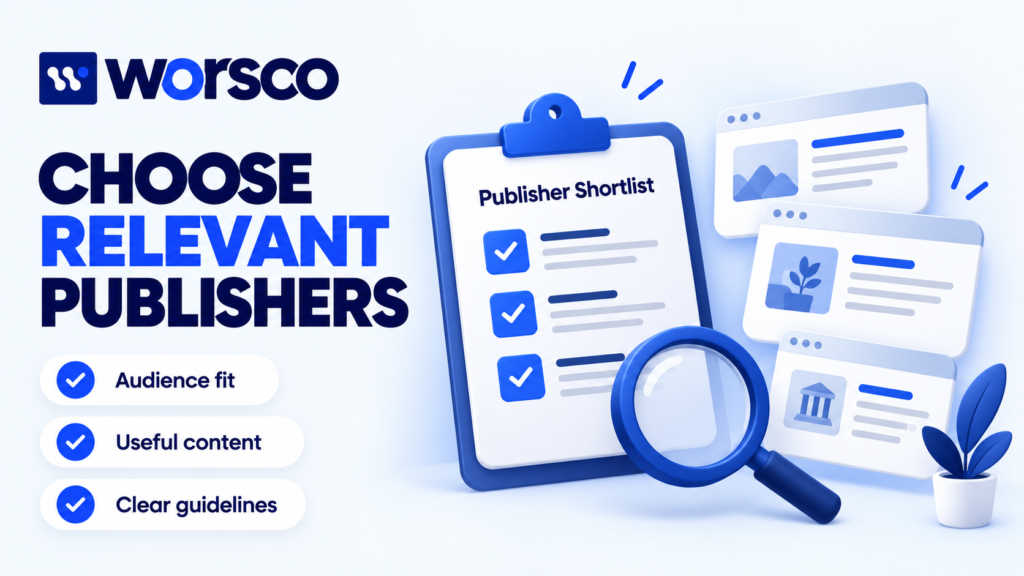
The table below is fictional. These are example publisher types, not real websites, verified opportunities, or Worsoo campaign results.
Assume you want to pitch a guide to testing mobile contact forms.
| Example prospect | What the review finds | Decision | Reason |
|---|---|---|---|
| Small business magazine | Publishes practical website advice and accepts outlines | Shortlist | The readers and topic fit |
| Cleaning industry journal | Covers lead handling but has no form-testing guide | Shortlist | The idea can use cleaning inquiry examples |
| Developer publication | Covers advanced coding and requires code samples | Hold | The basic guide is too simple for its readers |
| General blog selling any topic | Recent posts have little connection and weak sourcing | Skip | There is no clear audience fit |
| Marketing magazine | Published a detailed mobile form guide last month | Skip this idea | The proposed article adds too little |
Notice that “skip” does not always mean a bad website. A strong publisher can still be wrong for this particular article.
For each shortlisted website, save the publisher URL, relevant article, submission rules, contact method, proposed angle, and reason for choosing it. Add a status such as “researching,” “ready to pitch,” or “not suitable.”
The most useful field is often the reason for choosing the site. If it only says “high DR,” the research is incomplete.
Step 4: Find the correct contact and follow the rules
Use the submission page or the editor contact listed by the publication. If the site asks for a form, use the form. If it says it does not accept pitches, remove it from your active list.
Do not send the same idea to several people at one publication at the same time. That can create duplicate work for the team.
Before sending, check that the name, role, and email address match the publication. Use your real identity and explain any client or business connection that matters to the pitch.
You do not need to pretend you have followed the editor for years. One honest detail about an article you read is enough to show why you are contacting them.
Step 5: Write one pitch with a clear reader benefit
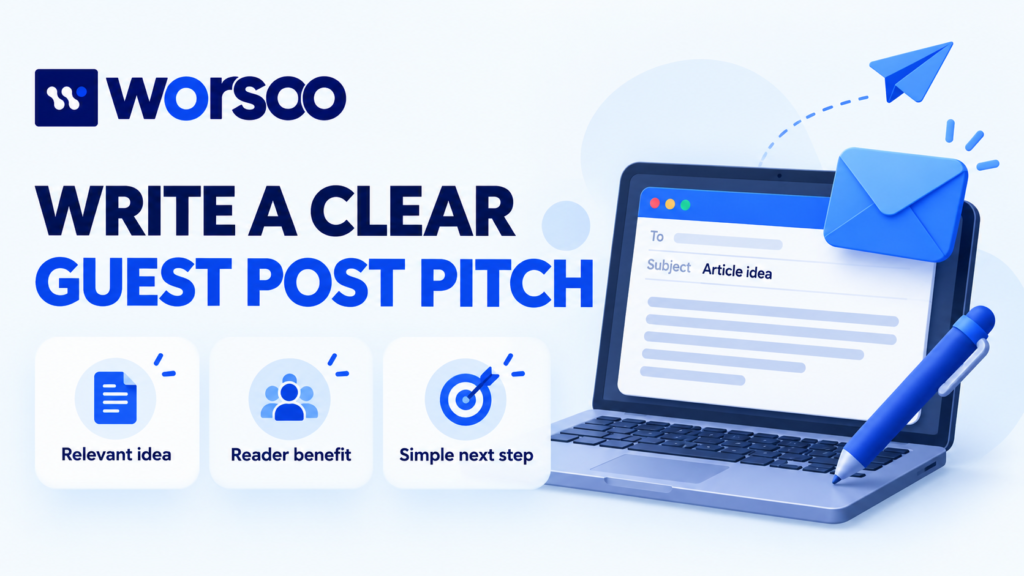
A good guest blog outreach email answers four questions:
- Why does this idea belong on this website?
- What will the reader learn?
- What will you add that is useful?
- What would you like the editor to do next?
Here is an illustrative pitch for the fictional small business magazine above. The publication, editor, and existing article are invented for the example. Replace every detail with something you have checked before using it.
Subject: Article idea: test your contact form on a phone
Hi Maya,
Your website planning guide helps owners choose their main pages. I would like to suggest a follow-on article: “How to Test Your Contact Form on a Phone.”
It would show readers how to check the fields, send a test inquiry, confirm that the email arrives, and spot errors on a small screen. I can include screenshots from a demo site and a short checklist.
I work with Worsoo, an SEO agency, and would disclose that connection in my author bio. Any reference to our resources would be subject to your editorial rules.
Would you like a short outline?
Thanks,
[Your name]
Only offer screenshots or tests you can produce. Do not invent client results, qualifications, or past work to make a pitch sound stronger.
The useful detail here is the gap between an existing planning guide and the proposed practical test. Changing the editor’s name in a generic email would not show that same fit.
What does outreach research tell us?
Backlinko and Pitchbox analyzed 12 million outreach emails in a study published on April 16, 2019. They reported an overall reply rate of 8.5%. Emails with personalized body text had a 32.7% higher response rate than emails without it.
You can read the original email outreach study for its findings.
These are historical figures from a broad outreach dataset. They are not a current guest post acceptance rate, a Worsoo result, or a forecast for your campaign. The study shows an association; it does not prove that personalization alone caused the difference.
The practical lesson is to give editors a clear reason to care. Measure your own replies and accepted ideas rather than treating an old average as a target.
Step 6: Handle replies and follow up with care
If an editor asks for an outline, send the outline they requested. Confirm the topic, length, evidence, deadline, and disclosure rules before writing the full article.
If the answer is no, accept it. A rejected topic may still teach you something about the publication’s readers.
When there is no reply, first check the submission rules for a waiting period. If the publisher gives none, one short follow-up after roughly a week is a reasonable starting approach. This is a workflow suggestion, not a proven best time.
Keep it in the same email thread. Briefly restate the idea and make it easy to decline. Stop if the person asks you to stop, and do not move through several staff members to force a response.
Keep paid placements and editorial work clear
An editorial pitch offers a useful article for an editor to judge. A paid placement includes a commercial arrangement. Be clear about which one you are discussing.
Google’s spam policies identify buying or selling links for ranking purposes as link spam. They also cover guest posts with optimized anchor text used in manipulative link arrangements.
If a publisher charges for placement, confirm the disclosure and link treatment before agreeing. Google’s outbound-link guidance says paid links should use rel="sponsored"; nofollow is also acceptable, though sponsored is preferred.
Do not demand a paid link that passes ranking credit. Let the publisher apply its editorial rules and use link text that makes sense to readers.
Our explanation of dofollow and nofollow links can help you understand the terms when reviewing a proposal.
Can guest posts help with AI search visibility?
A useful guest article can put your work in front of new readers. It does not guarantee that an AI tool will cite your business.
AEO means answer engine optimization. GEO means generative engine optimization. LLMs are the language models behind many AI tools. These terms do not create a separate shortcut for guest posting.
Google’s guidance for generative AI search says its usual SEO practices remain relevant. It does not require special AI schema or an llms.txt file. This guidance applies to Google’s search features; other services have their own systems.
For your guest article, make the author and business connection clear. Answer the main question early. Use real examples, explain where figures come from, and separate facts from opinions.
Those choices help readers judge the work. Avoid paying for repeated, unsupported claims that your brand is “the best” and treating them as proof of expertise.
Measure the quality of the outcome

Keep a simple record of what happened after each pitch.
| Measure | What to record | What it helps you judge |
|---|---|---|
| Delivered initial pitches | Messages sent without a known delivery failure | Size of the starting group |
| Human replies | Replies from people, excluding automatic messages | Whether the topic starts a conversation |
| Positive replies | Requests for an outline or draft | Whether the idea fits |
| Published articles | Live URLs and publication dates | Work that reached publication |
| Referral visits | Visits from the published article, where measurable | Whether readers click through |
| Useful inquiries | Relevant leads from those visits, where traceable | Business value beyond publication |
For example, if 20 delivered pitches bring four human replies, the reply rate is 20%. If two of those replies request an outline, the positive reply rate is 10% of delivered pitches.
This is a fictional calculation, not a target or industry average. Use the same definitions each time, and keep follow-ups separate from the number of unique publishers contacted.
If replies are low, review your list and topic fit before sending more. If articles go live but bring no useful visits, check whether their readers need the resource you linked.
Common questions about guest post outreach
Do I need a paid tool to start?
No. You can begin with search, the publisher’s own website, and a spreadsheet. Paid tools may help with larger research tasks, but you still need to check each publisher yourself.
Should I write the full article before pitching?
Follow the publisher’s rules. If it accepts ideas first, send a focused pitch or outline. Writing a full draft before checking the fit can waste time.
Is a high-DR website always the best choice?
No. Its audience, topic, editorial standards, and publishing terms matter. Use a tool score as one research input rather than the final decision.
Can guest post outreach guarantee rankings or clicks?
No. Acceptance, publication, indexing, clicks, and rankings are separate outcomes. A publisher’s approval does not guarantee any of the others.
Need help choosing publishers for your next article?
Start with a clear reader, one useful idea, and a shortlist you can explain. That gives your outreach a solid purpose before the first email goes out.
Ask Worsoo about SEO and outreach support. Share your website, target audience, and proposed topic so we can discuss publisher fit, research, and a clear reporting process.
1 comment on “Guest Post Outreach: Build a Relevant Publisher List and Pitch”