


Find guest post opportunities by looking for publications your intended readers already use. Check their contributor guidelines, recent articles, and submission rules. Then match a specific reader problem with something you can explain from real knowledge or evidence.
A website accepting guest posts is only a starting point. The useful question is whether you have something its readers need.
For example, someone who tests online stores may have a useful article for an ecommerce publication. That same article may not belong on a general lifestyle blog, even if the blog has a higher authority score.
This guide shows you where to look, how to verify an opportunity, and how to build a shortlist you can act on. It includes two real publisher examples and a fictional worksheet showing the decision process.
What counts as a guest post opportunity?
A guest post opportunity is a chance to contribute an article to a website you do not own. The publisher may ask for an idea, an outline, or a complete draft before deciding.
Publishers use different terms. Look for contributor articles, expert submissions, opinion pieces, tutorials, and case studies as well as guest posts.
An opportunity is not a confirmed placement. A public contribution page does not mean the editor will accept your topic, publish it quickly, or include a business link.
Separate three stages in your research:
| Stage | What it means | What to do next |
|---|---|---|
| Possible publisher | The website appears relevant | Read its content and rules |
| Qualified opportunity | Your topic and the submission route fit | Prepare the requested proposal |
| Accepted contribution | The editor has approved the idea or draft | Confirm scope and deliver the agreed work |
This keeps a list of possible websites from looking like a list of guaranteed results.
Start with what you can teach
Before searching for websites, write down three subjects you can explain well.
Choose tasks you have done, problems you have investigated, or topics you can support with reliable evidence. Your experience can be narrow and still be useful.
For example:
- A store manager can explain how they check product information before launch.
- A developer can show how they tested keyboard navigation on a demo site.
- An SEO specialist can explain how they record and verify broken internal links.
Now turn each subject into a reader question. “Technical SEO” is broad. “How can a shop owner check whether a category link leads to a missing page?” gives you a clearer article idea.
Write down the material you could provide: a checklist, screenshots, a documented example, or a small original test. Only offer evidence you have or can honestly produce.
Where can I guest post? Five places to look
1. Publications your audience already reads
Start with the magazines, blogs, and newsletters that cover your audience’s work.
Look through their article sections and author pages. Do they publish contributions from people outside the editorial team? Is there a clear way to propose an article?
You can also ask customers or colleagues which publications they read. Their answers can reveal smaller, relevant websites that do not appear on common guest-post lists.
Record why each publication belongs on your list. “Covers store operations for small retailers” is a useful reason. “Looks like a strong domain” leaves the audience question unanswered.
2. Industry groups and professional communities
Trade groups and professional associations may publish educational articles, member stories, or practical guidance.
Check who is allowed to contribute. Some accept outside experts; others restrict submissions to members or invited writers.
Read the format as well. A community may want a short case example rather than a full tutorial. Do not send a promotional article simply because the organization works in your field.
3. Publisher searches around your topic
Use your subject with terms that describe editorial submissions. For example:
ecommerce operations contributor guidelinesweb accessibility pitch an articlesmall business magazine submissionscontent strategy write for us
Open the publisher’s own website before adding it to your shortlist. A search result may show an old page, a copied list, or a submission route that no longer works.
Do not judge a site by the phrase “write for us.” It can appear on a carefully edited publication or a website that accepts nearly anything.
4. Bylines from knowledgeable people in your field
Find someone who writes useful articles on your subject. Look at where their work appears, then review those publications directly.
A byline can reveal a relevant outlet, but it does not prove that unsolicited submissions are welcome. The writer might be a staff member, a regular columnist, or an invited contributor.
Use the discovery to investigate the publisher’s process. Do not claim a connection to the author unless one exists.
5. Sources cited by related articles
Read strong articles in your field and follow their useful references. You may discover specialist publications that cover the same reader problems from another angle.
If you use a backlink tool, treat its results as research leads. A competitor’s link might come from a citation, interview, partnership, or old campaign. It is not proof that the site accepts guest articles.
For each possible publisher, check the actual page and identify how the contribution happened.
Two real examples of publisher guidelines
These examples concern web design, development, and related professional work. They are not suitable for every business or every SEO topic. Their public guidelines were checked on October 28, 2026; acceptance and editorial terms remain the publisher’s decision.
Smashing Magazine
Smashing Magazine’s writing guidelines describe contributions for people who work on the web. The publication considers tutorials, opinion pieces, detailed guides, and practical case studies.
Its guidance emphasizes lessons from work and useful examples. It also says it works with individual authors and rejects obvious attempts at content marketing.
A detailed lesson from a real web project could be worth considering if you have the relevant knowledge. A generic article built around promoting your agency would not match those stated rules.
Before proposing anything, check its current process and recent coverage. Do not interpret the contributor page as an offer to sell a backlink.
A List Apart
A List Apart’s contributor guidance describes an audience including designers, developers, content strategists, and similar web professionals. It asks for a clear argument supported by evidence rather than a sales pitch.
The page lists articles from 600 to 2,500 words, with about 1,500 words as an average. These are that publisher’s guidelines, not a universal SEO word-count target.
The submission route allows a draft or a short pitch with an outline. Use the page to understand the expected angle and effort before writing.
This may suit someone with a thoughtful, supported idea about web work. A basic list of SEO tips may not provide the kind of contribution it describes.
What these examples teach
Both pages give more useful information than a domain score alone: who the readers are, what the editors want, and how to submit.
Use the same checks with publishers in your own niche. A good match in one field is not automatically a good match in another.
Verify a guest post opportunity before you pitch
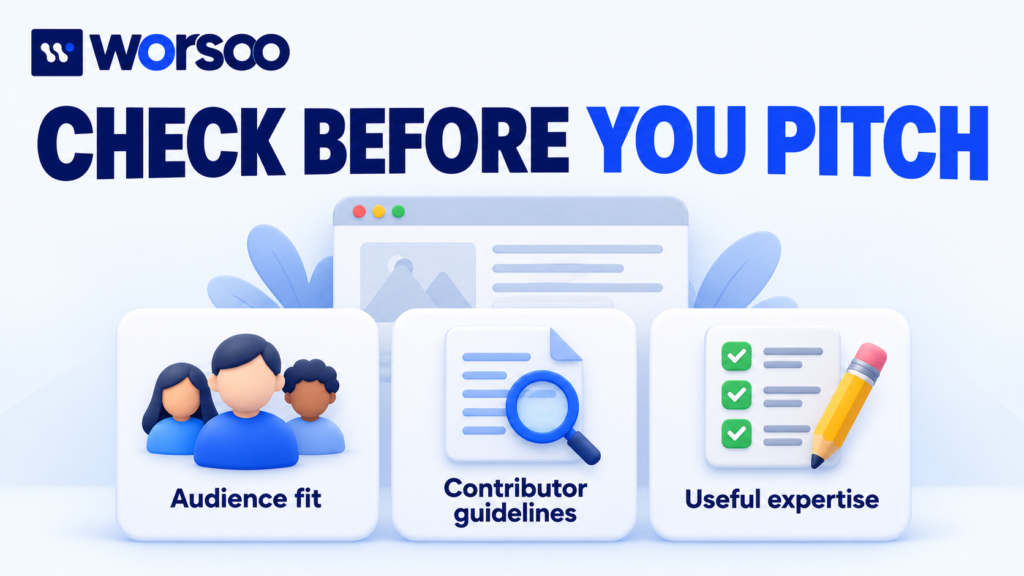
For each promising website, make a short evidence record.
| Check | Evidence to collect | Reason it matters |
|---|---|---|
| Audience | A relevant section and recent article | Shows who the publication serves |
| Contribution route | The publisher’s own guidelines or request | Confirms how to approach it |
| Topic fit | Your proposed question and closest existing coverage | Helps you avoid repeating its work |
| Editorial standards | Author information, sourcing, and review rules | Helps you understand the expected quality |
| Commercial terms | Any fee, payment, disclosure, or link policy | Prevents misunderstandings |
| Current status | Date checked and any submission notice | Reduces reliance on old information |
An old guidelines page is not enough by itself. Check whether the publication is still active and whether there is a closure notice or updated submission process.
If the site explicitly says it does not accept contributions, remove it from the active list. If the rules are unclear, mark the opportunity as unconfirmed rather than guessing.
Use website metrics as supporting evidence
Authority and traffic tools can help with research, but their numbers need context.
Ahrefs explains Domain Rating as a measure of backlink-profile strength relative to its database on a 0–100 scale. Its own guidance warns against judging a website on site-wide authority alone.
That means a high DR score is not an acceptance standard, an editorial quality certificate, or proof that your audience reads the site.
If you review estimated traffic, look at the country, subject, and trend. Label estimates clearly. An estimate is not the publisher’s own analytics, and a low estimate alone does not prove that no one reads it.
For a US audience, for example, a large total traffic figure is less helpful if the readers mainly come from another market and the content does not address US needs.
Our guide to what makes a good backlink explains why relevance and page context matter when reviewing an opportunity.
A fictional shortlist: which opportunities deserve work?
Imagine a writer who has tested checkout forms and can explain the lessons with screenshots from a demo store. The proposed article is “How to Test a Checkout Form Before Launch.”
The following publishers and findings are fictional. They illustrate decisions, not real opportunities or Worsoo campaign results.
| Possible publisher | What the review finds | Decision |
|---|---|---|
| Ecommerce operations blog | Serves shop owners, accepts outlines, and has no recent checkout-testing guide | Prepare a focused outline |
| Advanced development journal | Requires code examples and technical testing detail | Hold until the writer can meet that standard |
| Local business newsletter | Accepts short practical contributions for owners | Adapt the idea to its shorter format |
| Broad article directory | No clear audience or visible editorial process | Skip this campaign |
| Retail magazine | Closed to outside pitches at present | Record the status and stop outreach |
The second site may be a strong publication. It is simply not ready for this writer’s current evidence. The fifth may be relevant, but the submission route is closed.
This is why a short, checked list can be more useful than hundreds of unreviewed domains.
Separate editorial contributions from paid placements
Confirm who pays whom and for what.
A publisher paying a writer for an accepted article is different from a business paying a publisher to place promotional content. A fee described as “editorial” still needs a clear explanation of the arrangement.
Google’s spam policies identify buying or selling links for ranking purposes as link spam. They also state that paid advertising or sponsorship links are acceptable when qualified with rel="nofollow" or rel="sponsored".
If a placement is commercial, agree on the disclosure and link treatment before paying or writing. Do not assume that a high website score makes a paid ranking-credit link acceptable.
For editorial submissions, let the publisher judge whether a resource link helps its readers. Do not make a dofollow link the purpose of the article.
Build a research sheet you can reuse
Give every shortlisted publisher one row. Keep these fields:
- Publisher name and website.
- Reader group and relevant section.
- Guidelines URL and date checked.
- Existing article closest to your idea.
- Proposed angle and evidence you can provide.
- Submission method and commercial terms.
- Status: ready, needs research, closed, or unsuitable.
Add one sentence explaining why you chose the publisher. That sentence should connect the audience to your contribution.
For example: “This publication teaches first-time store owners, and our demo can show them how to test a checkout form.”
If the sentence only describes a metric, return to the audience check.
Turn the research into a proposal
Once the publisher, topic, and route fit, prepare the format it requests.
Your brief should name the reader’s problem, the article’s main point, and the example or evidence you will use. It should also state your role and any relevant business connection accurately.
Read our guest post outreach guide for the process from shortlist to pitch. When you are ready to draft the email, use our guest post outreach templates and replace the sample details with checked information.
Do not imply that your shortlist is a list of editor relationships. Finding a contact route does not mean you have worked with that publication.
Can AI help find guest post opportunities?
An LLM can suggest related industries or help organize research notes. It can also suggest publishers whose rules have changed, or invent a submission page that does not exist.
Check every suggested website and its actual guidelines before treating it as an opportunity. Record the page you used, not just the AI answer.
If your goal includes GEO or AEO visibility, keep the same evidence standard. Those terms refer to work aimed at generative search and answer systems. Publication alone does not guarantee that an AI service will mention or cite your brand.
Choose places where you can contribute something accurate and useful. Do not present paid promotion as independent proof that your business is the best.
Common questions about finding guest post opportunities
Where can I guest post if my website is new?
Look for publications that match your knowledge and accept outside contributors. A new website does not stop you from offering a useful article, but you still need a clear idea and enough evidence to write it well. Create a relevant sample if an editor needs to assess your writing.
Should I use a ready-made guest posting list?
You can use one to discover possible publishers. Recheck every entry on the publisher’s own site. The list may contain outdated rules, closed submissions, or websites that do not fit your topic.
Does a website need a “write for us” page?
No. Some publications use other terms or issue specific calls for contributions. Look for a clear, appropriate submission route. Do not assume that publishing an outside author means accepting every unsolicited pitch.
What is a good DR for guest posting?
There is no single score that proves an opportunity is useful. Review the audience, article quality, topic fit, and publishing terms. A tool score should support that decision rather than replace it.
How many websites should I research first?
Start with a group you can review properly. Ten is a manageable practice batch, not a proven ideal. Expand when you understand what makes a publication suitable for your particular contribution.
Need help finding suitable publishers?
Choose a topic you can support, look for the readers who need it, and verify the publisher’s rules. Your shortlist should explain why each opportunity deserves a pitch.
Ask Worsoo about outreach and SEO support. Share your website, target market, and the expertise you can bring so we can discuss publisher research and a suitable outreach approach.
1 comment on “How to Find Guest Post Opportunities That Fit Your Expertise”