

A good guest post outreach template gives you a clear structure for an email. It should explain the article idea, why it fits the publisher’s readers, and what useful knowledge you can bring. Replace the general parts with details you have checked before sending it.
Changing a name at the top is not enough.
An editor needs to understand what you want to write and why their readers would care. A short, specific proposal helps them make that decision. Praise, big claims, and long introductions often leave the real idea unclear.
Below are three templates for different situations: pitching a practical guide, offering original evidence, and replying to a request for contributors. Each includes guidance on what to change and what to leave out.
These are original sample drafts, not emails from a tested Worsoo campaign. They do not come with a promised reply or acceptance rate.
Choose the template that matches your situation
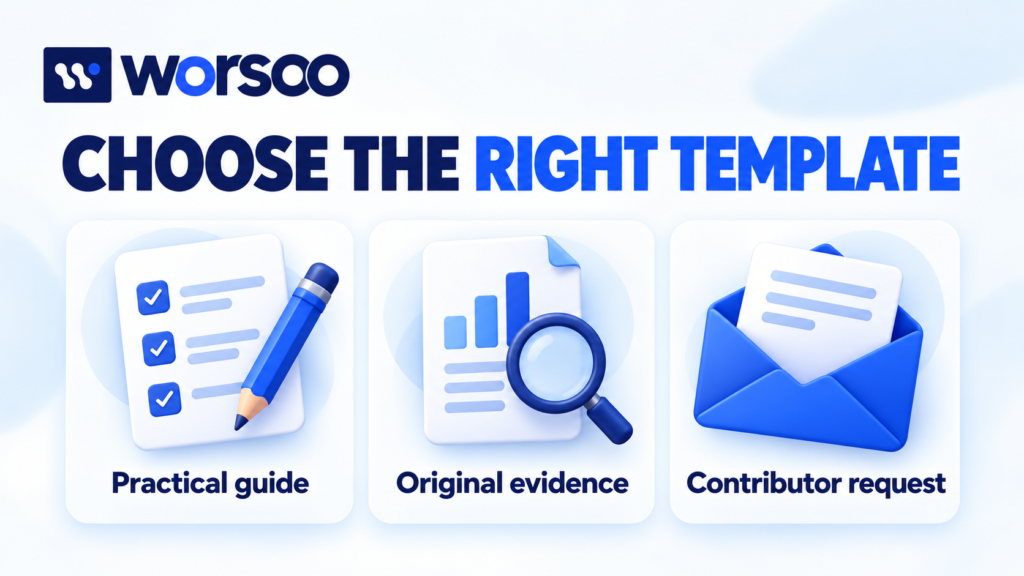
| Your situation | Template to use | What you need before sending |
|---|---|---|
| You can explain a useful task step by step | Practical guide pitch | A clear reader problem and steps you can verify |
| You have your own research, test, or documented example | Evidence-led pitch | The actual evidence, its limits, and permission to share it |
| A publisher has asked for contributions on a topic | Contributor request reply | The exact request and a matching idea |
If you have not chosen a suitable publisher yet, start with our guest post outreach guide. It covers building and checking a publisher list. This article focuses on turning that research into an email.
Template 1: Pitch a practical guide
Use this guest post pitch when you can help readers complete one clear task. It works best when you can show the steps with a checklist, example, or demonstration.
Subject: Article proposal: [specific task] for [reader group]
Hi [editor’s name],
I read your guide to [existing topic]. It covers [specific point]. I would like to propose a separate article on [related task] for your [reader group] readers.
The working title is “[proposed title].” It would explain how to [main action], including [useful example or checklist]. Readers would finish with [clear practical outcome].
My relevant background is [brief, accurate experience]. I can provide [material you can actually create or share].
Would you like a short outline for review?
Thanks,
[name]
[role and business]
What to personalize
Read the existing article before describing it. Name a point it actually covers, then explain what your proposed piece adds.
For example, a general guide to planning a business website may not explain how to test a quote form. That is a focused follow-on topic. Another broad “website tips” article may add very little.
Replace “clear practical outcome” with something a reader can do. “Check whether a test inquiry reaches the right inbox” is more useful than “improve business success.”
What to remove
Remove any offer you cannot deliver. If you do not have screenshots, either make them before pitching or say you plan to create them. Do not describe a proposed demonstration as a completed client project.
You can also remove the reference to an existing article if it feels forced. A direct explanation of audience fit is better than false familiarity.
Template 2: Offer original evidence or a documented example
Use this template only when the evidence exists. That could be a small test, a survey, a set of observations, or a case example you have permission to discuss.
Subject: Article idea using our [test or research] on [topic]
Hi [editor’s name],
I have completed [type of work] looking at [specific question]. Your coverage of [relevant subject] made me think the findings could be useful to [reader group].
I would like to propose “[working title].” The article would explain [main finding], how we checked it, and what readers can learn from it.
The work covers [sample and date range]. Its main limit is [important limitation], so I would avoid presenting it as a result for every business.
I can share [summary, method, or anonymized material] for your review. I am [role] at [business], and would disclose that connection.
Would you like to review the summary before deciding?
Thanks,
[name]
What to personalize
Tell the editor what you studied and why it matters. Include the sample size or scope if it helps them judge the claim.
For instance, a test on three demo pages can explain a method. It cannot prove how every website performs. A finding from one client may be useful, but the article should explain that client’s context.
Make the evidence easy to review. A short summary showing the question, method, result, and limits is often a useful starting point.
What to remove
Do not use “our research” for statistics copied from another website. Credit the original source and describe your contribution accurately.
Remove client names, private account details, and screenshots you are not allowed to share. If permission is needed, get it before offering the material to an editor.
Do not promise a surprising finding just because it makes the subject line more attractive. The result should drive the headline.
Template 3: Reply to a publisher’s contributor request
Use this version when a publication has posted a call for articles or invited pitches on a specific subject.
Subject: [Required subject format] — [your proposed topic]
Hi [editor’s name],
I saw your request for contributions about [topic] on [page or channel]. I would like to propose “[working title].”
The article would help [reader group] understand [specific question]. I would cover [point one], [point two], and [point three], using [example or evidence].
My relevant experience is [accurate background]. A suitable writing sample is [sample title and link, if requested or useful].
I can provide [outline or draft] by [realistic date] and follow your requirements for [relevant format or length].
Would this angle fit your brief?
Thanks,
[name]
[role and business]
What to personalize
Follow the publisher’s instructions before the template. If they require a form, use the form. If they request a full draft, do not send only a vague idea.
Use their requested subject format and deadline. Read the brief closely enough to explain how your angle fits it.
If you are pitching on behalf of a client, state that relationship. Name the proposed author accurately, especially when the editor needs someone with specialist experience.
What to remove
Do not claim you were personally invited if you only saw a public request. Replace “thank you for inviting me” with a simple reference to the published call.
Leave out unrelated writing samples. One relevant piece gives the editor more useful information than a large list of links on different subjects.
How to fill in a template without sounding generic
The strongest detail usually connects the reader’s problem to the article you can write.
Use this table while editing your guest post request:
| Template field | Weak version | More useful version |
|---|---|---|
| Topic | “SEO tips” | “How a shop owner can check broken product links” |
| Reader benefit | “Boost your success” | “Find links that send shoppers to missing pages” |
| Reason for contact | “Your website is amazing” | “Your store setup section serves first-time shop owners” |
| Experience | “I am a leading expert” | “I manage product pages for a small online store,” if true |
| Evidence | “We have great results” | “I can show the test steps on a demo store,” if available |
| Next step | “Send all your requirements” | “Would you like a short outline?” |
The examples are illustrative. Use only the experience and evidence that apply to you.
Before sending, try removing the publisher’s name. Could the remaining email be sent unchanged to any website? If so, explain the audience fit or proposed contribution more clearly.
This does not mean adding personal facts about the editor. Keep your research focused on their publication and professional brief.
A worked example: from a weak request to a clear pitch
Here is a fictional request that gives an editor little to work with:
Hello,
I love your website. I am an expert writer and can provide high-quality SEO content. Please accept my guest post and give me a dofollow link.
It gives no article idea, no reader benefit, and no evidence for the expertise claim.
A more useful version could read:
Hi [editor’s name],
Your store setup section helps new shop owners prepare for launch. I would like to pitch “How to Check Product Links Before Your Store Goes Live.”
The article would show readers how to test links from a category page, spot missing destinations, and record problems for their developer. I can create a demo-store example and a simple checklist.
I work with [business name] and would disclose that role in the author bio. Would you like an outline?
This example is a proposed draft, not a real email or campaign result. Before using it, confirm that the publisher has the section described and that you can create the promised material.
The change is practical: the editor can now judge a specific idea. It also leaves link decisions to the publisher’s editorial process.
What does research say about personalized outreach?
Backlinko and Pitchbox analyzed 12 million outreach emails in research published on April 16, 2019. Their email outreach study reported an overall response rate of 8.5%. Messages with personalized body text had a 32.7% higher response rate than messages without it.
That is a relative difference, not an extra 32.7 percentage points. These historical results cover broader outreach, not just guest post pitches. They do not establish a current acceptance rate or prove that personalization alone caused the difference.
Use the findings as a reason to test thoughtful, relevant writing. Do not advertise these sample templates as “proven to get replies.” Their results have not been measured.
What should a guest post subject line say?
A subject line should tell the editor what the email contains. Follow any format in the submission rules.
Useful patterns include:
- Article proposal: [specific task]
- Pitch for [section]: [working title]
- Research summary: [question studied]
Avoid fake urgency and misleading replies. Do not add “Re:” to a new message to make it look like part of an earlier conversation.
There is no reason to force the phrase “guest post” into every subject. A publisher asking for article pitches may prefer a clear working title.
How much should you say about links and payment?
Make the business relationship clear. If your proposal depends on a paid placement, say so and ask about the publisher’s sponsored-content process. Do not present it as an independent editorial contribution.
Google’s spam policies identify buying and selling links for ranking purposes as link spam. They also cover manipulative uses of keyword-rich links in guest posts.
For paid placements, Google’s outbound-link guidance recommends rel="sponsored". It also accepts nofollow for marking paid links.
A useful resource link may help the reader, but do not make a ranking-credit link the condition for contributing. Check the publication’s rules before writing the draft.
Our guide to what makes a good backlink explains why the page, audience, and context matter when judging a link opportunity.
Can AI help you adapt the templates?
Yes. An LLM, or large language model, can help shorten a draft or make unclear sentences easier to read. Give it verified notes about the publisher and the idea you actually want to offer.
A useful editing instruction is:
Rewrite this pitch in simple English. Keep the topic and facts unchanged. Do not invent experience, results, relationships, or details about the publisher. Mark any missing information in brackets.
Read the output carefully. Check names, article titles, and claims against your notes. Remove any bracketed field you cannot support.
Do not upload private client information into a tool without permission. An anonymized summary may be enough for editing.
Should the pitch promise GEO or AEO results?
No. GEO and AEO are terms used for work aimed at visibility in generative AI and answer systems. A guest post cannot guarantee that an AI service will cite a brand.
Google’s guidance on generative AI search says regular SEO practices remain relevant and special AI markup is not required for its search features.
Pitch the value you can deliver: an accurate article, a clear explanation, or useful evidence. Keep claims about rankings, clicks, and AI mentions separate from the work you control.
Check these details before pressing send
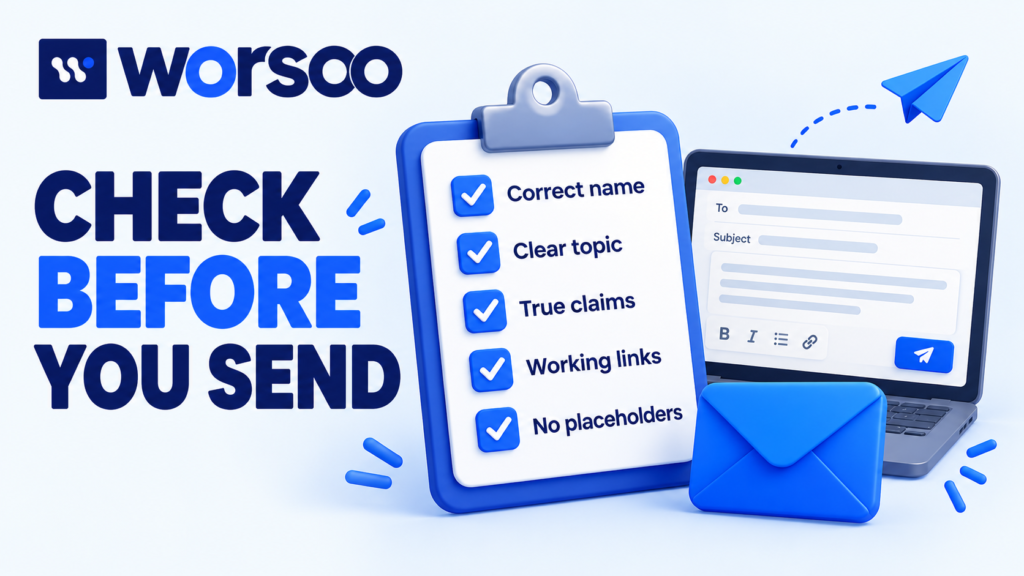
| Check | Ready when… |
|---|---|
| Publisher rules | You have followed the required contact method and format |
| Recipient | The name and role match the intended publication |
| Idea | The email names a specific topic and reader benefit |
| Evidence | Every experience claim and offered resource is accurate |
| Disclosure | Your business or client connection is clear |
| Placeholders | No brackets, wrong names, or unused template text remain |
| Request | The editor can see one clear next step |
Open any writing-sample links before sending. Check that the page works and that your name or contribution is represented accurately.
If the publisher says it does not accept pitches, do not send one. If the editor declines or asks you to stop, respect that response.
How to judge whether your template helps
Track delivered pitches, human replies, requests for outlines, and accepted articles. Keep automatic replies separate from editor responses.
Record which template you used and what you changed. If nobody responds, inspect the publisher fit and article idea before changing only the subject line.
A small test cannot prove that one template is best. Different topics, editors, and timing can affect the outcome. Look for useful feedback, such as an editor asking for a narrower angle or more evidence.
For managing the wider process, use our link building campaign guide. It explains how outreach fits into planning and reporting.
Common questions about guest post outreach templates
Can I send the same template to several websites?
You can reuse the structure. Rewrite the topic, audience fit, evidence, and request for each publication. Do not claim to have read an article unless you have read it.
What if I have no published writing samples?
Say so if asked. Offer a relevant outline or create a sample on your own website. A clear demonstration of your knowledge is more useful than invented publishing experience.
Should I attach a full article to the first email?
Follow the submission rules. If the editor asks for pitches, send an idea first. If a full draft is required, provide it in the requested format. Do not assume every publication uses the same process.
Should I follow up if there is no reply?
Check the publisher’s policy and stated response window. Where follow-ups are welcome, keep the message brief and in the original thread. Silence is not permission to contact every editor at the publication.
Want help turning your idea into a clear pitch?
Choose the template that fits your evidence, fill it with checked details, and read it from the editor’s point of view. The article idea should be easy to understand before you ask for a decision.
Ask Worsoo about outreach and SEO support. Share your website, target readers, and proposed article topic so we can discuss publisher fit and a clear outreach approach.