

Quick answer: Your backlink profile is the complete collection of links pointing to your website from other sites, plus everything Google can tell about those links, who’s linking, how trustworthy they are, what words they use, and how natural the whole pattern looks. Think of it as your site’s reputation file. Google reads it constantly to decide whether you deserve to rank.
Most site owners obsess over publishing content and never look at this file at all. That’s a mistake. When I audit a struggling site, the backlink profile is usually the first place the problem shows up, and it’s often the difference between a page that ranks and one that never moves. Here’s everything you need to understand yours.
What is a backlink profile, exactly?
A backlink profile is the full picture of every inbound link to your domain and the qualities attached to those links. It’s not a single number or score. It’s a portrait built from dozens of signals: which websites link to you, how authoritative they are, whether the links are followed or nofollow, what anchor text they use, how relevant the linking sites are to your topic, and how quickly you’ve earned them over time.
Google doesn’t just count your links; it evaluates the shape of the pattern. A hundred links from one spammy directory tells a very different story than fifty links from fifty respected, relevant publications. The second profile wins every time, even with fewer links.
The building blocks of a backlink profile
Every profile is made of the same core components. Understanding each one tells you what to strengthen.
| Component | What it means | Why it matters |
|---|---|---|
| Referring domains | The number of unique websites linking to you | The single strongest link-based ranking correlator (Ahrefs) |
| Domain authority | The strength/trust of the sites linking to you | One link from a trusted site can outweigh dozens of weak ones |
| Anchor text | The clickable words used in each link | Natural, varied anchors look earned; exact-match spam looks manipulative |
| Follow vs nofollow mix | The ratio of link types in your profile | A natural profile has both; all-followed looks engineered |
| Topical relevance | How related the linking site is to your niche | A relevant link passes far more value than an off-topic one |
| Link velocity | How fast you gain (or lose) links over time | Sudden unnatural spikes can trigger scrutiny |
Notice that only one of these is about quantity. The other five are about quality and pattern. That’s the whole game.
A quick glossary: links, in plain English
The link world is full of jargon that trips up beginners. Here are the terms you’ll run into, cleared up.
| Term | What it actually means |
|---|---|
| Backlink | Any link from another website that points to yours |
| What are inbound links? | Inbound links are simply backlinks viewed from your side, links coming into your site from elsewhere. “Inbound link” and “backlink” mean the same thing |
| When you link a resource, what is it called? | It’s called a citation or reference, and the link itself is a backlink for the site you’re pointing to. You’re vouching for that resource |
| What is a page link? | A page link points to one specific page rather than a homepage; deep links to individual pages help distribute authority across your site |
| Referring domain | One unique website linking to you, no matter how many links it sends |
| Anchor text | The visible, clickable words that carry the link |
If you only remember one thing here: inbound links, backlinks, and page links all describe the same basic thing from slightly different angles, a link from somewhere else arriving at your site.
Why your backlink profile matters so much
The data on this is blunt. Backlinko’s study of 11.8 million search results found the number one result on Google has, on average, 3.8 times more backlinks than the pages ranking in positions two through ten. Ahrefs, analyzing over a million SERPs, repeatedly finds referring domains to be the highest-correlating link factor with rankings.
At the same time, most of the web is invisible. Backlinko and Ahrefs both report that roughly 94% of all published content has zero backlinks. That sounds discouraging, but flip it around: earning even a handful of quality links puts you ahead of the vast majority of pages competing for attention.
Quality beats raw volume decisively. Moz’s research found that editorial links placed inside the body of relevant content carry roughly 2.3 times the value of links buried in sidebars or footers. And it’s worth knowing that nofollow links, by Ahrefs’ own explanation of how Domain Rating works, don’t directly strengthen that score, which is exactly why a healthy profile still needs earned, followed, editorial links at its core.
Healthy profile vs toxic profile
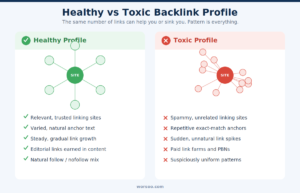
Not all links help. Some actively hurt. Here’s the contrast I look for in an audit.
| Healthy profile | Toxic profile |
|---|---|
| Links from relevant, trusted sites | Links from spammy, unrelated sites |
| Varied, natural anchor text | Repetitive exact-match keyword anchors |
| Steady, gradual link growth | Sudden unexplained link spikes |
| A natural mix of follow and nofollow | Suspiciously uniform patterns |
| Editorial links earned in content | Paid link networks and low-quality directories |
A toxic profile doesn’t just fail to help; a pattern that looks manipulative can drag your rankings down. If you find spammy links you didn’t build, Google’s disavow tool lets you tell it to ignore them, though it should be used carefully and only when the problem is real.
How to check your own backlink profile
You can’t improve what you can’t see. Here’s the practical starting point I give clients:
- Pull your data. Use Ahrefs, Semrush, or Moz to export your referring domains, anchor text distribution, and follow/nofollow split. Google Search Console shows a free, if simpler, view under Links.
- Judge quality, not just quantity. Scan for irrelevant or spammy domains. Ten strong links beat a thousand weak ones.
- Check your anchor text. If a large share is exact-match commercial keywords, that’s a red flag to diversify.
- Watch your velocity. Earn links at a believable pace. A natural profile grows steadily, not in overnight bursts.
- Compare to competitors. Look at who links to the pages outranking you. Those same sites are often your best link targets.
One shift for the AI era
Here’s something worth adding to your thinking in 2026: links are being repriced, not replaced. First Page Sage estimates backlinks now account for roughly 13% of Google’s ranking weight, down from around half historically. More striking, Ahrefs’ large brand study found that unlinked brand mentions now outweigh backlinks by about three to one when it comes to visibility inside AI Overviews. Building a recognizable brand and earning genuine mentions increasingly does double duty, feeding both your traditional backlink profile and your visibility in AI-generated answers.
Final thoughts
So, what is a backlink profile? It’s your site’s reputation, written in links, and Google reads it every time it decides where to rank you. A strong one isn’t about hoarding links; it’s about earning relevant, trustworthy, natural links at a believable pace, while keeping the toxic ones out.
If you’ve never actually looked at your profile, you’re flying blind on one of the most important signals you have. Not sure whether your backlinks are helping you or holding you back? A proper backlink audit is one of the first things we run for clients at Worsoo, and it often uncovers the exact reason a site isn’t ranking.
2 comments on “What Is a Backlink Profile? A Beginner’s Guide”