

SEO content writing is the process of creating a page that answers a search query better than every other result. The page must also be easy for Google and AI tools to read, trust, and cite. To do it well, pick a keyword with real demand, match the search intent, give the answer in the first 50 words, add first-hand experience, structure the page with clear headings and tables, and keep it updated.
Most sites skip these steps. They publish fast and hope. This guide shows a better way.
Last updated: October 2026. Written by the Worsoo SEO team.
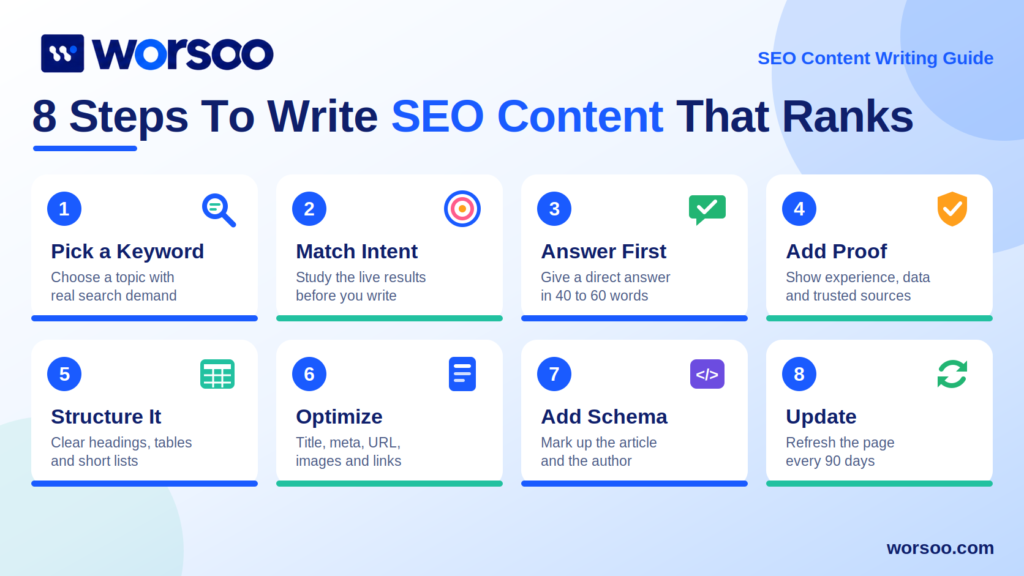
Quick Answer: The 8 Steps
- Choose a keyword that has real traffic potential
- Read the search results and match intent
- Write the answer first
- Add real experience and proof
- Structure the page for people and machines
- Optimize the on-page elements
- Add schema and strong internal links
- Publish, measure, and update
Why Most Content Never Ranks
Here is the hard truth. An Ahrefs study of about 14 billion pages found that 96.55% of pages get zero traffic from Google. Only a small group earns visits. The study points to three causes. Pages have no backlinks, target topics nobody searches for, or fail to match search intent.
Writing skill is not the main problem. Direction is. Writers often start with a topic they like instead of a query people type.
Google has also become stricter in 2026. The table below shows the updates that matter for content writers.
| 2026 Google Update | Date | What It Means For You |
|---|---|---|
| March spam update | March 24 | Thin and manipulative pages lose visibility |
| March core update | March 27 | Broad reassessment of content quality |
| May core update | May 21 | Google said to keep making satisfying content for people |
| September spam update | Sept 24 to Oct 8 | Fourth spam update of the year, rollout took almost 14 days |
The message is clear. Quality content for people is the safest long term plan. Google repeats this in its own guide on creating helpful, reliable, people-first content.
What Google Actually Rewards in 2026
Many writers still ask one question. Does Google punish AI content?
The data says the tool is not the issue. Ahrefs studied 600,000 pages across 100,000 keywords. It found that 86.5% of top ranking pages contain some AI content, and only 4.6% are fully AI. The link between AI share and ranking position was almost zero at 0.011.
So what gets punished? Mass produced pages with no value. Google lists this under scaled content abuse in its spam policies. The method does not matter. The value does.
In practice, we see the same pattern again and again when reviewing weak blog posts. The page repeats what ten other pages already say. It has no example, no data, and no opinion. A reader learns nothing new, so Google has no reason to rank it.
Step 1: Choose a Keyword That Can Earn Traffic
A good keyword has three traits. People search for it. You can realistically compete. The traffic leads to a goal.
Start with a seed idea and check it in a tool such as Ahrefs or Semrush. Look at three numbers.
| Metric | What It Tells You | Good Sign For a New Site |
|---|---|---|
| Search volume | How many people search each month | 100 to 1,000 for a first page |
| Keyword difficulty | How hard the top results are to beat | Low to medium |
| Traffic potential | Total traffic the top page earns | Higher than the keyword volume alone |
Then group related terms. One page should cover one main topic and its close variations. Our guide on SEO keywords and keyword research explains how to build these groups.
Common mistake: Targeting a head term like SEO with a brand new site. Start with long phrases and build up.
Step 2: Read the Search Results and Match Intent
Search intent is the reason behind a query. If your page does not match it, good writing will not save it. Read our full guide on search intent in SEO for more detail.
Open Google. Type your keyword. Study the first page. Then fill this table.
| Intent Type | Signs in the Results | Best Content Format |
|---|---|---|
| Informational | Guides, definitions, how to posts | Step by step guide or explainer |
| Commercial | Comparisons, best of lists, reviews | Comparison table with clear picks |
| Transactional | Product and service pages | Service page with a strong CTA |
| Navigational | Brand homepages | Not worth targeting |
Note three things. What format do the top pages use? How long are they? What questions do they leave unanswered? That last point is your opening. Cover the gap and your page becomes the better answer.
Step 3: Write the Answer First
Readers want the answer fast. AI search tools want the same thing. This is the core of answer engine optimization, also called AEO.
Use this simple pattern.
- Put the question in a heading
- Give a direct answer in 40 to 60 words
- Follow with proof, steps, or an example
Look at the opening of this article. It defines the term and lists the method in two short paragraphs. An AI tool can lift that block and a human can use it in seconds.
This matters more each year. Pew Research Center tracked 68,879 searches and found that people clicked a normal result in 8% of visits when an AI summary appeared, against 15% when none appeared. Only 1% of visits led to a click on a link inside the summary. To win, you need to be the source the summary draws from, and you need a page worth the click.
Step 4: Add Real Experience and Proof
Google asks for experience, expertise, authority, and trust. This is called E-E-A-T. Our article on what E-E-A-T means in SEO goes deeper. Here is how to show it inside your writing.
| E-E-A-T Signal | How to Show It On the Page |
|---|---|
| Experience | Share what you tested, with dates, tools, and results |
| Expertise | Explain why a step works, not only what to do |
| Authority | Link to primary sources like Google, Pew, and Ahrefs |
| Trust | Show the author, a clear update date, and a way to contact you |
Here is a weak line and a strong line.
Weak: Good content helps your rankings.
Strong: When we rewrote a thin service page to answer five real customer questions, it started winning impressions for long tail queries within weeks.
The second line is specific. It shows work was done. Add your own numbers from Search Console whenever you can. A real screenshot beats a stock photo every time.
Step 5: Structure the Page for People and Machines
Most readers scan before they read. Help them.
- Use one H1 and clear H2 and H3 headings
- Keep paragraphs to two or three lines
- Put key terms in the first sentence of a section
- Use a table when you compare things
- Use a numbered list for steps
Machines also read structure. Clear headings help Google find the right passage. They also help AI tools pull a clean answer. Name your entities plainly. Write Google Search Console, not the tool. Write Ahrefs, not a popular platform. Specific names build trust and help models connect facts.
Step 6: Optimize the On-Page Elements
Writing is only half the job. Check these items before you publish. Our complete guide to on-page SEO covers each one.
| Element | Best Practice |
|---|---|
| Title tag | Keyword near the start, under 60 characters |
| Meta description | Benefit plus keyword, under 155 characters |
| URL | Short and clean, such as /seo-content-writing/ |
| H1 | One only, close to the title |
| First 100 words | Include the main keyword and a direct answer |
| Images | Descriptive file names and alt text |
| Internal links | Three to five links with natural anchor text |
| External links | Link to trusted sources that support your claims |
Do not stuff keywords. Write the way a person would explain it to a friend. If a sentence reads badly out loud, rewrite it.
Step 7: Add Schema and Internal Links
Structured data tells search engines what your page is. Article and Organization schema are the safe base. Add author details so Google can link the content to a real person. Read our simple guide to schema markup in SEO for setup help.
A note on FAQ schema. Google cut back FAQ rich results in 2023, so do not expect a special display. Still write the FAQ section. AI tools and readers use it. Add the schema only if it matches the visible text.
Internal links matter just as much. They pass authority and guide readers. Link from this guide to related pages on your own site. For example, a technical audit page fits well with our SEO audit guide. A link building topic fits with our off page SEO guide.
Step 8: Publish, Measure, and Update
Publishing is the start. Here is a simple routine.
- Submit the URL in Google Search Console
- Check impressions and queries after two weeks
- Add missing questions that show up in the queries report
- Refresh the page every 90 days with new data
- Update the date only when the content truly changed
During a Google update, do not panic. Google notes that a drop does not always mean the update caused it. Compare your data before, during, and after the rollout, then act on real patterns.
Pre-Publish Checklist
Use this scorecard on every article.
| Check | Pass? |
|---|---|
| Keyword has real search demand | Yes or No |
| Intent matches the top results | Yes or No |
| Direct answer in the first 100 words | Yes or No |
| At least three stats from trusted sources | Yes or No |
| One original example or insight | Yes or No |
| Table or list added where useful | Yes or No |
| Author and update date visible | Yes or No |
| Internal and external links added | Yes or No |
| Clear CTA at the end | Yes or No |
If you miss more than two, do not publish yet.
Common SEO Writing Mistakes and Fixes
| Problem | Why It Hurts | Fix |
|---|---|---|
| Long intro before the answer | Readers and AI tools leave | Answer in the first paragraph |
| Copying the top results | Adds no value | Add data, examples, and your own view |
| No sources | Weak trust signal | Link to primary studies and official pages |
| Keyword stuffing | Reads badly and risks spam flags | Use natural variations |
| Wrong intent | Page never ranks | Re check the live results |
| Never updating | Content decays | Refresh every 90 days |
Frequently Asked Questions
What is SEO content writing?
SEO content writing is creating web content that matches what people search for and is easy for search engines to understand. It combines keyword research, search intent, clear structure, and real value for the reader.
How long should SEO content be?
Length should match the topic and the intent. Check the top results and cover the subject more completely. A short answer page can rank. A deep guide needs more words. Never add filler to reach a number.
Does Google penalize AI written content?
No. Google targets low quality and mass produced content, not the tool. Ahrefs found that most top ranking pages contain some AI content. Add human review, facts, and original insight.
How do I write content for AI search tools?
Lead with a direct answer, use question based headings, name entities clearly, cite trusted sources, and keep facts accurate. Pages that are clear and well sourced are easier to quote.
How often should I update SEO content?
Review important pages every 90 days. Update stats, add new questions, and fix broken links. Change the date only when the content has really changed.
How long does SEO content take to rank?
It depends on competition and site strength. Many new pages take several months. Our guide on how long SEO takes explains realistic timelines.
Final Thoughts
SEO content writing is not about tricks. It is about being the most useful result for a real question. Pick the right keyword. Match intent. Answer fast. Prove your claims. Keep the page fresh.
Do this on every article and you join the small group of pages that actually earn traffic.
Need help building content that ranks? The team at Worsoo offers SEO strategy, content planning, and technical support. Visit worsoo.com and tell us your goals.
1 comment on “SEO Content Writing: How to Write Content That Ranks”