

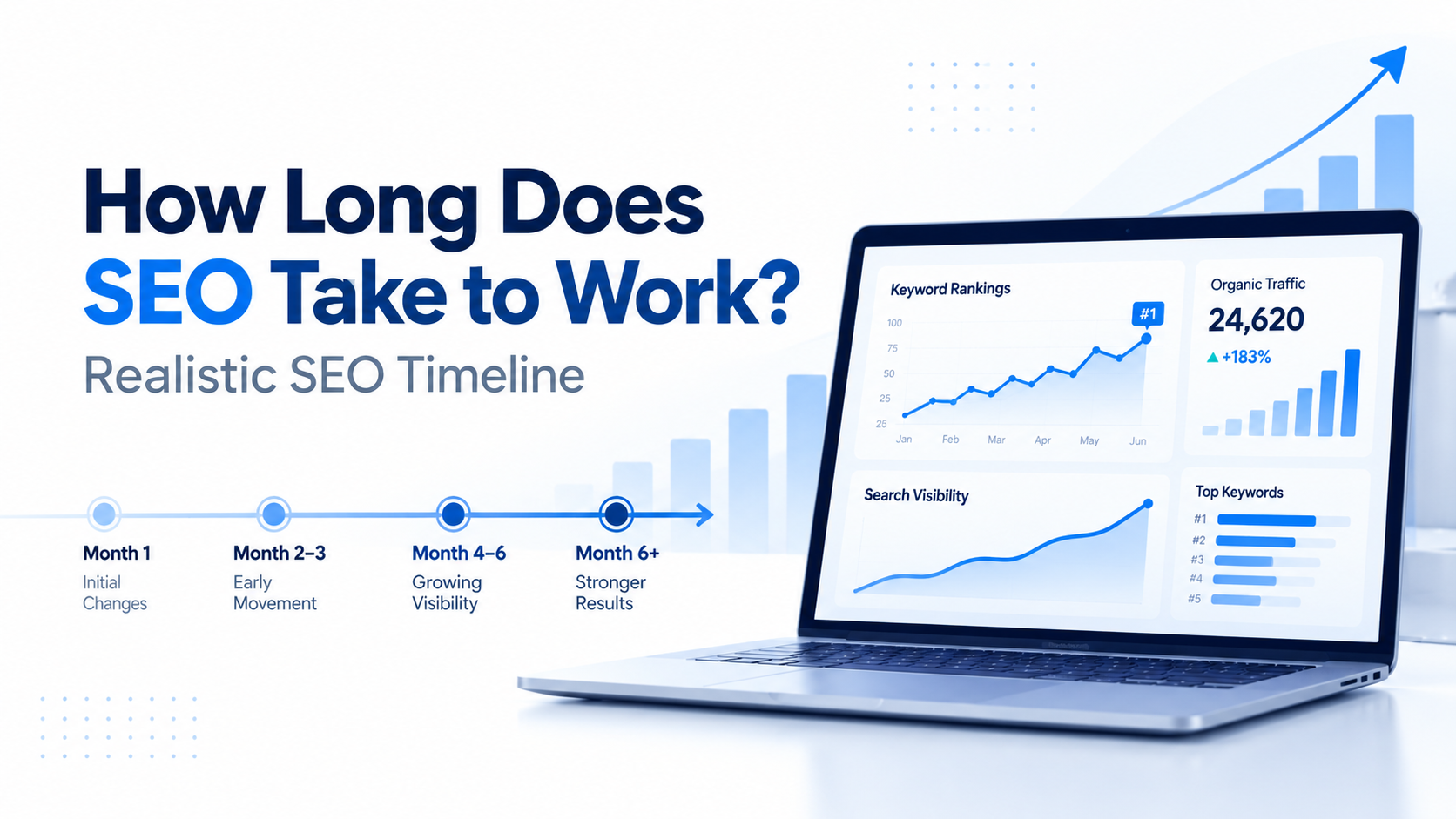
If you have recently invested in search engine optimization, you probably have one important question: How long does SEO take to work?
The short answer is that many websites may begin seeing meaningful SEO progress within 3 to 6 months, while stronger and more consistent organic growth can take 6 to 12 months or longer.
However, SEO doesn’t follow the same timeline for every website.
An established business with existing search visibility may see improvements relatively quickly. A new website competing against well-known brands might need significantly more time.
Your results depend on several factors, including website quality, keyword competition, technical SEO, content relevance, and your overall strategy.
In this guide, we’ll explore a realistic SEO timeline, explain what affects your results, and show you how to measure whether your investment is working.
How Long Does SEO Usually Take to Show Results?
SEO commonly takes several months to produce meaningful improvements in organic traffic, leads, or sales. However, there is no guaranteed timeline.
According to Google’s official SEO Starter Guide, some website changes can be reflected in search results within hours, while others may take several months.
Google also recommends allowing a few weeks to evaluate whether changes have made a difference.
An important distinction is that getting indexed, improving rankings, and generating customers are three different milestones.
For example, imagine you launch a new website for a plumbing company.
During the first few weeks, Google may discover and index its service pages.
After additional optimization, those pages might begin appearing for relevant searches.
Over time, better visibility could lead to organic visitors, phone calls, and service inquiries.
Each stage represents progress, but indexing alone does not mean an SEO campaign has achieved its business goals.
Realistic SEO Timeline: What Happens in the First 12 Months?
Understanding the SEO results timeline helps businesses set realistic expectations and avoid unnecessary frustration.
The following schedule is an illustrative campaign plan, not a promise of rankings or traffic.
| Timeline | Main SEO activities | Progress to monitor |
|---|---|---|
| Month 1 | SEO audit, technical fixes, keyword research | Crawlability, indexing, baseline data |
| Months 2–3 | Content improvements and on-page optimization | Impressions, keyword visibility |
| Months 4–6 | Content refinement, internal linking, authority building | Organic clicks, relevant inquiries |
| Months 6–12 | Performance analysis and continued optimization | Qualified leads, conversions, growth trends |
Month 1: Build a Strong SEO Foundation
The first month should focus on understanding your website’s current performance.
Before creating dozens of blog posts or targeting competitive keywords, you need to identify problems that may be preventing your website from performing well.
A typical first-month SEO plan includes:
- Conducting a website SEO audit.
- Checking crawling and indexing issues.
- Researching relevant business keywords.
- Analyzing competing websites.
- Reviewing page titles, headings, and internal links.
- Checking mobile usability and page performance.
- Configuring Google Search Console and website analytics.
For example, if an important service page is accidentally marked noindex, Google may be unable to include it in search results.
Correcting that problem is more urgent than publishing another informational article.
An audit helps businesses prioritize these issues instead of making random changes.
For a more detailed explanation, read Worsoo’s guide on what an SEO audit is and why it matters.
Expected progress: A better-optimized website, resolved priority issues, and a measurable starting point for future improvements.
Months 2–3: Improve Content and Search Visibility
During months two and three, the focus usually shifts toward improving existing pages and publishing content that answers potential customers’ questions.
Search engines may begin discovering new content and reassessing updated pages.
For example, a roofing company may want to rank for “roof repair.”
However, this broad keyword can be highly competitive.
The business could also target more specific searches, such as:
- Emergency roof repair in its service area.
- Signs a residential roof needs replacement.
- How much a roof inspection costs.
These topics can attract people at different stages of their buying journey.
The goal is not simply to publish more content. It is to provide useful answers to relevant searches.
You can learn more about identifying valuable search terms in Worsoo’s keyword research guide for beginners.
Expected progress: More relevant search impressions, early ranking movement, and potentially additional organic visitors.
Months 4–6: Evaluate Rankings, Traffic, and Leads
By months four through six, you may have enough search performance data to identify which parts of your strategy are showing promise.
Some pages might begin attracting more organic traffic, while others may need additional improvements.
Important activities at this stage include reviewing content performance, updating useful pages, improving internal links, and exploring legitimate opportunities to earn relevant backlinks.
Suppose a service page starts appearing for “commercial cleaning services near me” but receives few clicks.
You should investigate whether the page addresses the searcher’s needs, whether its title communicates value, and whether stronger competing results are attracting attention.
If the page receives visitors but no inquiries, the problem could involve its service information, calls to action, or customer experience rather than rankings alone.
Expected progress: Clearer performance trends and a better understanding of which improvements are contributing to business results.
Months 6–12: Work Toward Consistent Organic Growth
The second half of the first year is often an important period for developing a more established organic presence.
Instead of continually starting from scratch, businesses can use existing performance data to make better decisions.
This may involve improving pages that already attract qualified visitors, expanding successful topic areas, updating outdated information, and strengthening relevant internal links.
For a service business, the focus should increasingly shift toward commercial outcomes.
Are more potential customers discovering your services? Are organic visitors requesting quotes? Which pages contribute to actual sales opportunities?
These questions help determine whether SEO is becoming a valuable acquisition channel.
Expected progress: Potentially stronger organic visibility, more qualified inquiries, and a clearer picture of SEO’s business value.
Growth is not guaranteed to be continuous. Rankings can fluctuate, and some campaigns will require substantially more time.
What Factors Affect How Fast SEO Works?
Two businesses can start SEO campaigns on the same day and experience very different results.
Here are five important reasons why.
1. Website History and Existing Visibility
A new website often starts with limited content, few relevant backlinks, and little organic search history.
An established website may already have indexed pages and existing search visibility that can be improved.
For example, updating an informative page that already ranks on Google’s second page may produce results sooner than trying to rank a completely new website for a competitive term.
However, an older domain does not automatically rank better. Website age alone is not a guarantee of search performance.
2. Keyword Competition
The keywords you target can significantly influence the difficulty of your SEO campaign.
Consider these examples:
- SEO services
- SEO services for small businesses
- Local SEO services for dentists in Chicago
These searches attract different audiences and may have different competition levels.
Broad keywords often involve established competitors, while specific keywords can provide opportunities to reach people with clearer needs.
Choosing the right keywords also requires understanding why someone is searching.
For further guidance, explore Worsoo’s article about search intent in SEO.
3. Technical Website Health
Technical problems can prevent search engines from properly accessing, understanding, or indexing website content.
Common examples include broken internal links, incorrect redirects, blocked pages, and indexing configuration errors.
Google’s recrawling documentation explains that crawling updated pages may take anywhere from a few days to a few weeks.
Even after crawling, indexing and higher rankings are not guaranteed.
For this reason, technical SEO should be reviewed early rather than treated as an afterthought.
4. Content Quality and Relevance
Publishing articles every day does not automatically improve rankings.
Google emphasizes the importance of helpful, reliable content created for people rather than primarily to manipulate search results.
According to its people-first content guidance, original information, clear explanations, and genuine expertise are important considerations when evaluating content.
For example, someone searching “how much does SEO cost?” probably wants pricing information, factors that affect cost, and advice about choosing an SEO investment.
An article that discusses only the benefits of SEO may not fully satisfy that need.
Useful content should answer the main question, address relevant follow-up questions, and help readers make informed decisions.
5. Competition and Website Reputation
Your competitors are also improving their websites.
Some may have well-established content libraries, industry recognition, and relevant editorial backlinks.
Building a credible online presence takes time.
Businesses can support this process by publishing original resources, earning genuine industry coverage, developing relevant partnerships, and providing information worth referencing.
Avoid buying manipulative backlinks or participating in link schemes. These shortcuts can create problems rather than sustainable results.
Does Local SEO Take Less Time Than National SEO?
Local SEO can sometimes offer earlier opportunities than highly competitive national SEO campaigns, particularly for businesses targeting specific towns or service areas.
For example, a cleaning company serving a small city may face a different competitive environment from a nationwide cleaning franchise.
However, local SEO is not automatically faster.
Local competition, business relevance, online reputation, and geographic factors all influence visibility.
According to Google’s local ranking guidance, local results are mainly influenced by relevance, distance, and prominence.
For businesses serving local customers, useful priorities include maintaining an accurate Google Business Profile, developing location-relevant service pages, and encouraging genuine customer reviews.
Remember that Google Maps visibility and organic website rankings are related but distinct areas of search marketing.
How Do You Know If Your SEO Strategy Is Working?
One of the biggest mistakes businesses make is measuring SEO success using only keyword positions.
A ranking improvement is encouraging, but the ultimate goal is usually to attract potential customers.
Here are four useful performance indicators.
Organic Search Impressions
Impressions show how often links to your website are displayed in eligible Google Search results.
An increase may indicate that your content is becoming visible for more searches.
However, impressions do not necessarily mean people have visited your website.
Organic Clicks
Organic clicks measure how often users click through to your website from unpaid search results.
Increasing relevant organic clicks can be a stronger indication of progress than impressions alone.
Keyword Relevance
Pay attention to the search queries that attract visitors.
Ranking for a high-volume informational keyword may be useful, but a lower-volume commercial keyword could bring visitors who are more interested in purchasing your services.
Leads and Conversions
For many businesses, the most important SEO outcomes are qualified phone calls, consultation requests, contact form submissions, and sales.
Use Google Search Console’s performance reports alongside analytics and conversion tracking to understand how organic search contributes to your goals.
Don’t judge SEO purely by traffic volume. Judge it by the quality and business value of that traffic.
Practical Example: Two Businesses With Different SEO Timelines
Imagine two companies beginning SEO campaigns in the same month.
Business A: An established accounting website
This company already has several indexed service pages, some organic traffic, and a history of appearing in relevant searches.
Its SEO strategy focuses on improving existing content, fixing technical issues, and making service pages more useful.
Because the website already has some search visibility, certain improvements might be noticeable within weeks or a few months.
Business B: A newly launched marketing agency website
This company has a new domain, limited content, few external references, and strong competition.
Its first priorities include technical setup, building service pages, creating useful resources, and developing an online reputation.
It may take considerably longer before the site attracts consistent relevant organic traffic.
These are hypothetical examples, not client case studies or guaranteed results.
The lesson is simple: SEO timelines depend on your starting point and competitive environment, not just how much work you complete each month.
How Can You Improve SEO Results Without Risky Shortcuts?
Although there is no guaranteed method to accelerate rankings, businesses can avoid wasting time and resources by following a focused strategy.
Start with important pages. Improve your core service and product pages before investing heavily in unrelated blog content.
Target useful search opportunities. Choose keywords that match your audience’s questions, problems, and purchasing needs.
Improve existing content. Pages already receiving relevant impressions may offer opportunities for improvement.
Build meaningful internal links. Connect related articles and service pages so visitors can discover helpful information.
Monitor results regularly. Review performance trends and prioritize changes supported by data.
Maintain realistic expectations. Avoid agencies promising guaranteed first-page rankings within a fixed number of days.
If your business needs quicker search visibility while building organic traffic, paid search may complement your SEO campaign.
Our guide comparing SEO vs SEM explains how these approaches differ in speed, cost, and long-term value.
Frequently Asked Questions About SEO Timelines
Can SEO work in 30 days?
Yes. Some SEO improvements can become visible within 30 days, especially when optimizing existing pages or correcting technical problems. However, achieving meaningful traffic growth or competitive rankings in one month is not guaranteed.
Why does SEO often take 3 to 6 months?
Three to six months is a common industry planning estimate, not a fixed Google rule. The time required depends on how quickly improvements are implemented, pages are reassessed, and relevant search visibility develops.
How long does SEO take for a new website?
New websites may need several months or longer to establish consistent organic traffic. Their progress depends on content relevance, technical accessibility, competition, and how effectively they reach their intended audience.
Does publishing more blog posts improve SEO faster?
Not necessarily. Publishing useful content that meets search intent can support organic visibility, but producing large amounts of repetitive or low-value content does not guarantee faster results.
How long should I continue SEO before evaluating results?
Monitor technical progress and early visibility from the beginning. A three-to-six-month review can help evaluate broader trends, while competitive campaigns may require longer observation. Make adjustments throughout the campaign rather than waiting for a fixed deadline.
Can an SEO agency guarantee first-page rankings?
No. No SEO agency can guarantee a specific position in Google’s organic search results. Reputable providers should explain their methods, establish realistic objectives, and report measurable progress.
Build a Smarter SEO Strategy With Worsoo
Understanding how long SEO takes is an important first step. The next step is deciding which improvements will make the biggest difference for your website.
Every business has different SEO requirements.
Some websites need technical corrections and better page structure. Others need stronger service content, relevant keyword targeting, or improvements to their existing organic visibility.
At Worsoo, our on-page and off-page SEO services focus on helping businesses strengthen their online presence through research, website optimization, and strategies aligned with their goals.
Whether your business is launching a new website or improving an established one, an informed SEO plan can help you focus on the opportunities that matter.
Want to understand what your website needs to improve its organic search visibility?
Contact Worsoo to discuss your SEO goals and explore the next steps for your business.
Final Thoughts
So, how long does SEO take to work?
For many businesses, three to six months is a useful initial window for evaluating meaningful progress, while stronger and more consistent organic growth may take six to twelve months or longer.
These are estimates, not guaranteed outcomes.
Your timeline depends on competition, website quality, content relevance, technical accessibility, and the consistency of your SEO strategy.
Instead of chasing immediate rankings, focus on useful content, a technically accessible website, relevant search opportunities, and measurable business results.
SEO is a long-term investment, and its real value comes from attracting the right audience and turning relevant search visibility into meaningful business opportunities.