

E-E-A-T stands for Experience, Expertise, Authoritativeness, and Trust. It is the framework Google uses to describe what high quality content looks like. It is not a score or a single ranking factor. Google uses many signals that point to these qualities, and trust matters most. To show E-E-A-T, name real authors, share first-hand experience, back claims with trusted sources, and be open about who runs the site.
Many site owners treat E-E-A-T like a checklist from a secret algorithm. It is not. It is a lens. This guide shows what the lens looks at, what it ignores, and what you can fix on your own pages this week.
Last updated: October 2026. Written by the Worsoo SEO team.
E-E-A-T at a Glance
| Letter | Meaning | Question Google Asks | Proof You Can Show |
|---|---|---|---|
| E | Experience | Did this person actually do or use the thing? | Original photos, test results, real examples |
| E | Expertise | Does this person know the topic well? | Credentials, depth, accurate detail |
| A | Authoritativeness | Is this site or author a known source? | Mentions, links, citations from others |
| T | Trust | Can I rely on this page? | Accuracy, sources, clear ownership, secure site |
Google added the first E in December 2022. In its announcement, Google said the change helps judge content that shows real use of a product, a visit to a place, or lived experience. That is why a person who tested a tool now beats a writer who only summarized a press release.
Myths and Facts About E-E-A-T
Most bad advice comes from one mistake. People think E-E-A-T is a switch. The table below clears up the common myths.
| Myth | Fact |
|---|---|
| E-E-A-T is a ranking factor with a score | Google says E-E-A-T is not a specific ranking factor. Its systems use a mix of signals that point to it |
| Quality raters change my rankings | Raters test and judge search results. A rating does not push your page up or down |
| I need a degree to show expertise | Experience counts too. Some topics need a certified expert. Others need a person who has done the work |
| An author box fixes everything | A box with no proof behind it adds nothing |
| E-E-A-T only matters for health and money | It matters everywhere. It matters most for those topics |
| AI content always fails E-E-A-T | Google judges quality, not the tool. Weak and unchecked content fails |
On the last point, an Ahrefs study of 600,000 pages found that 86.5% of top ranking pages contain some AI content. Only 4.6% were fully AI written. So the question is not who typed the words. The question is whether a real person stands behind them.
Trust Is the Center of the Model
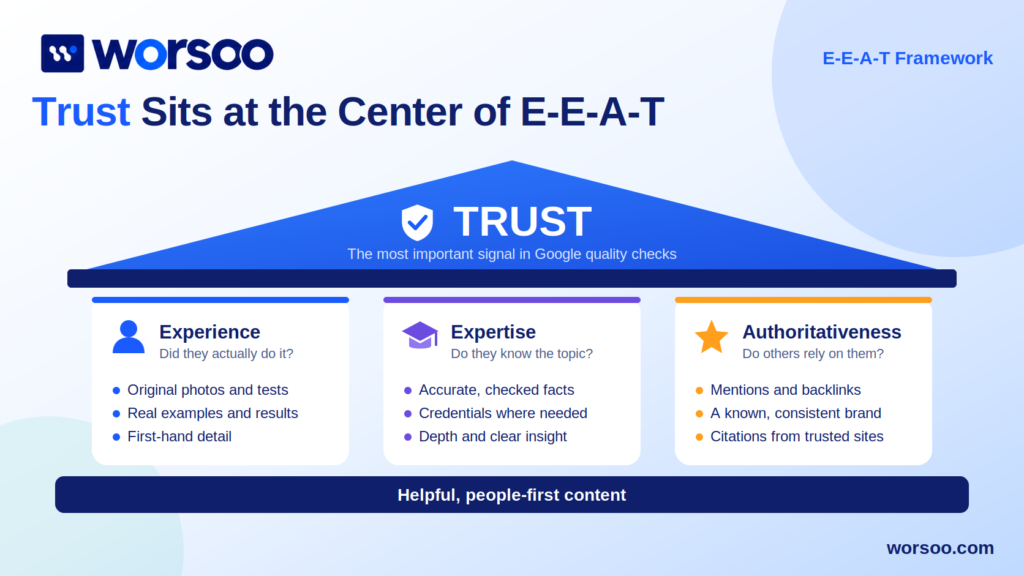
Here is the part most guides skip. The four letters are not equal. Google says that trust is the most important of these aspects. The other three feed into it.
Think of it as three supports holding up one roof.
| Support | What It Adds To Trust |
|---|---|
| Experience | Proves the content comes from real use, not guesswork |
| Expertise | Proves the facts are right and the advice is safe |
| Authoritativeness | Proves other people rely on you |
A page can have a famous author and still fail on trust. Imagine a review site that hides its affiliate links, or a blog that states false facts with confidence. Fame does not rescue it. Accuracy, honesty, and openness do.
How Google Checks Quality at Scale
Google cannot read every page by hand. So it works in two steps.
First, humans judge examples. Google works with about 16,000 external raters, and it publishes the Search Quality Rater Guidelines to train them. Raters compare result sets from tests. In 2023 alone, Google ran 719,326 search quality tests and 16,871 live traffic experiments, according to its own site.
Second, automated systems learn from that feedback. They look for signals that line up with what raters call high quality. Those signals include clear authorship, accurate facts, original work, and a good reputation.
This is why core updates feel like quality updates. Google ran a core update in May 2026 and said there was nothing new to do for sites already making helpful content for people. A spam update followed in September and finished on October 8. Sites that fake trust signals are the ones at risk.
When E-E-A-T Matters Most: YMYL Topics
Google calls some topics Your Money or Your Life, or YMYL. Bad advice here can harm health, finances, or safety. These pages face the most scrutiny.
| Topic Type | Examples | E-E-A-T Bar |
|---|---|---|
| Health and safety | Symptoms, medicine, first aid | Very high. Expert review expected |
| Finance | Loans, tax, investing | Very high. Clear credentials and sources |
| Legal and civic | Rights, voting, government rules | High |
| Product reviews | Tech, home, travel gear | Medium to high. Hands-on proof wins |
| Hobby and lifestyle | Recipes, crafts, tips | Medium. Experience matters most |
Sites such as Mayo Clinic show the pattern well. They name the author and the medical reviewer, and they publish editorial rules. NerdWallet does the same for money topics. You may not match them overnight, but you can copy the habits.
An SEO blog like yours sits in the middle. It is not YMYL. Still, readers act on your advice, so accuracy and real examples matter.
E-E-A-T and AI Search
Answer engines have the same problem Google has. They must choose sources they can trust. Pew Research Center studied 68,879 searches and found that people clicked a normal result in 8% of visits when an AI summary appeared and 15% when it did not. Fewer clicks mean the sources that get cited are worth more.
Here is what helps a page get picked.
- A direct answer near the top of the page
- Named authors and a clear brand
- Facts tied to a named source
- The same business name, address, and details across the web
- Fresh dates on pages that change
None of this is magic. It is clean, honest publishing.
How to Show E-E-A-T at Three Levels
Most guides stop at the author box. Real E-E-A-T works at three levels. Fix all three.
| Level | What To Fix | Action |
|---|---|---|
| Page | The content itself | Add original examples, sources, dates, and a direct answer |
| Author | The person behind it | Add a real bio, photo, links to profiles, and relevant work history |
| Site | The brand behind it | Add About, Contact, editorial policy, privacy policy, and a secure connection |
Page Level
Write from real work. Share what you tested, what failed, and what you would change. Add numbers from your own tools. Link to primary sources such as Google documents and published studies, not to random blogs.
Our guide on SEO content writing shows how to build this into every article.
Author Level
A good bio answers three questions. Who is this person? Why should I believe them? Where can I verify it? Link the name to an author page. List real work, talks, or past projects. Do not invent a title.
Site Level
Make it easy to find who runs the site. Add a real contact page and a physical or business address where it applies. State how you make and check content. Keep your on-page SEO clean so Google reads these pages correctly. Add Organization and Article markup too. Our guide to schema markup in SEO shows how.
Weak vs Strong: A Real Page Example
Look at two versions of the same service page paragraph.
| Version | Text |
|---|---|
| Weak | We are the best SEO agency with years of experience. We deliver great results for every client. |
| Strong | Our team audited 40 pages on a client site, fixed duplicate title tags and slow image files, and tracked the change in Google Search Console. Impressions rose over the next two months. Here is the report and the method we used. |
The weak version makes claims. The strong version shows work. When you write your own version, use your real numbers and your real client permission. Never invent a result.
The 30 Minute E-E-A-T Audit
Run this on your most important pages.
- Does every article show a real author name?
- Does the author page prove why that person can speak on the topic?
- Does each key claim link to a trusted source?
- Does the page include something original, such as a screenshot, test, or example?
- Is the publish or update date clear and honest?
- Does the site have About, Contact, Privacy, and editorial pages?
- Are ads and affiliate links clearly marked?
- Are facts, prices, and rules still current?
- Do other trusted sites mention or link to your brand?
- Would you trust this page if you did not own it?
Score one point for each yes. Fix anything under seven first. If you want a deeper review, our SEO audit guide lists the technical checks to pair with it.
Mistakes That Damage Trust
| Mistake | Why It Hurts | Fix |
|---|---|---|
| Fake author names and stock photos | Easy to spot and a clear trust failure | Use real people or a clear brand byline |
| Fake reviews and made up awards | May break Google spam policies | Show only real proof |
| Copying top results with small edits | Adds no experience or value | Add original data and views |
| Old facts on new dates | Misleads readers | Update the content before the date |
| Hidden ownership | Readers cannot judge who to trust | Add About and Contact pages |
| Buying low quality links for authority | Creates risk, not reputation | Earn mentions with useful work. See our off page SEO guide |
Google lists scaled content abuse and other tactics in its spam policies. Read them once a year.
Frequently Asked Questions
What does E-E-A-T stand for in SEO?
E-E-A-T stands for Experience, Expertise, Authoritativeness, and Trust. It is the framework Google uses to describe high quality content and judge how reliable a page and its creator are.
Is E-E-A-T a Google ranking factor?
No. Google says E-E-A-T is not a specific ranking factor. Its systems use many signals that point to content with strong E-E-A-T. You cannot see or improve a single E-E-A-T score.
Which part of E-E-A-T matters most?
Trust. Google states that trust is the most important aspect. Experience, expertise, and authoritativeness all support it.
How do I show experience on a website?
Share first-hand proof. Use original photos, test results, screenshots, case examples, and clear details that only someone who did the work would know.
Does E-E-A-T matter for small sites and new blogs?
Yes. A small site can win by showing real experience and clear authorship on a narrow topic. Authority grows over time as other sites mention and link to you.
How long does it take to build E-E-A-T?
It builds slowly. Page fixes can help within weeks. Brand reputation takes months. Our guide on how long SEO takes explains realistic timelines.
Final Thoughts
E-E-A-T is not something you add at the end. It is the result of how you work. Pick topics you can speak on. Show your proof. Name the people involved. Keep facts right. Be open about who you are.
Do this on every page and you build the kind of site that survives core updates, earns citations in AI answers, and wins repeat readers.
Want a team to review your content quality? Worsoo offers SEO audits, content strategy, and technical support. Visit worsoo.com and tell us your goals.
1 comment on “What Is E-E-A-T in SEO? Google Content Quality Signals Explained”