

No, AI content does not hurt SEO by itself. Google ranks pages on quality and usefulness, not on the tool that typed the words. What Google does penalize is mass produced content that adds little value, no matter how it was made. The safe way to use AI is simple. Let AI help with research, outlines, and drafts. Then add real facts, first-hand experience, and human review before you publish.
That is the short answer. The long answer matters more, because the rules changed again in 2026. This guide shows what Google allows, what the data says, where AI content fails, and how to build a workflow that keeps your rankings safe.
Last updated: October 2026. Written by the Worsoo SEO team.
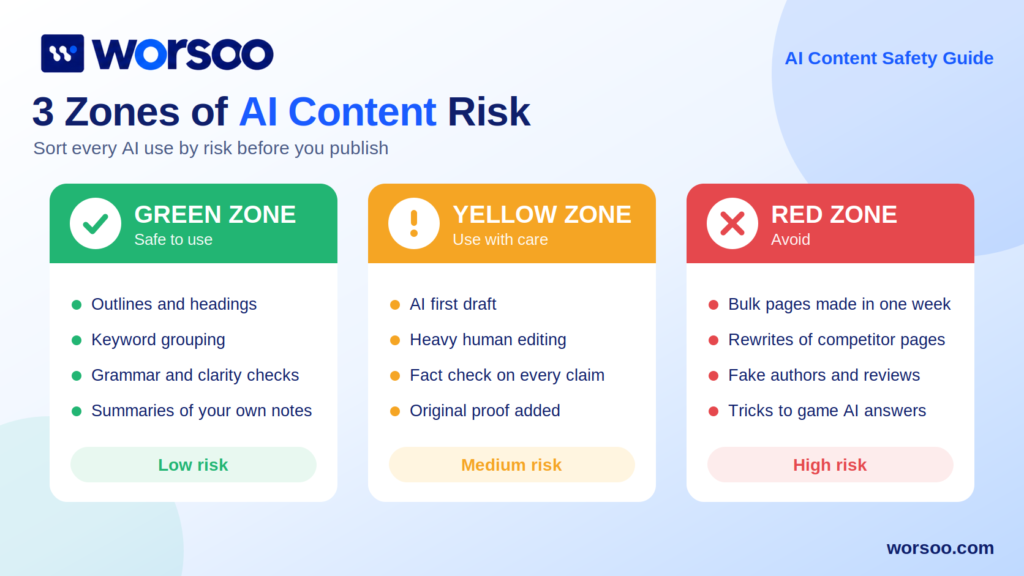
The Quick Verdict: Three Zones of AI Content
Before the details, use this table. It sorts common AI uses by risk.
| Zone | How You Use AI | Risk | Verdict |
|---|---|---|---|
| Green | Outlines, keyword grouping, grammar checks, summaries of your own notes | Low | Safe |
| Yellow | AI first draft, then heavy human editing, fact checking, and original input | Medium | Safe with care |
| Red | Thousands of pages made in bulk, rewrites of competitor pages, fake authors, fake reviews | High | Avoid |
Keep this table in mind. Every section below explains why each use lands where it does.
What Google Actually Says About AI Content
Google has been consistent for years. The method is not the problem. The purpose and the quality are.
| Date | What Happened | What It Means For You |
|---|---|---|
| February 2023 | Google published guidance on AI generated content | Using AI is not against the rules when the content helps people |
| March 2024 | Google added the scaled content abuse policy and aimed to cut low quality, unoriginal results by 40% | Mass producing pages to rank is spam, however it is done |
| May 15, 2026 | Google stated that its spam policies apply to generative AI responses, including AI Overviews and AI Mode | The same rules now cover AI answers too |
| September 24 to October 8, 2026 | Google ran its fourth spam update of the year | Enforcement is active and ongoing |
Read the policy wording once. Scaled content abuse means making many pages mainly to manipulate rankings and not to help users. The policy names generative AI tools as one way it can happen. It also covers human content mills. So the rule is about scale and value, not about AI.
Google also said the March 2026 and May 2026 core updates need nothing new from sites that already make helpful content for people. That is the clearest signal you can get.
What the Data Shows
Opinions are cheap. Data is better. Ahrefs studied 600,000 pages across 100,000 keywords. It found that 86.5% of top ranking pages contain some AI content, and only 4.6% are fully AI written. The link between AI share and ranking position was 0.011, which is close to zero.
Two lessons come from this.
First, AI use is normal at the top. If Google punished it, those results could not exist.
Second, Ahrefs found a small lean toward pages with less AI at position one. The signal is weak, but it fits what quality systems reward. Pages with more human input tend to carry more original value.
Where AI Content Goes Wrong
AI tools such as ChatGPT, Gemini, and Claude write fast. They do not know your business, your client, or your test results. That gap creates the same problems again and again.
| Problem | How It Shows Up | Fix |
|---|---|---|
| Generic content | Every paragraph could fit any website | Add your own examples, numbers, and opinions |
| Wrong facts | Old stats, invented studies, made up quotes | Check every claim against a primary source |
| No experience | No screenshots, tests, or real stories | Add proof from your own work |
| Repeated structure | Every article follows the same template | Change the format to fit the topic |
| Thin value | Words that say little | Cut filler and answer the question faster |
| Fake sources | Links that do not exist or do not say what is claimed | Open every link before publishing |
The most dangerous one is the wrong fact. A confident wrong answer damages trust fast. Our guide on E-E-A-T in SEO explains why trust is the center of Google quality checks.
The Red Zone: What Gets Sites in Trouble
Here is a real pattern we see. Someone builds a site with one thousand pages in one week. Each page targets a service plus a city, for example plumber in a different town on every page. The text is nearly identical with only the city swapped. This is scaled content abuse.
Other red zone habits include these.
- Rewriting the top ten results with a tool and publishing the result
- Creating author profiles for people who do not exist
- Posting AI generated reviews as if customers wrote them
- Buying expired domains and filling them with AI pages
- Writing lists built only to push one brand into AI answers
Google lists inauthentic mentions and site reputation abuse in the same spam policy family. These tactics carry the biggest risk now that the rules cover AI answers too.
A Safe Workflow: What AI Does and What You Do
The best teams split the job clearly.
| Stage | AI Role | Human Role |
|---|---|---|
| Keyword research | Group and label keywords | Pick topics that match business goals |
| Search intent | Summarize what top pages cover | Decide what gap you will fill |
| Outline | Suggest headings and questions | Cut weak sections and add your angle |
| Draft | Write a rough first version | Rewrite, add proof, set the tone |
| Facts | Nothing. Do not trust it here | Check every number and source |
| Experience | Nothing | Add tests, screenshots, quotes, and results |
| Final edit | Grammar and clarity checks | Read it aloud and approve |
Notice that AI has no role in facts or experience. Those two steps are where trust is earned.
If you want a full writing process, our guide on SEO content writing walks through it step by step.
Before and After: Fixing an AI Paragraph
Here is the same idea written two ways.
| Version | Text |
|---|---|
| Raw AI draft | Backlinks are important for SEO because they help your website rank higher and build authority in search engines. |
| Human edited | Backlinks still move rankings, but quality beats count. In our audits, one link from a relevant site often helps more than twenty from random directories. Check the source site before you chase the link. |
The second version has a view, a reason, and a warning. It sounds like a person who has done the work. Use your real numbers when you edit, and never invent a result.
AI Content and AI Search
AI content is not only about Google rankings anymore. It also decides whether you show up inside AI answers.
The click picture is changing fast. Ahrefs updated its study of 300,000 keywords and found that AI Overviews are linked to a 58% lower click rate for the top ranking page. Pew Research Center found that people clicked a normal result in 8% of visits when an AI summary appeared and 15% when it did not.
So the goal moves from ranking only to being the source AI tools pick. Here is what helps.
| Signal | Why It Helps |
|---|---|
| Direct answer in the first 50 words | Easy for AI tools to quote |
| Original data or test results | Cannot be copied from other pages |
| Clear author and brand | Builds trust and entity clarity |
| Sources linked to named studies | Makes claims checkable |
| Tables and short lists | Easy to extract |
| Fresh updates | Shows the page is maintained |
Here is the key insight. If you publish the same text as everyone else, AI tools have no reason to cite you. Original proof is the only real edge left. Also remember that tricks to game AI answers can break spam policy now. Earn the citation instead.
Pre-Publish Checklist for AI Assisted Content
Run this on every page that AI touched.
- Did a real person read the full article aloud?
- Is every statistic linked to a primary source?
- Did you open every link and confirm it works?
- Does the page include at least one original example, test, or screenshot?
- Does the first paragraph answer the main question?
- Is a real author named, with a real bio?
- Does the article add something the top results do not?
- Are product claims, prices, and dates still current?
- Is the structure different from your last article?
- Would you be happy to put your own name on it?
If you answer no to more than two, edit again.
What To Do If Traffic Dropped After an Update
Do not delete everything in a panic. Follow this order.
- Check Google Search Console and compare clicks before, during, and after the update window
- Confirm the drop matches the dates. A dip does not always mean the update caused it
- Review the pages that fell and ask if they are thin, generic, or copied
- Merge or remove pages that add no value
- Improve the pages that matter with original proof and expert review
- Wait. Google says systems may take months to learn that a site now follows its spam policies
Pair this with a full SEO audit so you also catch technical faults, and review common SEO errors that often hide behind a traffic drop.
Frequently Asked Questions
Does Google penalize AI generated content?
No. Google penalizes scaled content abuse, which means mass producing low value pages to manipulate rankings. The tool used does not matter. Quality and purpose do.
Can AI content rank on the first page of Google?
Yes. Ahrefs found that most top ranking pages contain some AI content. Pages that mix AI help with human editing and original input perform best.
How do I make AI content safe for SEO?
Add original examples, check every fact, name a real author, link to trusted sources, and edit the draft by hand. Do not publish raw output.
Does Google know if I used AI to write my article?
Google says it cares about quality, not the method. Detection is not the issue. A page that adds no value will struggle whether a person or a tool wrote it.
Do Google spam rules apply to AI Overviews?
Yes. On May 15, 2026, Google stated that its spam policies apply to generative AI responses in Search, including AI Overviews and AI Mode.
How do I get my content cited in AI answers?
Lead with a direct answer, add original data, name your author and brand, cite named sources, and keep facts fresh. Our SEO content writing guide shows how to structure each page.
Final Thoughts
AI is a tool. It is not a strategy. Used well, it saves hours and lets you publish better work. Used badly, it fills your site with pages nobody needs.
The rule is simple. Use AI to move faster. Use people to make it true, useful, and original. Do that, and AI content will not hurt your SEO. It will help you compete.
Need a safe content plan for your site? Worsoo offers SEO strategy, content audits, and technical support. Visit worsoo.com and tell us your goals.