

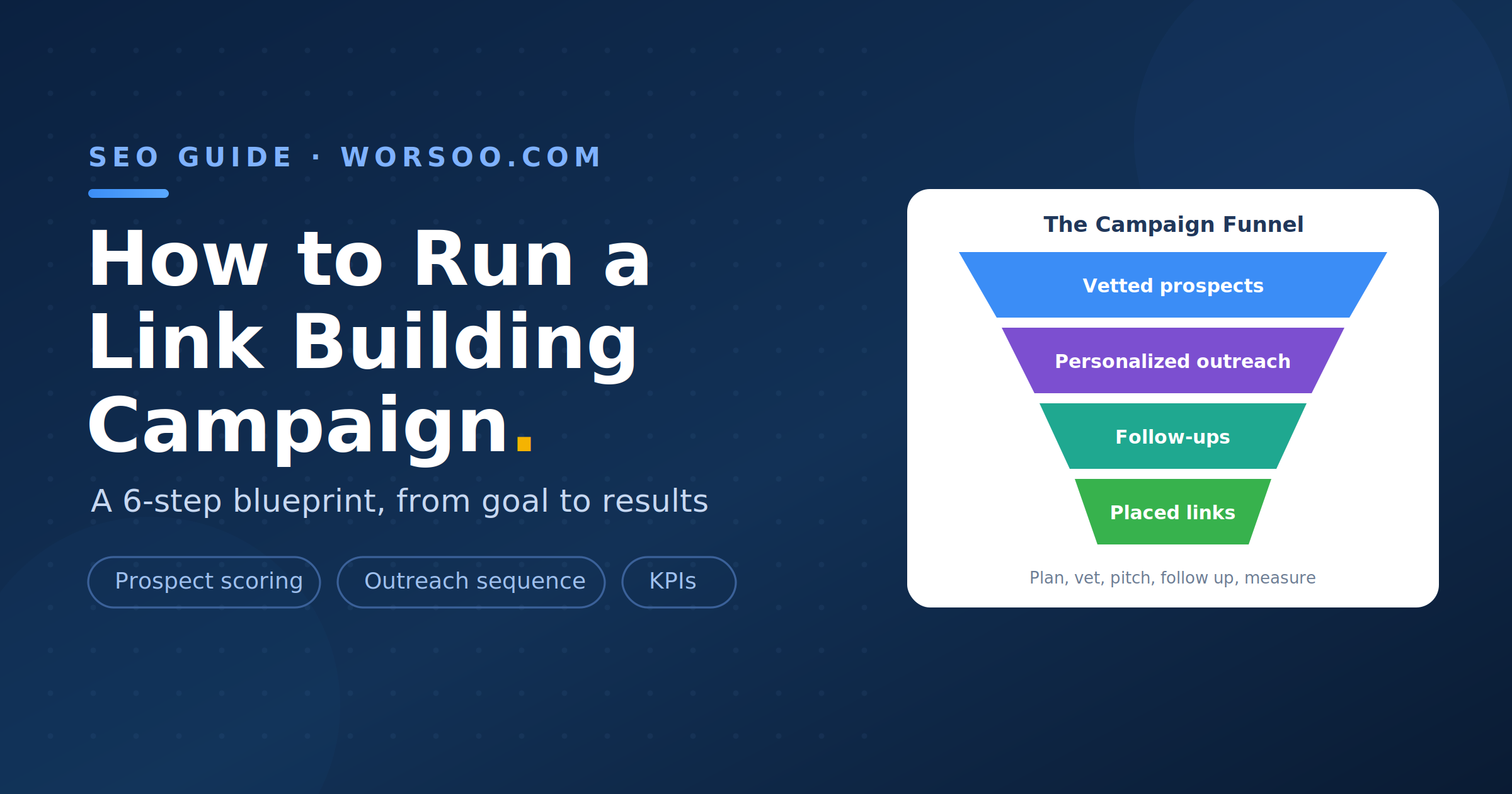
Quick answer: A link building campaign is a planned effort to earn backlinks to specific pages on your website. A successful campaign starts with a clear goal, a useful linkable asset, a list of relevant websites, personalized outreach, and regular tracking. The basic process is simple: choose a target page, study competitor backlinks, create something worth linking to, find and vet prospects, run outreach, and measure the results. Links may appear within weeks, while changes in rankings and organic traffic can take longer.
Random outreach rarely produces consistent results. A structured campaign gives you a clear process to follow and makes it easier to understand what is working and what needs to change.
What Is a Link Building Campaign?
A link building campaign is a planned SEO activity designed to earn backlinks to one or more specific pages.
Instead of sending emails whenever you have time, a campaign gives you a clear start date, target page, outreach process, and measurement plan. After the campaign ends, you can review the results and use what you learned in future campaigns.
| Ad Hoc Link Building | A Link Building Campaign |
|---|---|
| Emails are sent whenever there is time | A defined start date, end date, and outreach schedule |
| Links may point to random pages | Links are focused on selected target pages |
| No clear baseline | Goals and KPIs are defined before outreach |
| The same pitch is sent to everyone | Outreach is adapted to each prospect |
| Results are rarely documented | Results are tracked and reviewed |
This structure makes link building easier to manage and measure.
Large-scale outreach campaigns also show why planning matters. For example, Authority Hacker has published data from large outreach campaigns that demonstrate how response and link placement rates can vary depending on targeting, messaging, and follow-up.
The important lesson is not to copy a specific success rate. It is to build a process that lets you measure your own results.
The Link Building Campaign Blueprint
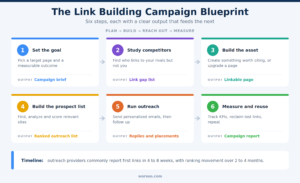
Here is the complete process:
| Step | What You Do | Main Output |
|---|---|---|
| 1. Set the goal | Choose a target page and measurable objective | Campaign brief |
| 2. Study competitors | Analyze backlinks to competing pages | Link gap list |
| 3. Build the asset | Create or improve a page worth linking to | Linkable asset |
| 4. Find and vet prospects | Identify relevant and trustworthy websites | Ranked prospect list |
| 5. Run outreach | Send personalized emails and follow-ups | Replies and placements |
| 6. Measure and repeat | Track results and improve the process | Campaign report |
Let’s look at each step in detail.
Step 1: Set a Goal Tied to a Page
A goal such as “get more backlinks” is too broad.
Instead, choose a specific page and define what you want to achieve.
For example:
Earn 15 new referring domains to an SEO audit service page over 90 days.
Your campaign goal should include:
- The target page
- The number or type of referring domains you want
- The campaign period
- The main SEO or business objective
Avoid assuming that a specific number of backlinks will automatically produce a particular ranking improvement. Search rankings depend on many factors, including content quality, search intent, competition, internal links, technical SEO, and the strength and relevance of competing pages.
Before setting your target, study the backlink profiles of pages that currently rank for your target keyword. This gives you a more useful benchmark for your campaign.
Step 2: Study the Competition
Competitor backlink research can help you find websites that already link to similar content.
Tools such as Ahrefs and Semrush can help you compare backlink profiles. Look for websites that link to competing pages but do not currently link to your website.
These websites can become potential outreach prospects because they have already shown an interest in the topic.
When exporting your prospect list, useful fields can include:
- Website or domain
- Linking page
- Target competitor page
- Topical relevance
- Estimated organic traffic
- Contact information
- Type of website
- Outreach angle
- Prospect score
Don’t automatically contact every website that links to a competitor. A backlink alone does not mean the website is a good prospect. Review the website before adding it to your outreach list.
Step 3: Build Something Worth Linking To
Good outreach starts with a useful reason for another website to link to your page.
Your target page should provide genuine value to the reader. Depending on your industry, useful linkable assets can include:
- Original research
- Industry statistics
- Surveys
- Free tools
- Calculators
- Templates
- Detailed guides
- Original case studies
- Data visualizations
- Useful resource pages
For example, if you want links to a page about local SEO, you could create original research analyzing local business listings.
You can then contact websites that discuss local SEO and explain how your research could add useful information to their existing content.
The goal should not simply be to obtain a backlink. The goal is to give the publisher a legitimate reason to reference your page.
Step 4: How to Analyze Link Building Prospects
Before sending an outreach email, analyze each prospect.
This step helps you avoid wasting time on irrelevant, inactive, or low-quality websites. It also gives you information that can be used to personalize your outreach.
Here are some useful signals to check:
| Signal | What to Check | Potential Red Flag |
|---|---|---|
| Topical relevance | Does the website regularly cover your subject? | Completely unrelated topics |
| Organic visibility | Does the site receive search traffic? | Very low or declining visibility |
| Freshness | Are new articles published regularly? | Website appears abandoned |
| Link behavior | Does the site naturally link to external resources? | Rarely links to useful external sources |
| Content quality | Is the content useful and well maintained? | Thin, copied, or low-value content |
| Commercial signals | Are most pages heavily promotional? | Excessive sponsored or promotional content |
| Contact quality | Can you identify an editor or relevant contact? | No clear way to reach the website |
Create a Simple Prospect Score
You can create your own scoring system to prioritize prospects.
For example, give each category a score from 0 to 2:
| Category | 0 | 1 | 2 |
|---|---|---|---|
| Relevance | Off-topic | Related | Strong topic match |
| Traffic | Very low | Moderate | Strong and stable |
| Link behavior | Rarely links out | Sometimes | Regularly links to useful sources |
| Freshness | Inactive | Occasional updates | Consistently active |
| Contact | No clear contact | Generic contact | Relevant editor or contact |
This gives each prospect a possible score from 0 to 10.
You can then use the scores to prioritize your work. For example, prospects scoring 8–10 could receive highly personalized outreach, while lower-scoring prospects can be reviewed more carefully before you spend time contacting them.
These score ranges are a practical campaign framework, not an industry-standard measurement.
Match Your Outreach to the Prospect
Different websites may require different outreach approaches.
| Prospect Type | Possible Outreach Approach |
|---|---|
| Resource page | Suggest a relevant resource |
| Niche publisher | Share useful research or data |
| Trade publication | Pitch original research or an industry story |
| Website with a broken link | Suggest your relevant page as a replacement |
| Contributor-friendly website | Pitch a useful, original article |
The key is to make the outreach relevant to the website and its audience.
Step 5: Run the Outreach Sequence
Once your prospect list is ready, start your outreach.
Personalization can improve the chances of getting a response because the recipient can see why you contacted them specifically.
Research from Backlinko on millions of outreach emails found low overall response rates and reported that personalization and follow-ups can improve outreach performance. Because outreach results vary by industry and campaign, use published benchmarks as general reference points rather than guaranteed results.
A simple sequence could look like this:
| Touch | Timing | Purpose |
|---|---|---|
| Email 1 | Day 1 | Introduce the relevant idea or resource |
| Email 2 | Day 4–5 | Send a short follow-up |
| Email 3 | Day 9–12 | Add another useful angle or resource |
| Email 4 | Day 16–21 | Close the conversation politely |
You do not need to send exactly four emails to every prospect. If someone asks you not to contact them again, stop contacting them.
Keep the First Email Short
A good outreach email does not need to be complicated.
For example:
Hi Sam,
I read your article on local SEO audits, especially the section about citation cleanup.
We recently published research analyzing 1,000 local business listings and found some useful patterns around citation errors. It may be useful for your readers.
Happy to send the data if you’d like to take a look.
Thanks,
Alex
The message is short, specific, and focused on why the resource could be useful.
Avoid unnecessary flattery, long introductions, and exaggerated claims.
Step 6: Measure, Reclaim, and Repeat
After your outreach campaign starts, track the results.
The most useful metrics depend on your campaign goal, but common KPIs include:
| KPI | What It Tells You |
|---|---|
| Emails sent | Size of your outreach activity |
| Reply rate | Whether prospects are responding |
| Positive reply rate | Whether your offer is relevant |
| Links placed | Direct campaign outcome |
| Referring domains | Number of unique websites linking to you |
| Cost per link | Campaign efficiency |
| Target-page traffic | Whether organic visibility is changing |
| Target-page rankings | Whether rankings are improving |
| Lost links | Links that may need to be investigated or reclaimed |
Do not judge a campaign only by the number of links.
A single relevant editorial backlink can be more useful than a large number of irrelevant links. Look at relevance, placement, website quality, and the value the link provides to users.
Reclaim Lost Links
Link building does not end after you earn a backlink.
Websites change. Pages are updated, URLs are redirected, and links can disappear.
Periodically check important backlinks. If a valuable link has been removed because of a page update or broken URL, investigate whether there is a legitimate opportunity to contact the publisher and suggest an appropriate replacement.
How Long Does Link Building Take?
There is no fixed timeline for link building results.
Some outreach campaigns may secure placements within a few weeks. Changes in organic rankings and traffic can take longer and may depend on the competitiveness of the keyword, the quality and relevance of the links, the existing authority of the website, and other SEO factors.
For this reason, avoid promising that a certain number of backlinks will produce a specific ranking result within a specific number of days.
Instead, treat link building as an ongoing process:
- Plan the campaign.
- Build or improve the asset.
- Find relevant prospects.
- Run personalized outreach.
- Track placements.
- Monitor organic performance.
- Review what worked.
- Improve the next campaign.
Common Link Building Campaign Mistakes
Even a well-planned campaign can fail if the process is poorly executed.
1. Targeting Irrelevant Websites
A large prospect list is not useful if most websites have no connection to your topic.
Focus on relevance before volume.
2. Sending the Same Email to Everyone
Generic emails make it difficult to explain why your resource matters to a specific publisher.
Personalize the important parts of your message.
3. Promoting a Weak Page
Outreach cannot solve every content problem.
If the page does not provide something useful, improve the content before starting the campaign.
4. Focusing Only on Domain Metrics
Metrics such as Domain Rating, Domain Authority, and Authority Score can help with prospect research, but they should not be the only criteria.
Also consider:
- Relevance
- Organic visibility
- Content quality
- Audience
- Link placement
- Editorial standards
5. Ignoring the Results
If you do not track your campaigns, you will not know which prospects, assets, or messages generated the best results.
Keep a campaign spreadsheet or use an outreach platform to record your activity.
Final Thoughts
A successful link building campaign is more than sending a large number of emails.
It starts with a clear goal and a specific target page. From there, you research competitors, create something worth referencing, build a relevant prospect list, personalize your outreach, and measure the results.
The process becomes more useful over time because every campaign gives you new information. You learn which types of websites respond, which content earns links, which outreach angles work, and where your process needs improvement.
If you prefer to have an experienced team handle prospect research, website vetting, outreach, and link placements, Worsoo provides link building services focused on relevant websites and editorial placements.
1 comment on “How to Run a Link Building Campaign: A Step-by-Step Blueprint”