

Not all website links work the same way in search engine optimization. Some can contribute to how Google evaluates the pages they point to, while others include attributes that qualify or limit that endorsement.
This brings us to a common SEO question: What’s the difference between dofollow vs nofollow links?
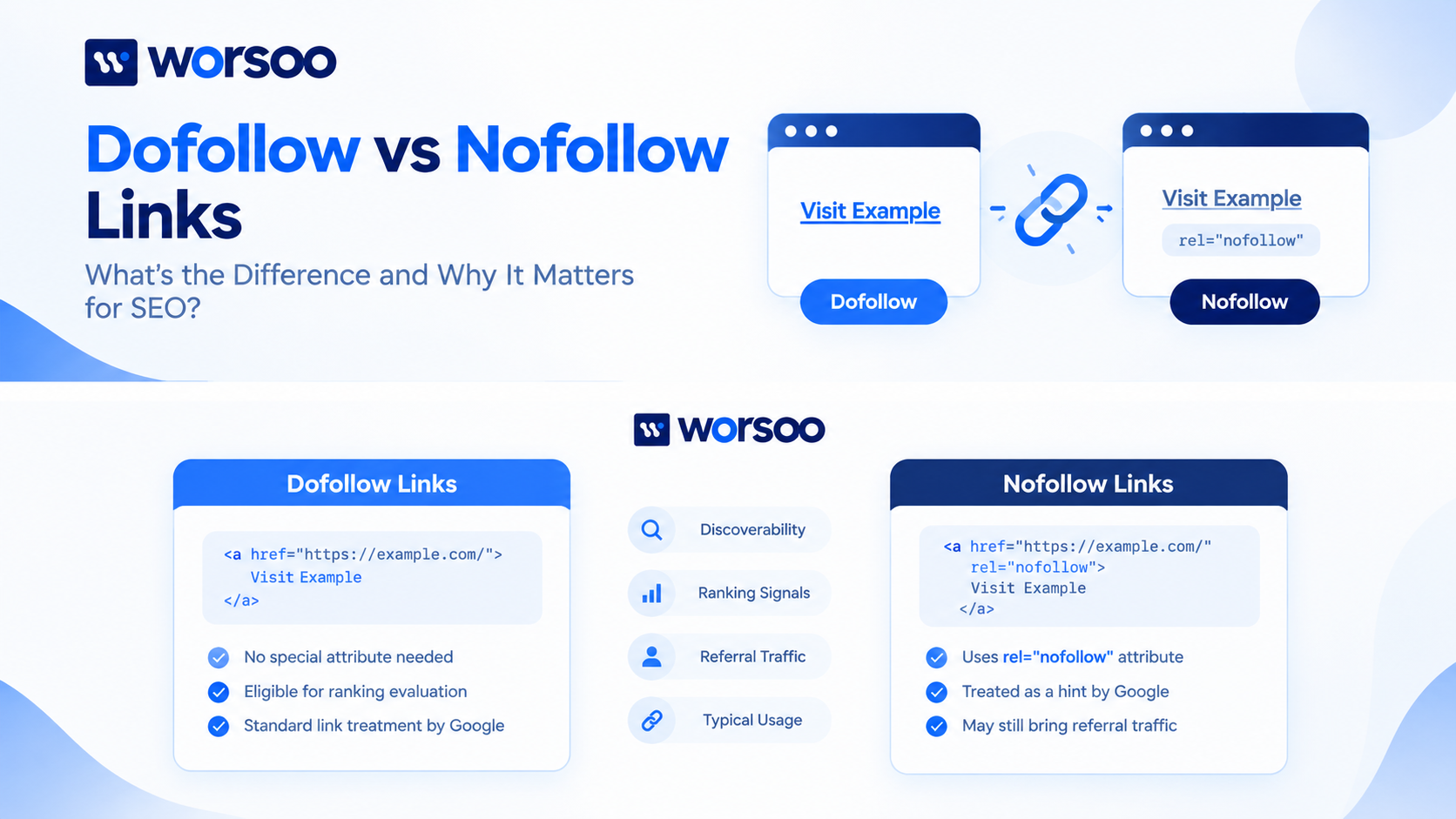
A dofollow link is a standard hyperlink that search engines can evaluate as a normal editorial link. A nofollow link contains the rel="nofollow" attribute, which tells Google that the publisher doesn’t necessarily want to endorse the linked page or provide normal ranking credit.
But there’s an important detail: Google treats nofollow as a hint, not an absolute command.
Both types of links can also bring real visitors to your website.
Understanding these differences helps you evaluate backlinks, structure internal links, and follow Google’s guidelines without getting lost in technical jargon.
Let’s break it down.
What Are Dofollow Links?
A dofollow link is an ordinary hyperlink that doesn’t contain a qualifying attribute such as nofollow, sponsored, or ugc.
In SEO discussions, these links are also called follow links.
Technically, there is no special HTML attribute required to make a link dofollow.
Consider this example:
<a href="https://example.com/">Visit Example</a>
The link contains the destination URL and clickable anchor text. There is no rel="nofollow" attribute.
That makes it a standard link.
Search engines can use eligible links to discover pages and evaluate relationships between websites.
Google also uses links as part of its ranking systems, although an individual dofollow link does not guarantee higher rankings.
Why Do Dofollow Links Matter for SEO?
Dofollow links can contribute to SEO in several ways.
They help search engines discover pages. Search engine crawlers can follow ordinary hyperlinks to find additional website content.
They can contribute ranking signals. Relevant editorial links may help Google’s systems evaluate the linked content.
They connect related information. Links help users and search engines understand how pages relate to one another.
They generate referral traffic. A person reading an article can click a relevant link and visit another website.
For example, imagine a digital marketing publication references a useful keyword research guide on another website.
A standard editorial link may help readers discover the guide while also making that reference available to search engines.
However, the value of the link depends on more than its attribute. Relevance, editorial context, placement, and the quality of the referring page all matter.
What Are Nofollow Links?
A nofollow link is a hyperlink containing the rel="nofollow" attribute.
Here’s an example:
<a href="https://example.com/" rel="nofollow">Visit Example</a>
Visitors can click this link just like any other hyperlink.
The difference is how the publisher qualifies its relationship with the destination.
A nofollow attribute indicates that the publisher doesn’t necessarily want Google to treat the link as a conventional endorsement.
Google originally introduced nofollow in 2005 to help address link spam, particularly within blog comments.
In 2019, Google changed its approach and began treating nofollow as a hint for ranking purposes. In March 2020, it also became a hint for crawling and indexing.
You can read the details in Google’s official article, Evolving Nofollow: New Ways to Identify the Nature of Links.
Do Nofollow Links Have SEO Value?
Yes, although their value differs from standard editorial links.
A nofollow backlink may:
- Bring interested visitors from another website.
- Introduce your brand to relevant audiences.
- Help readers discover useful resources.
- Lead to future editorial mentions and backlinks.
- Support legitimate promotion and community participation.
However, you should not assume that Google will count a nofollow link as ranking credit.
For a deeper discussion, read Worsoo’s existing article on whether nofollow links help SEO.
Dofollow vs Nofollow Links: Key Differences
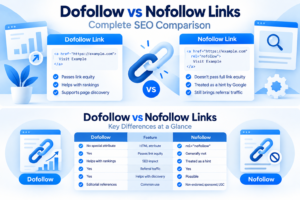
The most important difference concerns how the linking website qualifies its endorsement of the destination.
Here’s a practical comparison.
| Feature | Dofollow links | Nofollow links |
|---|---|---|
| HTML attribute | No special attribute needed | rel="nofollow" |
| Clickable by visitors | Yes | Yes |
| Eligible for normal ranking evaluation | Yes | Generally not treated as normal endorsements |
| Google’s treatment | Standard link evaluation | Treated as a hint |
| Can generate referral traffic | Yes | Yes |
| May help content discovery | Yes | Potentially, including through other discovery paths |
| Typical usage | Editorial references and internal links | Links not intended as endorsements |
| Guarantees better rankings | No | No |
| Requires special HTML | No | Yes |
A common mistake is assuming dofollow automatically means valuable, while nofollow automatically means useless.
Neither statement is accurate.
A standard link from an irrelevant, low-quality website may provide little value. Meanwhile, a nofollow link on a relevant industry publication could send potential customers directly to your business.
The best link is not always the one with the most attractive SEO label.
It’s the one that serves a legitimate purpose and connects you with a relevant audience.
How Dofollow and Nofollow Links Affect Link Equity
Link equity is an informal SEO term describing ranking value that hyperlinks may contribute to other pages.
You’ll sometimes hear marketers call it link juice.
Although the nickname sounds like something sold at a smoothie bar, the underlying idea relates to how search engines evaluate links.
Google’s PageRank system historically used links to help assess the importance of webpages, and link analysis remains part of Google’s broader ranking systems.
How Dofollow Links Relate to Link Equity
A regular editorial link is eligible for Google’s normal link evaluation.
For example, if a relevant industry website independently references your original research, the link may contribute useful signals.
However, there is no reliable public formula for calculating exactly how much ranking credit a specific backlink passes.
SEO tools may assign their own authority scores, but these are third-party metrics rather than Google’s internal PageRank values.
How Nofollow Links Relate to Link Equity
Nofollow links generally aren’t treated as normal editorial endorsements.
Nevertheless, Google’s hint-based approach means the attribute is not an absolute guarantee that a link will be excluded from every aspect of search analysis.
That doesn’t justify claiming nofollow links pass a certain percentage of link equity.
No such universal percentage has been established in Google’s documentation.
Practical takeaway: Focus on obtaining relevant editorial links through legitimate methods rather than trying to calculate an imaginary amount of link juice.
When Should You Use Dofollow Links?
Regular links are appropriate in many everyday situations.
1. Linking to Relevant Sources
When an external resource provides useful information, you can normally link to it without adding nofollow.
For instance, an SEO article explaining indexing may reference Google’s official documentation.
The link helps readers verify the information and learn more.
Google’s SEO link best practices encourage useful, contextual external links.
2. Creating Internal Links
Internal linking is one of the most practical applications of standard hyperlinks.
For example, an introductory article about backlinks can link to a detailed guide on analyzing backlink profiles.
This helps readers find related information and gives search engines clearer paths through a website.
Worsoo’s article about backlink profiles is an example of a related resource worth linking to where it fits the topic.
3. Referencing Original Research
If you’re citing trustworthy original research, a standard editorial hyperlink is generally appropriate.
It provides readers with access to the evidence behind your claims.
4. Linking to Useful Business Resources
An article about SEO planning might naturally link to a company’s relevant services or supporting guides.
Links should make navigation easier rather than appear solely for keyword optimization.
When Should You Use Nofollow Links?
Nofollow becomes useful when you want to link to a page without implying a normal editorial endorsement.
1. Links You Don’t Want to Endorse
Sometimes you need to reference an external webpage without endorsing it.
For example, you may be discussing misleading advice or analyzing a questionable claim.
In that situation, nofollow can help qualify the relationship.
2. Paid or Sponsored Links
Paid links require special attention.
Google recommends using rel="sponsored" for advertisements, sponsorships, and compensation-based links.
The nofollow attribute is also acceptable for qualifying such links.
However, placing a regular ranking-credit-passing link purely in exchange for payment can violate Google’s spam policies.
3. User-Generated Content
Links submitted through blog comments, discussion forums, or other user-generated sections may be marked with rel="ugc".
Nofollow is also supported.
These attributes help distinguish user-submitted links from links independently selected by the website publisher.
4. Other Non-Endorsed References
Some external references don’t fit sponsored or user-generated categories but still shouldn’t receive a conventional endorsement.
This is where the general nofollow attribute is useful.
Always consider why the link exists before selecting its attribute.
Nofollow vs Sponsored vs UGC: What’s the Difference?
Google supports several link attributes, each serving a different purpose.
| Attribute | Main purpose | Typical example |
|---|---|---|
rel="nofollow" |
Qualifies a link when you don’t want to endorse its destination | Non-endorsed reference |
rel="sponsored" |
Identifies compensated links | Advertisement or sponsored article |
rel="ugc" |
Identifies user-generated links | Forum post or blog comment |
A single link can contain more than one value.
For example:
rel="ugc nofollow"
This identifies a user-generated link while also applying nofollow.
Google explains the appropriate uses in its documentation on qualifying outbound links.
Remember that these attributes describe the relationship between pages. They are not general-purpose tools for hiding website content from search engines.
How to Check Whether a Link Is Dofollow or Nofollow
Checking a link attribute is straightforward, even if you don’t have advanced technical skills.
Method 1: Use Your Browser’s Inspect Tool
Open the webpage containing the link.
Right-click the link and select Inspect.
Your browser’s developer tools should display the corresponding HTML element.
Look for the rel attribute.
If you see rel="nofollow", the link has the nofollow qualification.
If you see rel="sponsored" or rel="ugc", the link has those qualifications.
If none of these values is present, the hyperlink is generally a regular follow link.
Method 2: Check the Page Source
Open the webpage’s HTML source and locate the hyperlink.
Inspect its attributes to understand how the publisher has marked it.
This method can be useful when reviewing a small number of links.
Method 3: Use an SEO Backlink Tool
Backlink analysis platforms can help identify link attributes across many referring pages.
Depending on the platform, reports may include referring domains, anchor text, link type, and whether backlinks have been discovered or lost.
However, third-party tools don’t necessarily detect every backlink that exists.
Their measurements and authority scores should be treated as estimates.
How to Add Nofollow Links in WordPress
If your website uses WordPress, you can create ordinary and qualified links without changing the entire page structure.
Adding a Regular Dofollow Link
- Open your WordPress post or page editor.
- Select the text you want to link.
- Click the link option and enter the destination URL.
- Save the link.
A normal hyperlink doesn’t require a special dofollow attribute.
Adding a Nofollow Link
The precise steps depend on your WordPress editor and installed plugins.
In the block editor, you can use the appropriate block’s HTML editing option to add the attribute manually.
For example:
<a href="https://example.com/" rel="nofollow">Example Website</a>
If your SEO or link-management plugin provides a nofollow option, you may also be able to apply it through that interface.
Always check the saved page’s actual HTML to confirm the attribute is present.
The same principle applies to sponsored and UGC attributes.
Which Is Better for SEO: Dofollow or Nofollow?
If you’re specifically evaluating links for their potential to contribute normal ranking signals, relevant editorial dofollow backlinks are generally preferable.
But that doesn’t make nofollow links worthless.
Consider two hypothetical scenarios.
Scenario A: A regular link from an unrelated website
A small marketing agency receives a dofollow backlink from an unrelated website with poor-quality content.
The link exists, but the referring page has little contextual relevance to the agency’s services.
Its SEO benefit may be limited.
Scenario B: A nofollow link from a respected industry publication
The same agency receives a nofollow mention in a popular marketing publication.
Readers visit the agency’s website to explore a genuinely useful guide.
Some visitors become prospective clients.
In that situation, the nofollow link may deliver meaningful business value despite not providing a guaranteed ranking benefit.
These examples illustrate why backlink quality cannot be reduced to a single attribute.
The better approach is to evaluate relevance, editorial context, legitimacy, and actual results.
Common Dofollow and Nofollow Link Mistakes
Understanding link attributes also means avoiding practices that can undermine your SEO strategy.
Buying Dofollow Links to Manipulate Rankings
Purchasing links primarily to influence search rankings can violate Google’s link spam policies.
Advertisements and sponsored placements must be appropriately qualified.
Read Google’s spam policies before considering a paid link-building arrangement.
Adding Nofollow to Every External Link
Some website owners assume that all outbound links weaken their rankings.
Google doesn’t recommend adding nofollow to every external citation.
Link naturally to reliable resources that help readers.
Using Nofollow to Prevent Indexing
Nofollow is not a dependable method for keeping a page out of Google’s index.
A linked page may still be discovered through other websites, sitemaps, or different paths.
If you need an accessible page excluded from search results, use a supported noindex directive instead.
Chasing a Perfect Link Ratio
There’s no official Google requirement to maintain a fixed ratio of dofollow to nofollow backlinks.
Don’t create unnecessary links simply to reach a particular percentage.
Ignoring Internal Linking
Businesses sometimes focus entirely on acquiring external backlinks while neglecting connections between their own pages.
Relevant internal links help visitors navigate a website and help search engines understand its structure.
Use descriptive anchor text and link to related pages when it genuinely helps the reader.
How to Build a Better Backlink Strategy
Instead of choosing link-building opportunities based solely on whether they’re dofollow, evaluate the entire context.
A practical strategy involves:
- Creating original, useful content that others may want to reference.
- Identifying relevant industry publications and resources.
- Improving existing pages that already attract visitors.
- Developing legitimate professional relationships.
- Earning editorial mentions through worthwhile contributions.
- Monitoring backlinks and referral traffic.
- Avoiding automated spam and manipulative link schemes.
For example, a detailed research article that answers a common industry question may naturally attract references over time.
A business could also create an original checklist or practical resource that other websites find useful.
Neither approach guarantees backlinks, but both give publishers a reason to link.
You can explore Worsoo’s link-building campaign guide for more information about building an organized off-page SEO strategy.
Frequently Asked Questions
Are dofollow links better than nofollow links?
Dofollow links are generally more useful when evaluating a link’s eligibility to contribute normal ranking signals. However, nofollow links can still generate referral traffic, brand exposure, and business opportunities.
Do nofollow links pass link equity?
Google generally doesn’t treat nofollow links as conventional editorial endorsements. However, nofollow is a hint, so you should not describe its treatment as an absolute exclusion in every situation.
Can Google crawl nofollow links?
Potentially. Google treats nofollow as a hint, and a linked page may also be discovered through other links or sitemaps.
Should internal links be dofollow?
In most cases, yes. Ordinary internal links help visitors navigate important pages and give search engines paths to discover related website content.
Is rel=”dofollow” necessary?
No. A regular hyperlink without qualifying attributes is already considered a follow link. Adding rel="dofollow" is unnecessary.
Do I need both dofollow and nofollow backlinks?
Websites may naturally earn different types of links. However, there is no official Google requirement for a particular mixture or ratio.
Can buying dofollow links hurt SEO?
Yes. Buying links primarily to manipulate rankings can violate Google’s spam policies. Paid placements should use appropriate qualifying attributes.
Improve Your Website’s SEO With Worsoo
Understanding dofollow vs nofollow links is useful, but effective SEO involves much more than backlink attributes.
Your website also needs valuable content, technically accessible pages, a clear internal linking structure, and a strategy aligned with your audience’s search behavior.
At Worsoo, our on-page and off-page SEO services focus on helping businesses strengthen their search visibility through relevant optimization techniques.
Whether you’re reviewing your backlink profile or developing a more comprehensive SEO strategy, the goal should be to make informed decisions based on quality and measurable results.
Want to improve your website’s search visibility?
Contact Worsoo to discuss your SEO goals.
Final Thoughts
The difference between dofollow and nofollow links comes down to how search engines can interpret and evaluate the relationship between webpages.
Dofollow links are ordinary hyperlinks eligible for normal link evaluation.
Nofollow links contain an attribute that qualifies the publisher’s endorsement, although Google now treats that qualification as a hint rather than an absolute command.
Both types can bring visitors to your website, and neither guarantees rankings.
For businesses, the best approach is to prioritize relevant editorial links, helpful content, legitimate promotion, and useful website navigation.
Don’t build your SEO strategy around collecting the maximum number of dofollow links.
Build it around earning links that make sense for your audience and contribute to meaningful long-term results.