

An editor replies, “Send it over.” Do they mean the idea, the outline, or the whole article? Before you attach a file, read their last message alongside their guest post submission guidelines. The word submission can mean a different thing at each publication.
If the editor asks for a pitch, send a working title, the reader’s question, and a short outline. If they ask for the finished guest post, send one clean draft in their preferred format, along with the bio, sources, and images they request. The checklist below helps you choose what belongs in that email.
What goes in a guest post submission?
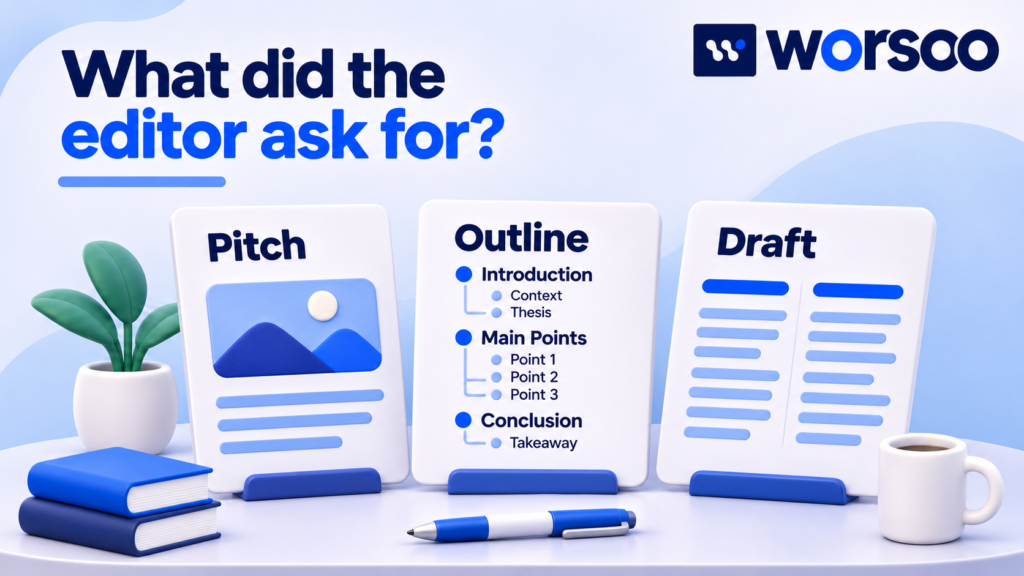
| What the editor asks for | What to send | What to check |
|---|---|---|
| “Pitch us an idea” | A title, who the article helps, and what readers will learn | Could the editor explain the idea to a colleague in one sentence? |
| “Send an outline” | Proposed headings and a line under each about the example or evidence you will use | Can the editor see what each section adds? |
| “Send the draft” | One clearly named document, the author’s name, and any requested extras | Can the editor open the file and leave comments? |
| “Please revise” | The revised draft in the same thread, plus a short note on the changes | Can the editor find the part they asked you to change? |
When a reply leaves room for doubt, ask one short question: “Would you like the outline first, or the full draft?” That can save you an afternoon of writing in the wrong format.
Read the publisher’s rules before you write
Look for three details first. What do they want to see? Where should you send it? How long should it be? Real publications give different answers.
- Smashing Magazine asks for an outline of 200–300 words. It wants to see the main headings and what each section will cover. That number is for the proposal itself. Smashing Magazine’s writer guidelines
- A List Apart accepts several starting points, including a pitch of one or two paragraphs with an outline. Its published articles average about 1,500 words. Those are two separate targets for two different stages. A List Apart’s contributor guide
- SIGNAL Magazine lists 500–800 words for an online article and 1,200–1,600 words for print. It also asks for a bio and gives instructions for sending images. Even at one publication, the right length depends on where the piece will run. SIGNAL’s guest author guidelines
Next, read two recent articles in the section you want to write for. Notice who they address and what they assume the reader already knows. A guide to website forms for a shop owner might start with a missed order. A developer reading about the same form may want the steps to reproduce an error. For help finding the question behind a topic, see Worsoo’s guide to search intent.
Show the editor the idea in one paragraph
Suppose you want to write for a newsletter for small shops. “I can write about website forms” gives the editor a topic. It leaves them to work out why their readers would open the article.
Here is a fictional pitch with enough detail for an editor to make a decision.
Working title — Your Contact Form Says “Sent.” Did the Message Arrive?
A shop owner can see a thank-you message on their website even when the inquiry never reaches the right inbox. I’d like to walk your readers through a test they can run from their phones. I’ll show the message a customer sees, where the owner should look for it, and what to record if it goes missing. I can include two screenshots from a demo shop so readers can follow along.
The strongest detail is the gap between what the customer sees and what the shop receives. The editor can picture the article. The writer has also named the evidence they will supply. Use an example you can actually produce.
Prepare a draft the editor can review
Give the editor one working copy. Put the agreed title and byline at the top. If the editor asked for comments in a shared document, grant access to their email address and check the settings. If they asked for Word, a name such as contact-form-test-draft.docx makes the attachment easy to find later.
Put evidence beside the claim. If you quote a number, link to the original source and explain what it measured. For a firsthand test, say what you tried and what happened. In the shop example, “The form showed a thank-you message, but the test email landed in spam” supports a specific lesson. That one test tells you nothing about how often other shops miss messages.
Make each step easy to find. A heading like “Check the inbox that receives form messages” tells readers where to look when they get stuck. Give each screenshot a caption explaining what to notice. For more on headings, image descriptions, and link wording, see Worsoo’s on-page SEO guide.
Identify the exact images the publisher can use. Name files to match their place in the draft, such as 01-test-form.png and 02-inbox-result.png. Include a short credit and say who owns each image. If a client supplied product photos, identify the approved photos in writing. An editor choosing a cover image should be able to tell which product belongs to the client. Use demo details or hide customer information before sharing screenshots.
Write a guest post author bio that explains why you know the topic
Start with the author’s real name and the work they do. Then add one detail that connects the writer to this article. Two plain sentences can do the job when the publisher gives no length limit.
Fictional example: “Mina Ali maintains online shops for independent retailers. She tests checkout pages and contact forms after website updates.”
For your own bio, replace both sentences with facts the author can stand behind. If you represent a client, ask the named author to approve the bio. Disclose any business connection that matters to the story and follow the publisher’s rules on AI assistance. For a paid placement, tell the editor about the arrangement before they review the draft. Google recommends marking paid links with the sponsored attribute and also accepts nofollow. Google’s guide to qualifying links
Copy this email when the editor requests the finished draft
Subject: Requested draft — [Agreed article title]
Hi [Editor’s name],
Here’s the draft of [title] for [publication or section]. It shows [specific reader] how to [useful outcome].
You can review it here: [draft link]. I’ve included [requested images or files] and added the credits under each image. My short author bio is at the end of the draft.
[If relevant, explain your connection to any company or product mentioned.]
Please let me know if you’d like me to expand [specific example or section].
Thanks,
[Author’s name]
If you’re sending a revision, change the first line to say what you fixed. “I added the inbox screenshot under Step 3 and corrected the product name in the caption” gives the editor two things they can check right away.
Final check before you press Send
-
I’m using the email address or form named in the guidelines.
-
I’m sending the pitch, outline, or draft the editor requested.
-
The title, length, and file format match what we agreed.
-
The editor can open the draft and all requested images.
-
The author approved the byline and bio. Sources, image credits, and relevant disclosures are in place.
-
The email states what I’m sending and what needs a reply.
Common guest post submission questions
Should I send a finished article with my first email?
Send one if the publication invites full drafts. If it asks for ideas first, send a pitch in the requested format. If the rules are silent, offer a short outline so the editor can assess the idea before you write the full piece.
Can I submit an article already published on my blog?
Check the publication’s rules on previously published work. If it considers reprints, share the original URL and publication date up front so the editor can decide.
When should I follow up?
Use the response window in the publisher’s guidelines. SIGNAL, for example, asks writers to allow at least two weeks. Once the stated window passes, reply in the same thread with the title and the date you sent it. That gives the editor enough detail to find your submission.
Want help preparing a guest post for a specific publication? Send Worsoo the publisher’s guidelines, your proposed topic, and the stage you’re at. That gives us a starting point for reviewing the pitch or draft with you. Contact Worsoo