

Backlinks are one of the most important parts of off-page SEO. They help search engines understand how websites are connected and how different pages are referenced across the internet.
However, having thousands of backlinks does not automatically mean your website has a strong SEO foundation.
The quality, relevance, and trustworthiness of those links matter more than the total number.
This is why businesses perform a backlink profile analysis.
A backlink profile analysis helps you understand:
- Which websites are linking to your website
- Whether those links are valuable
- If your link growth looks natural
- Which backlinks may create SEO risks
- How your website compares with competitors
A successful SEO strategy does not focus on collecting random backlinks. It focuses on earning relevant mentions from trustworthy websites that are connected to your industry.
In this guide, you will learn how to analyze a backlink profile, which metrics matter, which tools you can use, and how to improve your website’s backlink strategy.
What Is Backlink Profile Analysis?
Backlink profile analysis is the process of reviewing all external links pointing to your website to understand their quality, relevance, and potential SEO value.
Your backlink profile includes:
- Total backlinks
- Referring domains
- Link quality
- Anchor text distribution
- Dofollow and nofollow links
- Link relevance
- Link growth patterns
- Potential spam signals
If you are new to backlinks, first understand the basics in our guide about what a backlink profile is.
A backlink profile analysis goes beyond simply counting links.
Instead of asking:
“Which websites are linking to my website?”
A professional analysis asks:
“Are these backlinks helping my SEO goals?”
A website with 50 highly relevant backlinks can often have a stronger profile than a website with thousands of unrelated links.
Why Is Backlink Profile Analysis Important for SEO?
Many businesses focus on getting new backlinks but forget to analyze their existing links.
This can lead to wasted effort, missed opportunities, and potential SEO problems.
Regular backlink analysis helps you make better decisions.
1. Identify Valuable Backlinks
Not every backlink has the same value.
A backlink from a trusted website within your industry can provide more value than many unrelated links.
For example:
A backlink from a digital marketing publication to an SEO agency website is relevant because both websites discuss related topics.
A backlink from an unrelated website with no connection to marketing may provide very little value.
When reviewing backlinks, consider:
- Website relevance
- Content relationship
- Link placement
- Audience quality
- Website credibility
The best backlinks are those that help both search engines and users understand why one website references another.
2. Discover SEO Opportunities
Backlink analysis can reveal new opportunities for improving your website’s authority.
For example, you may discover:
- Websites linking to competitors but not your business
- Content that attracts the most backlinks
- Industry websites worth contacting
- Topics that naturally earn mentions
This information helps you create a smarter link-building campaign strategy instead of randomly trying to acquire links.
A good link-building strategy focuses on quality relationships and useful content rather than simply increasing backlink numbers.
3. Find Potentially Harmful Backlinks
Not every backlink improves SEO.
Some backlinks may require review because they appear unnatural or irrelevant.
Examples include:
- Spam websites
- Automated link networks
- Irrelevant directories
- Paid links created only for rankings
- Excessive keyword-focused anchor text
According to Google’s spam policies, websites should avoid practices designed to manipulate search rankings through unnatural links.
However, it is important not to remove backlinks simply because a tool labels them as risky.
A small industry website or a new blog can still provide value if the link is relevant and natural.
Always review backlinks manually before taking action.
4. Improve Your Link Building Strategy
Backlink analysis helps you understand what is already working.
For example, you may discover:
- Industry guides receive more backlinks
- Research-based content attracts more mentions
- Certain topics perform better
- Competitors earn links from specific websites
This information helps you create content that has a better chance of earning natural backlinks.
Instead of asking:
“How can we get more backlinks?”
Ask:
“What type of content deserves to be referenced by other websites?”
How To Analyze a Backlink Profile Step-by-Step
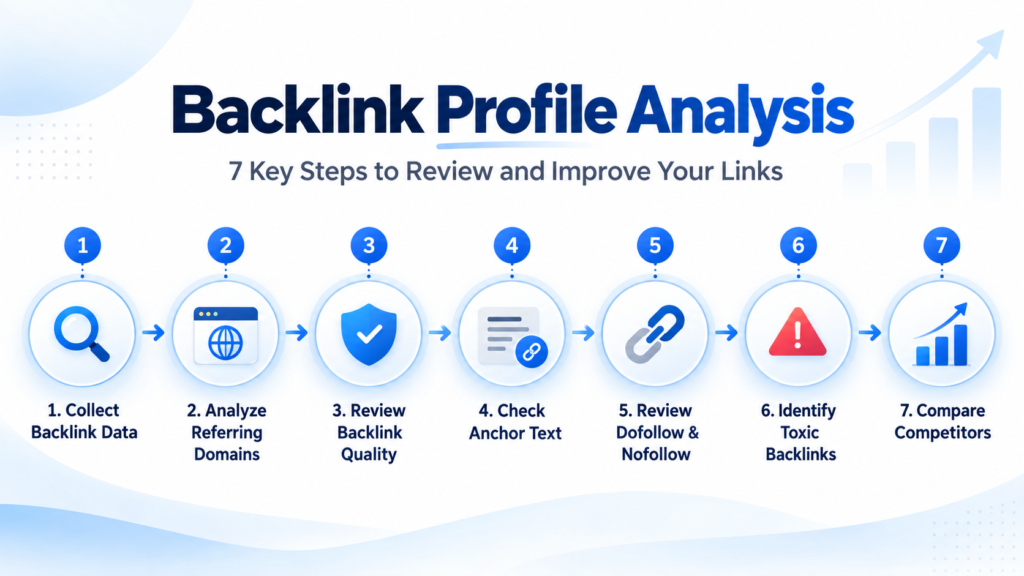
A proper backlink analysis involves reviewing different parts of your link profile.
Step 1: Collect Your Backlink Data
The first step is collecting information about websites linking to your domain.
You can use:
- Google Search Console
- Ahrefs
- Semrush
- Moz Link Explorer
Google Search Console provides free backlink information through its Links report.
It shows examples of:
- Top linking websites
- Most linked pages
- Common anchor text
Professional SEO tools provide additional information, including:
- Historical backlink data
- Competitor comparisons
- Link authority metrics
- New and lost backlinks
Remember that third-party SEO tools provide estimates. They do not have access to Google’s complete internal ranking systems.
Step 2: Analyze Referring Domains
A referring domain is a website that links to your website.
For example:
If five different pages from one website link to your website:
- Backlinks = 5
- Referring domains = 1
Referring domains are important because a natural backlink profile usually includes links from multiple relevant websites.
When reviewing referring domains, check:
Website Relevance
Ask:
Does this website relate to my industry?
Example:
SEO agency → marketing website ✅
SEO agency → unrelated entertainment website ❌
Relevance helps search engines understand the relationship between websites.
Website Quality
Review:
- Does the website publish useful content?
- Does it have a real audience?
- Does it appear trustworthy?
- Is it relevant to your customers?
Do not rely only on third-party authority scores.
Metrics from SEO tools can help compare websites, but they are not official Google measurements.
Step 3: Review Backlink Quality
A high-quality backlink usually has several characteristics.
Relevant Source
The linking website should have some connection with your topic.
For example:
A software company receiving a backlink from a technology publication makes sense.
A software company receiving thousands of links from unrelated websites may require investigation.
Natural Placement
The location of a backlink matters.
A link placed naturally inside useful content usually provides more context than:
- Footer links
- Sitewide sidebar links
- Automatically generated pages
A backlink should exist because it helps the reader.
Useful Context
Ask this question:
“Would a real visitor benefit from clicking this link?”
If the answer is yes, the backlink has stronger marketing value.
Step 4: Analyze Anchor Text Distribution
Anchor text is the clickable text used in a hyperlink.
For example:
Learn more about SEO strategies
In this example, SEO strategies is the anchor text.
Analyzing anchor text helps you understand how other websites describe your content.
A healthy backlink profile usually contains a natural mixture of different anchor text types.
Brand Anchor Text
Examples:
- Worsoo
- Worsoo SEO Agency
- worsoo.com
Brand-based anchors are common because people naturally mention businesses by name.
URL Anchor Text
Examples:
- worsoo.com
- https://worsoo.com
These are also natural and commonly appear in backlink profiles.
Generic Anchor Text
Examples:
- Click here
- Learn more
- Visit website
These anchors provide less keyword information but are normal parts of natural linking patterns.
Keyword-Based Anchor Text
Examples:
- SEO services
- backlink analysis
- technical SEO agency
Keyword-based anchor text can be useful when it appears naturally.
However, using the exact same keyword repeatedly across hundreds of backlinks can create an unnatural pattern.
For example:
A website receiving many backlinks with the exact anchor:
“best SEO company”
may appear manipulated.
A natural backlink profile usually contains different anchor text variations.
Step 5: Review Dofollow and Nofollow Links
A backlink profile should also be analyzed based on link attributes.
Common link types include:
- Dofollow links
- Nofollow links
- Sponsored links
- User-generated content (UGC) links
A standard hyperlink without additional attributes is generally considered a dofollow link.
A nofollow link contains:
rel="nofollow"
Google explains that link attributes such as nofollow, sponsored, and UGC are treated as hints rather than absolute instructions through its guidance on qualifying outbound links.
You can learn more about this topic in our detailed guide about dofollow and nofollow links.
There is no official Google rule that says your website needs a specific ratio of dofollow and nofollow links.
A strong backlink profile is judged by:
- Relevance
- Quality
- Trust
- Natural growth
Not by a specific percentage of link types.
Step 6: Identify Toxic or Suspicious Backlinks
Many SEO tools provide backlink risk reports.
However, these reports should not be followed blindly.
A backlink should not automatically be considered harmful because:
- The website has low authority
- The website is new
- The website has limited traffic
Instead, look for patterns.
Potential warning signs include:
- Thousands of backlinks appearing suddenly
- Links from unrelated websites
- Automated link networks
- Pages created only for selling links
- Excessive exact-match keyword anchors
The goal of backlink analysis is not to remove every imperfect link.
The goal is to identify links that appear unnatural or created only to manipulate rankings.
Step 7: Compare Your Backlink Profile With Competitors
Competitor backlink analysis helps identify opportunities that may already work in your industry.
By studying competitors, you can discover:
- Websites linking to competing businesses
- Content formats earning backlinks
- Industry publications mentioning competitors
- Potential outreach opportunities
For example:
A competitor may receive backlinks because they created:
- A detailed industry report
- A useful checklist
- Original research
- A complete resource guide
Instead of copying competitor backlinks, analyze why those pages earned attention.
Then create something more useful.
Important Backlink Metrics To Monitor
A successful backlink profile analysis focuses on meaningful metrics.
1. Referring Domains
Referring domains show how many unique websites link to your website.
A diverse backlink profile is generally healthier than one where most links come from a small number of websites.
Example:
Website A:
500 backlinks from 3 websites
Website B:
100 backlinks from 80 websites
Website B may have a more natural distribution.
However, quality and relevance are still more important than quantity.
2. Domain Relevance
A backlink from a website related to your industry usually provides stronger contextual value.
Examples:
SEO company → marketing publication ✅
SEO company → unrelated website network ❌
Search engines use context to understand relationships between websites.
3. Link Placement
Where a backlink appears can affect its usefulness.
Common placements include:
- Main article content
- Author biography
- Resource pages
- Directories
- Footer sections
Editorial links inside valuable content generally provide stronger context.
4. Link Growth Rate
Monitoring backlink growth over time helps identify unusual patterns.
Natural growth usually happens gradually.
However, sudden increases can happen for legitimate reasons, such as:
- Viral content
- Media coverage
- Product launches
- Industry mentions
The important thing is understanding why growth happened.
Best Tools for Backlink Profile Analysis
Different tools provide different levels of backlink information.
Google Search Console
Best for:
- Free backlink overview
- Top linking websites
- Most linked pages
Google Search Console is a useful starting point for every website owner.
Ahrefs
Best for:
- Detailed backlink research
- Competitor analysis
- Link opportunity discovery
Semrush
Best for:
- Backlink audits
- Competitor comparisons
- Monitoring link changes
Moz Link Explorer
Best for:
- Beginner-friendly backlink research
- Website comparison
Using multiple data sources often provides a more complete understanding of your backlink profile.
How To Improve Your Backlink Profile
After analyzing your backlinks, the next step is improving your overall profile.
Create Link-Worthy Content
The strongest backlinks usually come from valuable content.
Examples:
- Original research
- Industry reports
- Detailed guides
- Free tools
- Helpful resources
People naturally link to content that helps their audience.
Improve Existing Content
Some pages already have backlink potential but need improvement.
Consider adding:
- Updated information
- Better examples
- Visual elements
- Original insights
- More complete explanations
Better content increases the chance of earning additional mentions.
Build Industry Relationships
Successful link building is not only about sending outreach emails.
Relationships matter.
Connect with:
- Industry publications
- Bloggers
- Business communities
- Professional organizations
Strong relationships can create long-term opportunities.
Use a Strategic SEO Approach
Backlinks are only one part of SEO.
A complete strategy includes:
- Technical SEO
- Content optimization
- Keyword research
- Internal linking
- Off-page SEO
Businesses looking for professional support can explore Worsoo’s professional SEO services to improve their website visibility and search performance.
Common Backlink Profile Analysis Mistakes
Mistake 1: Focusing Only on Backlink Numbers
More backlinks do not automatically mean better SEO.
A smaller number of relevant links can be more valuable than thousands of unrelated backlinks.
Mistake 2: Removing Every Low-Quality Link
Not every weak backlink is harmful.
Always review:
- Relevance
- Context
- Link purpose
before removing or disavowing links.
Mistake 3: Ignoring Internal Linking
Backlink analysis focuses on external links, but internal links are also important.
A strong internal linking structure helps visitors and search engines discover important pages.
Mistake 4: Buying Spam Backlinks
Cheap backlink packages often create risky patterns.
Google recommends avoiding link schemes designed to manipulate search rankings.
Mistake 5: Not Monitoring Competitors
Competitor backlink research can reveal valuable opportunities.
Ignoring competitor data means missing potential growth areas.
Frequently Asked Questions About Backlink Profile Analysis
What is backlink profile analysis?
Backlink profile analysis is the process of reviewing websites linking to your domain to evaluate backlink quality, relevance, and SEO opportunities.
How do I check my website backlinks?
You can check backlinks using Google Search Console or SEO platforms such as Ahrefs, Semrush, and Moz.
What makes a good backlink?
A good backlink usually comes from a relevant, trustworthy website and appears naturally within useful content.
How often should I analyze my backlink profile?
Most businesses should review their backlink profile regularly, especially after link-building campaigns or major SEO changes.
Can toxic backlinks hurt SEO?
Unnatural backlinks created to manipulate rankings can create SEO risks. However, not every low-authority backlink is harmful.
Are more backlinks always better?
No. Quality, relevance, and trust are more important than the total number of backlinks.
Improve Your Backlink Strategy With Worsoo
A backlink profile analysis helps you understand whether your website’s backlinks are supporting your SEO goals.
However, backlinks are only one part of a successful search strategy.
A complete SEO campaign combines:
- Technical optimization
- Quality content
- Keyword research
- Internal linking
- Link building
- Performance tracking
At Worsoo, we help businesses improve their online visibility through data-driven SEO strategies.
Our professional SEO services help businesses identify opportunities, improve rankings, and build sustainable organic growth.
If you want to understand your website’s backlink strengths and weaknesses, contact Worsoo’s SEO team for a professional analysis.
Final Thoughts
A backlink profile analysis helps businesses understand whether their links are helping or limiting SEO growth.
The goal is not to collect the highest number of backlinks.
The goal is to build a natural, relevant, and trustworthy backlink profile.
By analyzing your backlinks regularly, studying competitors, improving content, and focusing on quality link opportunities, you can create a stronger foundation for long-term organic search success.