

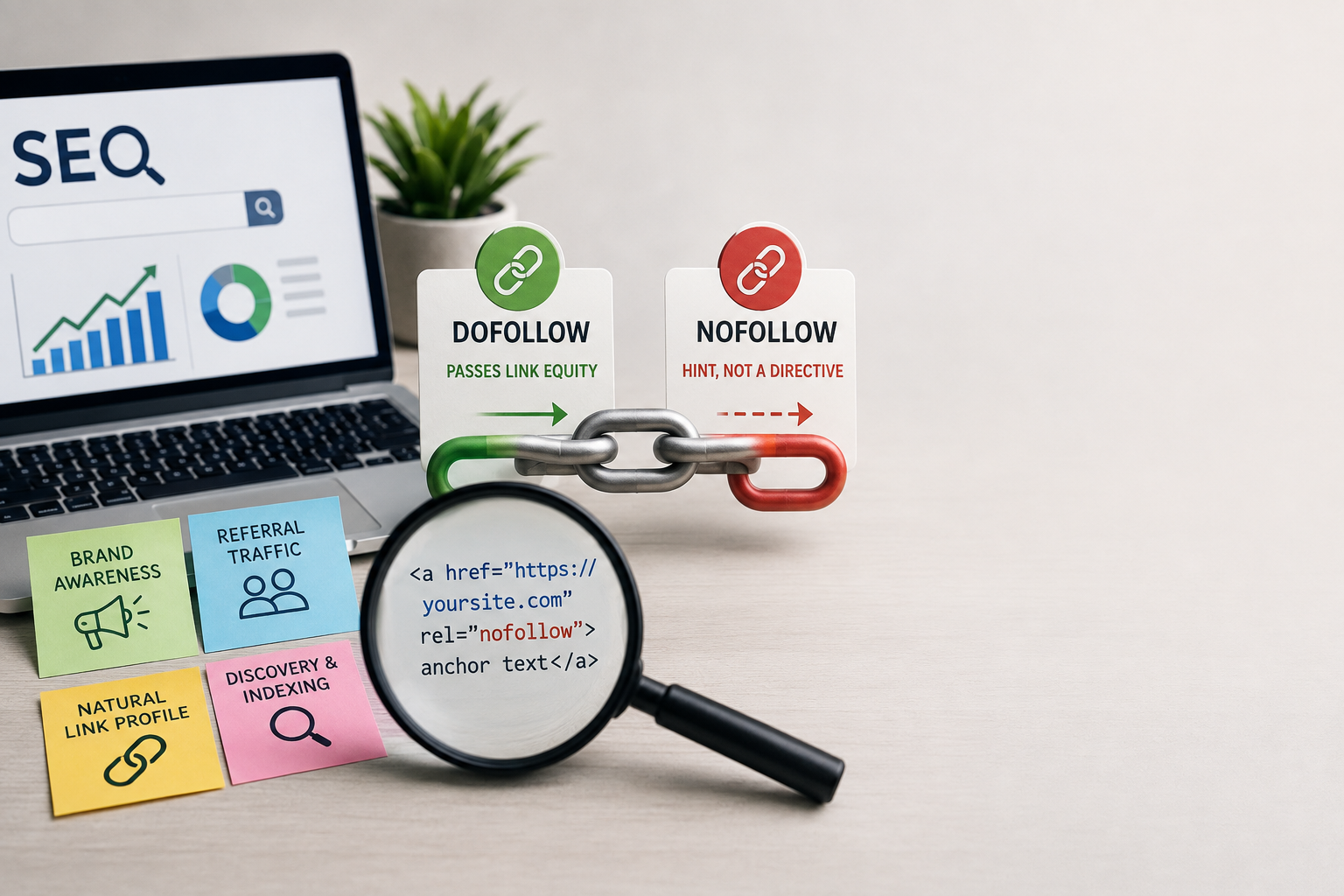
When it comes to backlinks, many website owners ask the same question:
Do nofollow links help SEO?
For years, many marketers believed nofollow links had no SEO value because they did not pass traditional PageRank signals. Others believed every backlink was valuable regardless of the attribute.
The reality is more balanced.
A nofollow link usually does not pass ranking authority in the same way as a traditional followed link, but it can still support SEO through referral traffic, brand visibility, content discovery, and a natural backlink profile.
In modern SEO, the value of a link is not only determined by whether it is followed or nofollow. The source, relevance, audience, and context of the link also matter.
Quick Answer: Do Nofollow Links Help SEO?
Yes, nofollow links can help SEO indirectly.
A nofollow link may not provide the same direct ranking benefits as a followed link, but it can help your website by:
- Bringing targeted referral traffic
- Increasing brand awareness
- Supporting natural backlink growth
- Helping users discover your content
- Creating a diverse backlink profile
A strong SEO strategy should not focus only on followed links. Real websites naturally earn different types of links from different sources.
What Is a Nofollow Link?
A nofollow link is a hyperlink that includes an additional HTML attribute telling search engines that the website owner does not necessarily endorse or pass traditional ranking signals through that link.
A standard link looks like this:
<a href="https://example.com">SEO Guide</a>A nofollow link looks like this:
<a href="https://example.com" rel="nofollow">SEO Guide</a>The rel="nofollow" attribute provides additional information to search engines about how the link should be interpreted.
Google introduced the nofollow attribute in 2005 to help websites fight comment spam.
At that time, many websites were being targeted by spam comments containing hundreds of backlinks designed to manipulate search rankings.
The nofollow attribute gave website owners a way to say:
“This link exists, but I am not passing ranking endorsement through it.”
Why Did Google Create Nofollow Links?
Before nofollow links existed, marketers could easily manipulate search rankings by creating large numbers of low-quality backlinks.
Common spam methods included:
- Blog comment spam
- Forum profile links
- Guestbook links
- Automated backlink software
- Paid link schemes
These practices damaged search quality because websites could rank based on artificial link manipulation rather than useful content.
The nofollow attribute helped website owners control how external links were interpreted.
The 2019 Google Nofollow Update
One of the biggest changes happened in 2019.
Google introduced two additional link attributes:
| Attribute | Purpose |
|---|---|
rel="sponsored" |
Paid placements, advertisements, affiliate links |
rel="ugc" |
User-generated content such as comments and forums |
rel="nofollow" |
Links that do not represent an endorsement |
The biggest change was that Google changed nofollow from a strict instruction to a hint.
Previously, Google treated nofollow links as:
“Do not consider this link.”
After the update, Google could use nofollow links as a signal when its systems believed the link provided useful information.
This means nofollow links are not completely ignored.
Do Nofollow Links Improve Google Rankings?
The simple answer:
Not directly in the same way as followed links.
A website should not build a strategy around getting thousands of nofollow links and expecting rankings to increase automatically.
However, nofollow links can support SEO in several important ways.
1. Nofollow Links Can Generate Referral Traffic
A backlink is not only valuable because of ranking signals.
A link from a popular website can send real visitors.
For example:
A marketing website publishes an article about SEO tools and links to your SEO guide with a nofollow attribute.
Even if the link does not pass traditional authority, readers may click it.
Those visitors can:
- Read your content
- Explore other pages
- Subscribe
- Contact your business
- Share your content
Traffic from relevant audiences is valuable.
A nofollow link from a website with thousands of active readers may be more useful than a followed link from a website nobody visits.
2. Nofollow Links Build Brand Awareness
SEO is not only about rankings.
People are more likely to trust businesses they repeatedly see across different platforms.
A nofollow mention from:
- Industry publications
- News websites
- Communities
- Social platforms
- Professional forums
can introduce your brand to new audiences.
Over time, this can increase:
- Brand searches
- Direct traffic
- Customer trust
For example:
A business owner sees Worsoo mentioned in an SEO discussion, later searches for “Worsoo SEO services,” and eventually becomes a customer.
The original nofollow mention helped create that journey.
3. Nofollow Links Create a Natural Backlink Profile
A healthy website does not usually have only one type of backlink.
Real businesses naturally earn:
- Followed editorial links
- Nofollow mentions
- Social links
- Directory links
- Community references
- Brand mentions
A backlink profile containing only followed links can look unnatural.
Search engines evaluate whether links appear to be earned naturally.
A balanced backlink profile better represents how real businesses grow online.
4. Nofollow Links Can Help Content Discovery
Links help users and search engines discover information.
Although Google does not guarantee ranking benefits from nofollow links, these links can still help connect users with valuable content.
Examples:
- A forum discussion linking to your guide
- A Reddit post mentioning your research
- A social profile sharing your article
- A news article referencing your resource
These mentions can help more people find your website.
Nofollow vs Dofollow Links: What Is The Difference?
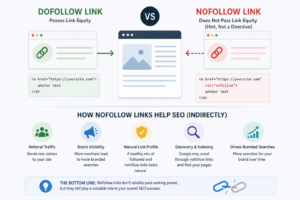
| Feature | Dofollow Links | Nofollow Links |
|---|---|---|
| Pass traditional link equity | Usually yes | Usually no |
| Can send referral traffic | Yes | Yes |
| Help brand visibility | Yes | Yes |
| Common source | Editorial articles | Forums, social, news sites |
| SEO role | Authority building | Visibility and trust building |
| Should businesses ignore them? | No | No |
The best SEO strategy understands the role of both.
Are Nofollow Links Worth Building?
Yes, nofollow links can be worth building when they come from relevant and trusted sources.
The mistake many businesses make is judging every backlink only by its ability to pass authority.
A better question is:
Can this link bring value to my business?
A valuable nofollow link can:
- Send qualified visitors
- Increase brand exposure
- Create new business opportunities
- Help people discover your content
- Lead to future followed links
For example:
A software company gets mentioned in a popular technology community. The link is nofollow, but thousands of relevant users see the brand.
Some users visit the website, share the content, and later other websites reference the company with followed links.
The original nofollow link helped create visibility.
Examples of Valuable Nofollow Links
Not all nofollow links have the same value.
A link from a trusted website with real users is usually more valuable than a link from an unknown website.
Here are examples of useful nofollow links:
| Source | SEO Value |
|---|---|
| Industry publications | Brand exposure and credibility |
| Reddit discussions | Targeted community traffic |
| YouTube descriptions | Audience discovery |
| Social media profiles | Brand visibility |
| Expert interviews | Trust building |
| Online communities | Referral visitors |
| Business directories | Local visibility |
The important factor is not only the link attribute.
The important factors are:
- Website relevance
- Audience quality
- Context of the mention
- User engagement
Do Nofollow Links Help Build Brand Authority?
Yes, indirectly.
Modern SEO is connected with brand trust.
When people repeatedly see a company mentioned across trusted websites, they become more familiar with that brand.
This can influence:
- Branded searches
- User trust
- Click-through rates
- Customer decisions
For example:
A business owner sees an SEO company mentioned in:
- An SEO community
- A marketing article
- A business podcast
- A social discussion
Even if some links are nofollow, these mentions help establish credibility.
The Follow-to-Nofollow Ratio Myth
Many SEO discussions talk about having a specific ratio of followed and nofollow links.
Examples:
- 70% followed links
- 30% nofollow links
However, there is no official Google rule that websites must maintain a specific backlink ratio.
Every website has a different backlink profile.
A local business may naturally have:
- Directory links
- Social mentions
- Review links
- Local publications
A large brand may have:
- News mentions
- Editorial links
- Community discussions
The goal is not achieving a perfect percentage.
The goal is building a backlink profile that looks natural and comes from real marketing activity.
How To Build Valuable Nofollow Links
A good SEO strategy does not chase nofollow links only.
Instead, businesses should create situations where valuable mentions happen naturally.
1. Create Helpful Resources
People link to useful content.
Examples:
- Industry research
- Complete guides
- Free tools
- Statistics pages
- Templates
- Checklists
High-quality resources can earn mentions from different websites.
2. Participate in Industry Communities
Relevant discussions can create awareness.
Examples:
- Professional forums
- Reddit communities
- Industry groups
- Question-and-answer websites
The focus should be helping people, not dropping promotional links.
3. Use Digital PR
Digital PR helps businesses get mentioned in online publications.
Examples:
- Expert opinions
- Industry insights
- Original research
- Newsworthy announcements
These mentions can generate traffic and improve brand recognition.
4. Build Relationships
Many valuable links happen because of relationships.
Examples:
- Partner websites
- Industry experts
- Business communities
- Podcast appearances
Strong relationships often lead to natural mentions.
How To Check If a Link Is Nofollow
You can check a link manually.
Method 1: Browser Inspection
- Right-click the link
- Select “Inspect”
- Check the HTML code
A nofollow link contains:
rel="nofollow"Method 2: SEO Tools
SEO platforms can analyze backlink profiles and show:
- Follow links
- Nofollow links
- Referring domains
- Anchor text
- Link quality
Common SEO tools include:
- Ahrefs
- Semrush
- Moz
These tools help businesses understand whether their backlinks are diverse and healthy.
Common Nofollow Link Mistakes
Mistake 1: Ignoring Nofollow Links Completely
Some businesses remove nofollow opportunities because they assume they have no value.
This can mean losing:
- Traffic opportunities
- Brand mentions
- Customer exposure
Mistake 2: Buying Large Numbers of Low-Quality Links
More links do not always mean better SEO.
A thousand irrelevant links are less valuable than one meaningful mention from a trusted source.
Focus on:
- Relevance
- Quality
- Audience
- Context
Mistake 3: Using Only One Link Type
A natural SEO strategy includes different types of mentions.
A website should not depend only on:
- Followed backlinks
- Guest posts
- Directories
A diverse approach creates stronger long-term results.
How Nofollow Links Fit Into a Modern SEO Strategy
SEO has changed from simple link counting to a broader understanding of online authority.
Search engines look at many signals, including:
- Content quality
- User experience
- Website authority
- Brand reputation
- Link relationships
Nofollow links support this bigger picture.
A strong SEO campaign focuses on:
| Strategy | Purpose |
|---|---|
| Quality content | Attract users and mentions |
| Technical SEO | Improve website performance |
| Followed links | Build authority |
| Nofollow links | Increase visibility |
| Brand building | Improve trust |
Worsoo SEO Expert Insight
At Worsoo, we view backlinks as part of a complete SEO ecosystem.
A successful link-building strategy is not about collecting the highest number of links.
It is about earning mentions from places where your potential customers already spend time.
For example:
A local business may benefit from:
- Local news mentions
- Industry directories
- Community websites
- Customer discussions
A B2B company may benefit from:
- Expert interviews
- Research mentions
- Industry publications
The right backlink strategy depends on the business, audience, and goals.
Frequently Asked Questions About Nofollow Links
Do nofollow links help SEO?
Yes. Nofollow links can support SEO indirectly through referral traffic, brand awareness, content discovery, and a natural backlink profile.
Are nofollow links useless?
No. While they usually do not pass traditional link equity like followed links, they can still provide valuable business and marketing benefits.
Should I build nofollow backlinks?
Businesses should focus on earning valuable mentions from relevant websites. If those links are nofollow, they can still provide benefits.
Do nofollow links improve Google rankings?
Nofollow links do not reliably pass ranking authority, but Google treats link attributes as hints and may use them in certain situations.
What is the difference between nofollow and sponsored links?
Sponsored links are used for paid placements, advertisements, or affiliate relationships. Nofollow is used when a website does not want to endorse a link.
Are social media links nofollow?
Many social media platforms use nofollow or other link attributes. However, these links can still generate traffic and brand awareness.
Final Thoughts
So, do nofollow links help SEO?
The answer is yes, but not in the simple way many people expect.
They are not a replacement for quality followed backlinks, but they are still valuable parts of a complete SEO strategy.
Nofollow links can:
- Bring referral traffic
- Increase brand visibility
- Support content discovery
- Create a natural backlink profile
- Introduce your business to new audiences
The best SEO strategy does not chase link attributes.
It focuses on earning valuable mentions from trusted places.
If you want to understand how your backlink profile affects your rankings, Worsoo can help.
Get a free SEO audit from Worsoo and discover opportunities to improve your website visibility, authority, and organic growth.
2 comments on “Do Nofollow Links Help SEO? A Complete Guide to Nofollow Links in SEO”