

You agree to pay for an article on another website. The publisher asks whether you want a sponsored label. Someone else says the link must be “dofollow” to have any value.
Before choosing, separate two questions: Will readers understand that the article is paid content? And how will the paid link be marked in the page’s code?
These are different checks. Passing one does not complete the other.
Quick answer: A sponsored guest post is an article published on another website as part of a paid or sponsored arrangement. Its commercial nature should be clear to readers. Google recommends rel="sponsored" for paid links and also accepts nofollow. Agree on the content, disclosure, and link treatment before publication, then check the live page.
This guide explains a practical review process. The legal guidance referenced is from the US Federal Trade Commission. Requirements can differ by country and situation; seek qualified advice for a specific campaign.
What is paid guest posting?
Paid guest posting usually means paying to have an article published on someone else’s website. The payment may cover writing, editing, publication, distribution, or a combination of services.
Paying a freelance writer to prepare an unpaid editorial submission is a different arrangement. In that case, the publisher has not necessarily received payment for placement.
Describe the actual relationship rather than relying on the phrase “guest post.”
| Arrangement | What to clarify |
|---|---|
| Unpaid editorial contribution | Who wrote it, their affiliation, and the publisher’s rules |
| Sponsored article | Who funded it and how that relationship is presented |
| Paid link insertion | The existing article, agreed change, and paid-link treatment |
| Affiliate content | Whether a purchase or action can earn the writer or publisher money |
An agency can help arrange these projects, but its involvement does not change what the reader needs to understand or how a paid link should be handled.
For the wider project terms, use our guide to a contract for guest posting. Here, the focus is the published article and its links.
Disclosure and link attributes do different jobs
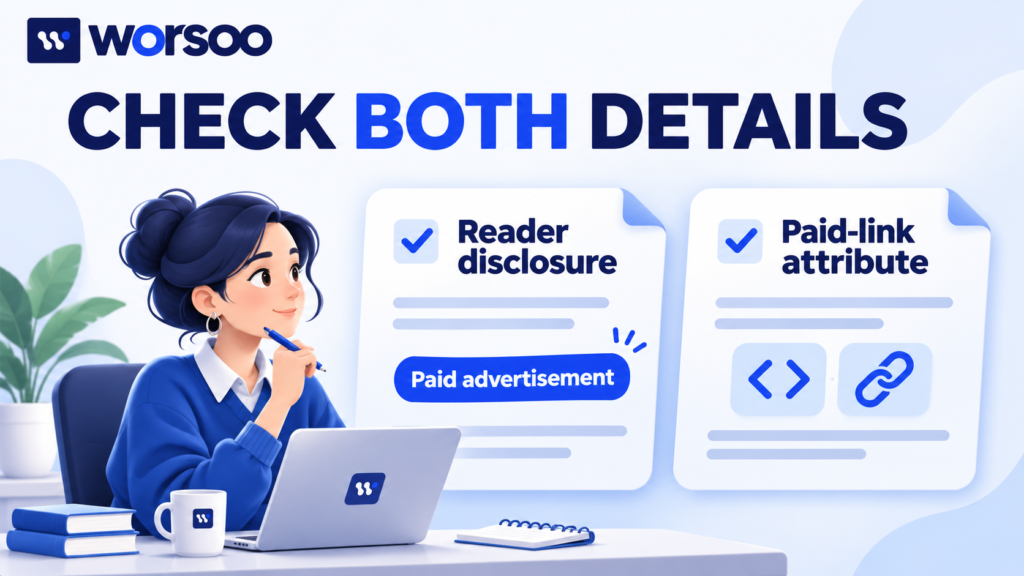
A disclosure is visible wording that explains the commercial relationship to readers. A link attribute is information inside the HTML link.
| Item | Who it helps | Example |
|---|---|---|
| Visible disclosure | Readers | “Paid advertisement from Example Brand” |
| Link attribute | Search systems interpreting the link relationship | rel="sponsored" |
A visitor should not need to inspect code to understand the article’s commercial nature. Equally, a visible advertising label does not automatically add an attribute to the link.
Keep separate items for both in the publication checklist. Ask the publisher to confirm the wording and the HTML treatment instead of accepting a vague “yes, sponsored.”
How should paid guest post disclosure appear?
The FTC’s native advertising guide explains that advertising must not mislead people about its commercial nature. When disclosure is needed, it should be clear, prominent, and understandable.
For article-style ads, check the label near the headline and on any promotional preview that could otherwise mislead readers. Review mobile as well as desktop. A brand logo alone does not clearly explain a paid relationship.
Example wording to discuss with the publisher:
Paid advertisement from Example Brand.
Use truthful wording that fits the arrangement. A vague label such as “Partner story” may leave readers unsure. Disclosure does not make unsupported product claims acceptable, and no single example label guarantees compliance in every setting.
Put the wording into the brief
Record the exact proposed label and where the publisher plans to place it. If the article will also appear in a newsletter or promotional card, ask how that version will be reviewed.
This small step gives the editor something concrete to implement. “Please handle disclosure properly” leaves more room for different interpretations.
Which link attribute should a sponsored guest post use?
Google’s outbound-link guidance recommends sponsored for advertisements and paid placements. nofollow remains acceptable for identifying paid links. The ugc value describes user-generated content, such as comments or forum posts; it is not a substitute for identifying a paid relationship.
Here is a simple sponsored-link example:
<a href="https://example.com/service/" rel="sponsored">
  Example Brand
</a>
The destination and brand above are placeholders. Replace them with the approved details.
Google also supports multiple rel values. For example:
<a href="https://example.com/service/" rel="sponsored nofollow">
  Example Brand
</a>
“Dofollow” is a common industry term, not a required HTML attribute. Do not ask an editor to add rel="dofollow" as if it were Google’s prescribed setting.
Link qualification and page indexing are separate matters. A sponsored attribute does not act as a page-level noindex instruction.
Why buying ranking credit is a different proposition
Google’s spam policies identify buying or selling links for ranking manipulation as link spam. The policy includes paid articles that pass ranking credit and certain campaigns using optimized anchor text.
Google distinguishes advertising and sponsorship links that are properly qualified from attempts to manipulate rankings. It also lists contractual link requirements that prevent the content owner from qualifying the link.
This means a brief should not require a publisher to remove paid-link attributes so the buyer can obtain ranking credit.
Review the offer in plain business terms: Which readers could the article reach? What useful information will it provide? Where will interested visitors go next?
If the seller’s whole explanation is “pay for this link and your rankings will rise,” ask for a clearer account of the service and its limits.
What can make a sponsored article useful?
Start with a reader problem that fits the publication.
For example, a software company might explain how a small team can prepare customer records before moving to a new system. The article can provide a checklist, common mistakes, and an honest explanation of where its product fits.
The paid relationship does not remove the need for useful writing. Ask whether someone could learn something from the article without clicking the sponsor’s link.
| Weak approach | More useful direction |
|---|---|
| Repeat that the sponsor is “the best” | Explain the product’s use case and limits |
| Add a keyword link to an unrelated paragraph | Place a relevant link where it helps the reader |
| Copy a sales page into an article | Build the article around a practical question |
| Invent a customer success story | Use a documented example or label a fictional scenario |
| Use stock images of a different product | Use approved images that represent the subject accurately |
Our guide on how to write a guest post covers planning, evidence, and editing in more detail.
Choose a publisher by audience fit
Before discussing price, read several recent articles. Check whether the publication covers your subject in a way your intended customers would understand.
A large domain metric does not tell you how many people will read a particular sponsored article. Ask how the article will be discovered: category placement, internal links, a newsletter, or another agreed channel.
Request a current example of the proposed format. Look at the actual page rather than relying only on a screenshot or a seller’s description.
Useful questions include:
- Does the article fit the publication’s normal topics?
- Can readers reach paid articles through the site’s navigation?
- What editing does the publisher provide?
- Which distribution activities are included in the fee?
- What page-level reporting, if any, will be available?
Record what is confirmed and what is only an estimate. Our guide to finding guest post opportunities offers a broader publisher-review process.
A practical pre-publication checklist
Keep one approved version of the brief. Include the final draft, image files, URLs, and contact person responsible for corrections.
| Check | What to confirm |
|---|---|
| Topic and audience | The article solves a relevant reader problem |
| Facts | Claims have support and product details are current |
| Disclosure | Wording and placement are agreed |
| Destination | Each sponsor link points to the approved page |
| Anchor text | The wording fits the sentence and destination |
| Link attribute | The agreed paid-link treatment is recorded |
| Images | Files are approved and usage rights are clear |
| Publisher location | Domain and section match the order |
| Distribution | Included promotional activities are named |
| Corrections | The process for reporting a mismatch is clear |
Do not treat a sample article as proof that your order will use identical settings. Confirm the current requirements with the publisher.
If something important remains undecided, mark it as pending. A blank field is easy to mistake for approval.
How to check the live article
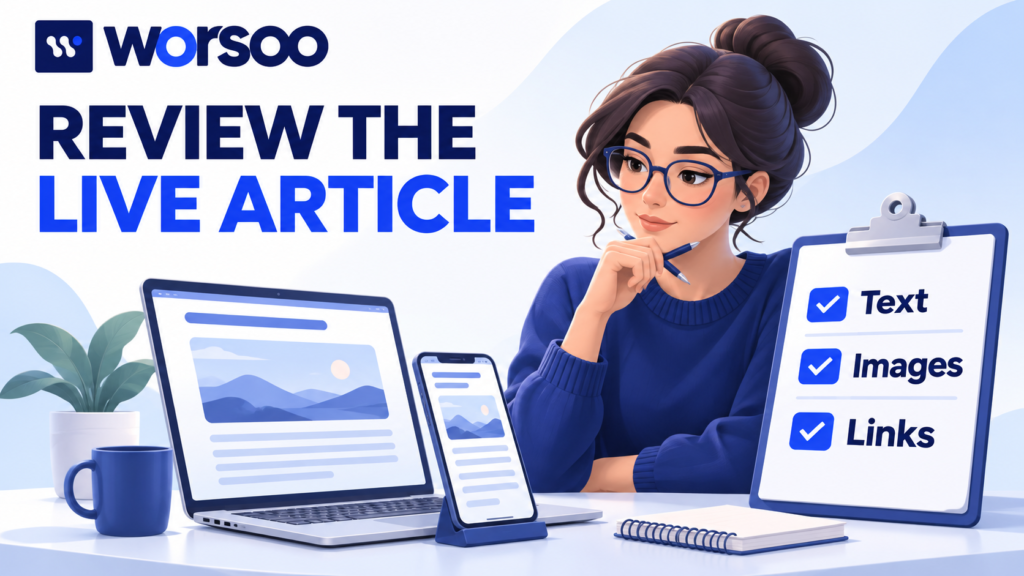
Open the published page on desktop and mobile. Compare it with the approved brief.
First review what a normal reader sees: headline, label, text, images, and working links. Then inspect the technical details.
To check a link in a desktop browser, right-click it and choose Inspect. Find the relevant <a> element and look at its href and rel attributes. If the markup is difficult to interpret, ask the publisher or a developer to confirm it.
Check each agreed sponsor link. Do not assume one correctly configured link proves that every link on the page is the same.
Save a delivery record with the live URL, review date, final draft version, and any mismatch. Describe a problem specifically: “The second sponsor link points to the old product page” is easier to fix than “the article is wrong.”
Worked example: the label is present, but the destination is wrong
Imagine an office-software company sponsors a guide to preparing customer records. The publisher uses the agreed label and paid-link treatment, but links to an old product page.
| Review item | Fictional finding | Next action |
|---|---|---|
| Article text | Matches the approved draft | Record as checked |
| Paid relationship | Presented as agreed | Record as checked |
| Sponsor link destination | Uses an outdated page | Request the approved destination |
| Image | Shows the correct product | Record as checked |
After the correction, click the link again and check its attributes. Keep the correction record with the order.
This example shows why “live” and “checked” should be separate statuses. Publication is one event; delivery review is another.
Measure results without inventing success
Decide what you want to learn before publication. That could be referral visits, relevant enquiries, or readership reported by the publisher.
Use the data actually available. Publisher-wide traffic estimates are not measurements of your article’s readership.
| Measure | What it can help you assess | Important limit |
|---|---|---|
| Article views supplied by publisher | Reported readership | Depends on the publisher’s measurement method |
| Referral visits | Visits attributed to that source | Attribution can be incomplete |
| Relevant enquiries | Business interest recorded after visits | Requires reliable tracking and review |
| Completed sales | Recorded commercial outcomes | A customer may interact with several channels |
Agree on tracking parameters only if the buyer and publisher want them. Keep URLs exactly as approved when the brief requires that.
For illustration, suppose a campaign costs $300 and records 60 attributed visits. The observed cost per attributed visit is $5. If it also records 3 enquiries, the observed cost per enquiry is $100.
Those numbers are fictional arithmetic, not industry benchmarks or a promise of results. They do not prove that the placement caused every enquiry or that the campaign was profitable.
There is no useful reason to add an unrelated success statistic to an order review. Report the evidence you have and clearly identify what you cannot measure.
Do sponsored guest posts help with AEO, GEO, or LLM visibility?
A published article may be available online, but payment does not guarantee that an answer engine will retrieve, cite, or recommend it.
Google’s generative AI search guidance warns against seeking inauthentic mentions and says there is no special schema markup required for its generative AI features. Those features still rely on Google’s search quality and spam systems.
This is Google-specific guidance, not a universal description of every LLM service.
If AI visibility is part of your reporting, define the observation process. Record the service, date, question, answer, and cited page. Keep an observed mention separate from a measured referral or enquiry.
Do not turn one favorable answer into a claim that the brand now appears across AI search. Likewise, an article with no observed citation in a small test has not necessarily been assessed by every service.
Common questions
Does every guest post involve payment?
No. Some contributions are accepted through unpaid editorial processes. Clarify who is paying whom and what the payment covers before describing the arrangement.
Does adding a sponsored label handle the link code too?
No. Review the visible presentation and the link implementation separately. Ask the publisher to confirm both in the brief and check the live result.
Is a sponsored link still clickable?
Yes. A rel attribute does not prevent a normal visitor from clicking the link. Check that the destination works and matches what the reader expects.
Should I remove the disclosure after delivery?
Do not plan a temporary label simply to pass the delivery check. Keep the published presentation truthful about the ongoing commercial relationship.
Can I guarantee that the article will stay online forever?
Record the publisher’s actual commitment and the provider’s remedy separately. A limited replacement period is not the same as control over a website for its entire lifetime.
Plan a sponsored post around the reader
Choose a relevant publication, prepare useful content, and settle the disclosure and link details before the article goes live. Then check delivery against the brief and measure what you can actually observe.
Explore Worsoo’s SEO services and share your website, audience, and publishing goal. We can discuss suitable content, publisher requirements, and the checks needed for your project.