

Imagine someone in Dallas searches for “emergency plumber near me.” Your company offers exactly that service, but Google shows three competitors instead.
You have a website, a Google Business Profile, and genuine customer reviews. So what’s missing?
The answer isn’t always obvious. Your business category might be incorrect, your website may lack a relevant service page, or outdated directory listings could be confusing potential customers.
A local SEO audit helps you investigate those possibilities systematically.
Whether you run a dental clinic, roofing company, restaurant, or home service business, this guide explains how to check your Google Maps presence, website, customer reviews, and local search performance.
You’ll also get a practical checklist and a sample audit report.
What Is a Local SEO Audit?
A local SEO audit is a structured review of how effectively a business appears in location-based Google Search and Maps results.
It examines your Google Business Profile, local website pages, online business information, customer reviews, technical SEO, and competitive visibility.
Google identifies three main factors influencing local search rankings:
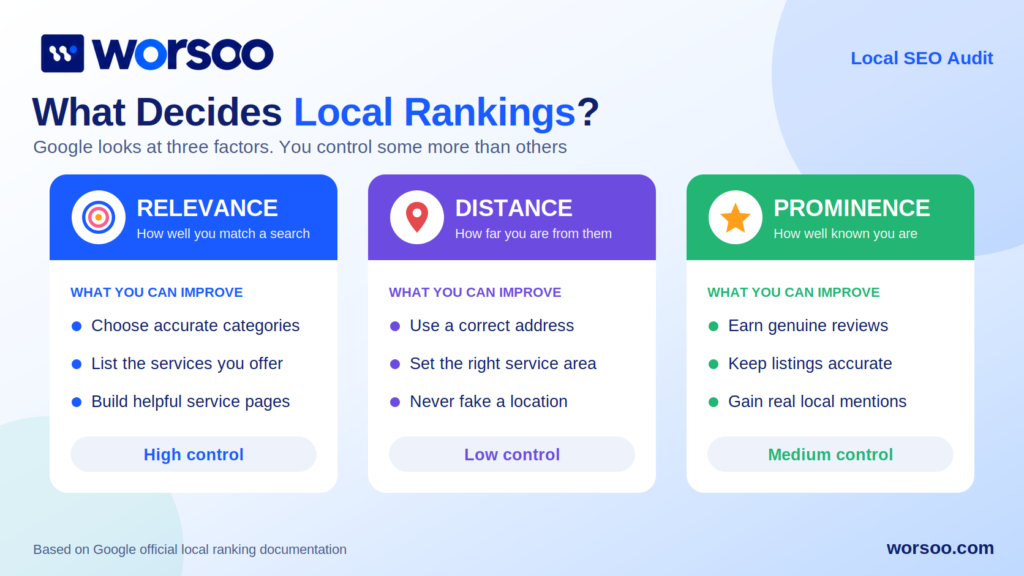
- Relevance: How closely a business matches the search.
- Distance: How far the business is from the searcher’s location.
- Prominence: How well-known or established the business is.
These factors are explained in Google’s official local ranking documentation.
A business can’t simply pay Google for better organic local rankings. But it can improve the accuracy, usefulness, and accessibility of its online information.
For broader background, read Worsoo’s guide to local SEO services.
Local SEO Audit Checklist: What Should You Check?
Start with a simple spreadsheet to organize findings.
| Audit area | What to review | Initial priority |
|---|---|---|
| Google Business Profile | Verification, categories, business information | Critical |
| Google Maps visibility | Rankings for relevant local searches | High |
| Name, address and phone | Accuracy across important platforms | High |
| Reviews | Authenticity, responses and policy compliance | High |
| Local landing pages | Service relevance and useful location information | High |
| Local citations | Incorrect or duplicate business listings | Medium |
| Technical SEO | Indexing, mobile experience and internal links | High |
| Local authority | Relevant backlinks and community mentions | Medium |
Priorities should be adjusted according to the actual impact on your business.
For every issue, record the affected location, supporting evidence, recommended action, owner, and completion status.
Step 1: Audit Your Google Business Profile
Your Google Business Profile is an important starting point because it supplies business information used across Google Search and Maps.
First, confirm that the profile is verified and that you have appropriate management access.
Then inspect these details:
| Profile element | What to verify |
|---|---|
| Business name | Matches your real-world business identity |
| Primary category | Accurately represents your main business |
| Secondary categories | Describe genuinely offered services |
| Address or service area | Correct for your business model |
| Phone number | Connects customers to the business |
| Website URL | Opens the appropriate working website |
| Business hours | Accurate, including special hours |
| Services | Reflect what the business actually provides |
| Photos | Genuine and representative |
For example, a dental practice should use an appropriate category rather than adding unrelated categories merely to appear in more searches.
Google’s business representation guidelines also explain that service-area businesses generally should hide their address if they don’t serve customers at that location.
Don’t use virtual offices or fabricated locations to target additional cities.
Practical tip: Test the phone number and website link yourself. Correct-looking contact details aren’t useful if customers can’t reach you.
Step 2: Check Google Maps Visibility
Next, investigate where your business appears for searches that matter.
Choose a small group of relevant queries, such as:
- “roof repair Austin”
- “emergency roofer Austin”
- “roofing contractor near me”
These are examples, not verified keyword-volume recommendations.
Search results can vary depending on the searcher’s location, device, and other context.
For a useful comparison, record the query, approximate search location, date, and businesses appearing prominently.
Avoid assuming one screenshot from your office represents rankings across the entire city.
Example of a local visibility report
| Search query | Location checked | Observation |
|---|---|---|
| Roof repair Austin | Central Austin | Business not among first three Maps results |
| Emergency roofer Austin | North Austin | Business appears prominently |
| Roofing contractor near me | South Austin | Stronger competing profiles appear |
This is a hypothetical example, not a real business ranking report.
Look for patterns rather than treating every position change as a problem.
A company may be highly relevant to customers near its location but less visible farther away because distance influences Google’s local results.
Step 3: Check Business Information and Local Citations
A local citation is an online mention or listing containing information about a business.
Common examples include relevant business directories, industry associations, and local chambers of commerce.
Check that your business name, address, and phone number are accurate wherever customers are likely to encounter them.
Suppose a plumbing company moved from one building to another.
Its website shows the new address, but an important directory still displays the previous location.
Customers using that directory could visit the wrong address or question whether the business is legitimate.
Identify outdated details and request appropriate corrections.
Focus on accurate, useful listings rather than buying hundreds of low-quality directory placements.
What about businesses with several locations?
Each legitimate branch may need its own location information and relevant website page.
Avoid creating duplicate Business Profiles for the same location simply to target additional neighborhoods.
Your audit should distinguish real business branches from service areas.
Step 4: Audit Customer Reviews and Reputation
Reviews can influence how customers evaluate businesses.
Google also states that review volume and positive ratings can contribute to local ranking prominence.
However, review quality and authenticity matter more than manipulating review counts.
Review the following:
- Recent feedback and recurring customer concerns
- Whether business owners respond professionally
- Complaints requiring operational improvements
- Suspicious reviews that may violate platform policies
- Whether review requests follow Google’s rules
For example, if several genuine customers mention delayed appointments, the right response isn’t just to improve the average rating.
Investigate the appointment process and address the underlying problem.
According to Google’s prohibited-content policy, businesses must not offer discounts, payments, or other incentives in exchange for reviews.
Google also prohibits selectively requesting positive reviews while discouraging negative feedback.
A trustworthy review strategy asks genuine customers for honest opinions without trying to control the rating.
Step 5: Examine Local Landing Pages
Your website should clearly explain which services you provide and where you provide them.
Imagine a cleaning company serves Austin and Round Rock.
It may benefit from dedicated pages if those pages genuinely help customers understand its services in each area.
But duplicating one page and replacing the city name doesn’t create meaningful value.
A strong local service page should include:
- An accurate service description
- Real service coverage
- Relevant customer questions
- Clear contact options
- Genuine photos or examples where available
- Appropriate links to related services
Example: Weak vs. useful local content
| Weak approach | Better approach |
|---|---|
| Repeating “best plumber Dallas” throughout the page | Explaining specific plumbing services available in Dallas |
| Creating nearly identical pages for many cities | Creating useful pages for genuine service areas |
| Using vague testimonials | Publishing authentic, attributable customer feedback with permission |
| Hiding contact details | Making calls, appointments, and inquiries straightforward |
Keep your website content consistent with your Business Profile.
For additional technical checks, Worsoo’s SEO services cover broader on-page and off-page optimization.
Step 6: Check Technical SEO and Local Business Schema
Even an accurate Business Profile doesn’t replace a functional website.
Inspect important service and location pages for:
- Accidental noindex directives
- Broken links and redirects
- Incorrect canonical tags
- Mobile usability problems
- Missing navigation links
- Unclear contact information
Use Google Search Console to check indexing and search performance.
You should also examine whether your website uses appropriate LocalBusiness structured data.
Google’s Local Business structured-data documentation explains how to describe business details such as location, opening hours, and telephone number.
Structured data must accurately represent the actual business.
Adding schema doesn’t guarantee higher Maps rankings or special search features.
Step 7: Review Local Backlinks and Community Visibility
A business may earn relevant links through genuine relationships with organizations in its community.
Examples include local trade associations, event partners, industry publications, and chambers of commerce.
During the audit, investigate whether important links are still working and whether your website has earned references from credible, relevant sources.
Don’t buy artificial links or create fake community partnerships.
For a small business, one useful link from a legitimate local organization may offer more business value than dozens of unrelated directory links.
The goal is to build a credible presence that reflects the business’s real activities.
Step 8: Measure Local SEO Performance
Rankings alone don’t tell you whether local SEO is helping your business.
Review the available performance data in Google Business Profile and your website analytics.
Google’s Business Profile performance documentation identifies metrics including searches, views, calls, direction requests, and website clicks, depending on business eligibility.
Your report might track:
| Metric | Why it matters |
|---|---|
| Business Profile website clicks | Shows visits initiated through the profile |
| Call-button clicks | Indicates potential customer contact |
| Direction requests | Useful for businesses customers physically visit |
| Organic landing-page traffic | Shows website search visibility |
| Qualified inquiries | Connects visits to real business opportunities |
| Completed bookings | Measures a more meaningful business outcome |
Be careful with attribution.
A call-button click isn’t necessarily a completed conversation, and a website visit doesn’t automatically become a customer.
When possible, track real leads and booked appointments in addition to visibility metrics.
Step 9: Consider AEO, GEO and AI Search Readiness
Local customers may also discover businesses through AI-powered search experiences.
Answer Engine Optimization (AEO) involves making useful business information easy to understand.
For example, an HVAC company’s website should clearly answer whether it provides emergency repairs, which areas it serves, and how customers can request help.
Generative Engine Optimization (GEO) and LLM discoverability similarly benefit from accessible content, accurate business identity, and trustworthy information.
For your audit, confirm that your company details are consistent across your website and important business profiles.
Don’t create fake offices, invented service histories, or AI-generated testimonials to appear more authoritative.
No legitimate optimization technique can guarantee that an AI assistant will recommend your business.
Step 10: Prioritize Findings and Build an Action Plan
Once the audit is complete, organize issues by their potential impact.
Here’s an illustrative action plan for a local service business.
| Finding | Priority | Recommended action |
|---|---|---|
| Important business category is incorrect | High | Select the accurate category |
| Listed phone number no longer works | Critical | Correct and test the number |
| Major service page is noindexed | Critical | Investigate and correct indexing |
| Important directory contains old address | High | Request listing correction |
| Location page lacks useful service details | Medium | Improve original local information |
| Several unanswered customer concerns | Medium | Review and respond appropriately |
Focus first on issues that interfere with customer contact, business accuracy, or important website visibility.
Assign an owner, record the fix, and confirm that the correct information is visible afterward.
Quick Local SEO Audit Checklist
Use this checklist before finishing your report.
-
Verify Google Business Profile information.
-
Confirm accurate business categories and service areas.
-
Review visibility for important local searches.
-
Check business information across relevant directories.
-
Review genuine customer feedback and responses.
-
Inspect service and location landing pages.
-
Check indexing, mobile usability, and internal links.
-
Validate LocalBusiness structured data where applicable.
-
Review relevant local backlinks.
-
Track calls, clicks, inquiries, and other useful outcomes.
A completed checklist doesn’t guarantee better rankings. It gives your business a more reliable process for identifying and addressing problems.
Need Help With Your Local SEO Audit? Contact Worsoo
A local SEO audit can reveal problems that aren’t immediately obvious when you look at your website or Google Business Profile.
At Worsoo, we help businesses explore SEO improvements, including on-page optimization, content strategy, technical issues, and local visibility.
If your business isn’t appearing for relevant local searches, understanding the cause is the first step toward choosing the right improvements.
Explore our professional SEO services or contact Worsoo to discuss your website and request a tailored consultation or quote.
Frequently Asked Questions
What is included in a local SEO audit?
A local SEO audit reviews Google Business Profile information, Maps visibility, local search queries, customer reviews, citations, service pages, technical issues, and relevant backlinks.
Can I perform a local SEO audit for free?
Yes. Google Business Profile, Google Search Console, and manual checks can help you investigate many local SEO issues without purchasing software.
How often should local businesses conduct an SEO audit?
Review important business information regularly, especially after changes in address, phone number, operating hours, services, or website structure. More comprehensive reviews can be scheduled periodically.
Does Google Business Profile guarantee Maps rankings?
No. Google evaluates relevance, distance, and prominence, among other signals. A complete profile helps provide accurate information but doesn’t guarantee a particular ranking.
Is a local SEO audit different from a general SEO audit?
Yes. General SEO audits examine website search performance broadly, while local audits place additional emphasis on Google Maps, Business Profile accuracy, geographic relevance, reviews, and local business information.
Final Thoughts
A useful local SEO audit goes beyond checking whether your business appears on Google Maps.
It examines whether nearby customers can find accurate information, understand your services, trust your business, and contact you easily.
Start with your Business Profile and important local pages. Document confirmed issues, prioritize meaningful fixes, and monitor the outcomes.
When you need help translating those findings into an SEO strategy, Worsoo is available to discuss your next steps.
1 comment on “Local SEO Audit: Step-by-Step Checklist for US Businesses”