

Quick answer: A SERP is the page Google (or Bing, or any search engine) shows you after you type a query. So what is a SERP, exactly? It stands for Search Engine Results Page, and in 2026 it looks nothing like the tidy list of ten blue links it used to be. Today a single results page can stack an AI-generated summary, a featured snippet, a map, four ads, a “People Also Ask” box, and video carousels above the first traditional result.
If you run a website and you don’t understand how the modern SERP is built, you’re optimizing blind. I’ve audited enough client sites to know that the businesses winning search right now are the ones who treat the SERP as a battlefield with many positions to capture, not a single ranking to chase. Here’s how it actually works.
What does SERP mean?
SERP stands for Search Engine Results Page. When people ask what does SERPs mean, they’re usually referring to the plural, the collection of results pages a search engine can return across different queries. And if you’ve wondered what is a SERPs versus a SERP, there’s no real difference in meaning; “SERPs” is just the plural or the casual shorthand marketers throw around in meetings.
The key thing to grasp is that no two SERPs are identical. Google assembles each results page in real time based on the searcher’s intent, location, device, search history, and the query itself. A search for “pizza” triggers a local map pack. A search for “what is compound interest” triggers a definition box. Same search engine, completely different page.
The anatomy of a modern SERP
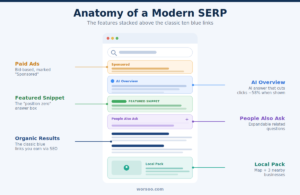
A results page is made of two broad categories: organic results, which you earn through SEO and can’t pay for, and paid results, the ads businesses bid on. Wrapped around those are SERP features, the rich elements Google inserts to answer questions faster. Here’s what you’ll commonly find:
| SERP feature | What it is | Can you influence it? |
|---|---|---|
| Organic results | The classic “blue links” ranked by relevance and authority | Yes, through SEO |
| Paid ads | Sponsored listings marked “Sponsored,” usually top and bottom | Yes, through Google Ads |
| AI Overview | An AI-generated summary pulling from multiple sources | Indirectly, by being a citable source |
| Featured snippet | A boxed answer at “position zero,” above result #1 | Yes, with structured, direct answers |
| People Also Ask | Expandable related questions | Yes, by answering related queries |
| Knowledge panel | A fact box on the right for brands, people, places | Partly, via Wikipedia, Wikidata, schema |
| Local pack | A map with three nearby businesses | Yes, through local SEO and Google Business Profile |
| Image & video packs | Visual result rows | Yes, with optimized media |
| Shopping results | Product listings with prices | Yes, through Merchant Center |
| Sitelinks | Sub-page links under a main result | Indirectly, via site structure |
Understanding this layout matters because every feature that appears above your organic listing pushes it further down the page, and further from a click.
Why your position on the SERP matters
Ranking position is not a vanity metric. It maps almost directly to traffic. According to First Page Sage’s 2026 analysis, the top three organic results capture roughly 68.7% of all clicks on a search page. Estimates for the number one spot alone range from about 28% in Backlinko’s clickstream study to nearly 40% in cleaner-SERP datasets, but every credible study agrees on the shape of the curve: attention collapses fast as you move down.
The drop-off is steep enough that page two is essentially invisible. Backlinko found that only a tiny fraction of searchers ever click through to the second page of results. In practical terms, if you’re ranking eleventh, you may as well be nowhere.
There’s an upside hidden in the SERP features, though. A featured snippet, which sits above the first organic result, earned an average click-through rate of about 8.2% in Semrush’s 2026 SERP Features Report, and pages that held both the snippet and the top organic spot pulled a combined CTR above 50%. Capturing a feature can matter more than nudging your ranking up one slot.
How AI is reshaping the SERP
This is the part that changes everything, and it’s why “what is a SERP” is a more urgent question in 2026 than it was two years ago.
Google’s AI Overviews, the generated answer boxes at the very top of many pages, now appear on more than 20% of searches, according to SparkToro’s 2026 research. When one shows up, it cuts the click-through rate to organic results by roughly 58%, per an Ahrefs study of 300,000 keywords using December 2025 data. Google itself commands about 91% of the global search market (StatCounter, 2026), so its design choices set the rules for everyone.
The result is the rise of the zero-click search. SparkToro and Similarweb found that 68% of U.S. Google searches ended without any click to the open web in early 2026, up from around 60% in 2024. Put bluntly: for every 1,000 searches, only about 276 now send a visitor to an external site.
So what do you do about it? You stop treating the SERP as a place to win a click and start treating it as a place to win a mention. This is the core idea behind GEO (Generative Engine Optimization) and AEO (Answer Engine Optimization): structuring your content so that AI Overviews, and answer engines like ChatGPT, Perplexity, and Gemini, cite you as a source. Brands cited inside AI Overviews saw meaningfully higher click-through and paid rates than those left out, according to Seer Interactive’s late-2025 data. Visibility is becoming the new currency, and a citation in an AI answer is the new top ranking.
What about SERP tracking tools like SERPBook?
Because rankings shift daily, most serious site owners track their positions with software rather than checking by hand. If you’ve come across the question what is SERPBook, it’s one example of a SERP rank-tracking tool, part of a category that includes far better-known platforms like Ahrefs, Semrush, and AccuRanker. These tools monitor where your pages sit for target keywords over time, flag which SERP features you’re winning or losing, and show how AI Overviews are affecting your visibility. If you’re doing SEO without one, you’re guessing.
How to earn more SERP visibility
Based on what actually moves the needle for the sites I work on, here’s where to focus:
- Match search intent precisely. Look at what already ranks for your keyword. If the SERP is full of how-to guides, a product page won’t rank there.
- Structure content for features. Use clear headings, concise direct answers, and schema markup so Google can pull you into snippets, People Also Ask, and AI Overviews.
- Answer the question fast. Lead with a direct, quotable answer in the first 40 to 60 words. This is what gets extracted by both featured snippets and AI systems.
- Build topical authority and E-E-A-T. Demonstrate real experience, cite trustworthy data, and earn mentions. Answer engines favor sources they can trust.
- Own the local pack if you serve a geographic area, by keeping your Google Business Profile complete and gathering genuine reviews.
Final thoughts
A SERP is no longer a ranking; it’s a layout, and your job is to occupy as much of it as you can. The blue-link era is fading, replaced by a page where AI summaries, snippets, and features increasingly answer the query before anyone scrolls. The winners in 2026 aren’t just ranking number one. They’re the sources Google and AI engines quote to give the answer.
If you’re not sure which SERP features you’re currently winning, or bleeding traffic to, that’s exactly the kind of audit worth running before you write another word of content. Want a clear picture of where your site stands on the SERPs that matter to your business? That’s what our team at Worsoo does, and it’s the fastest way to stop guessing and start ranking.
3 comments on “What Is a SERP? Search Result Features Explained”