

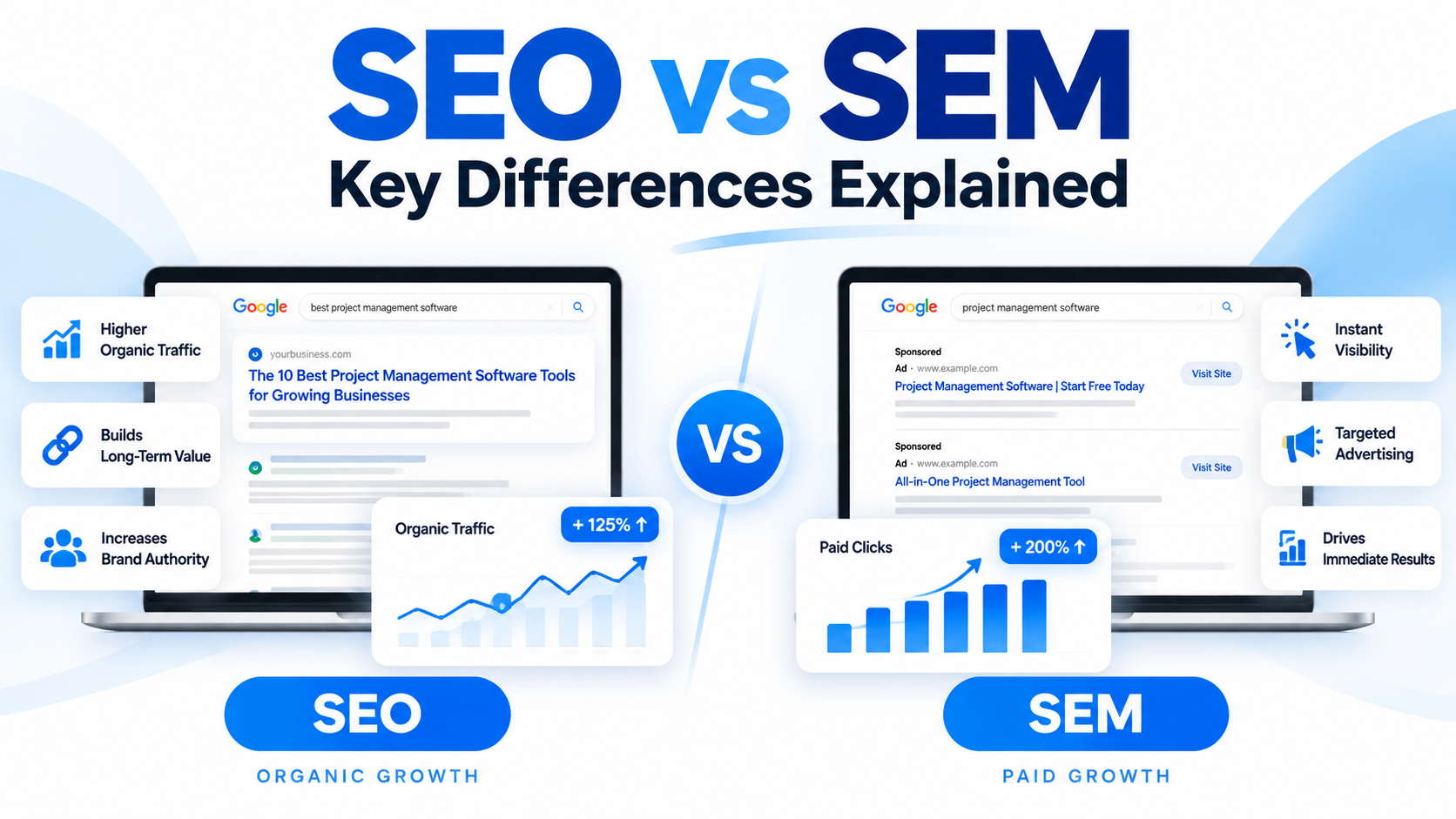
SEO vs SEM comes down to one key difference: SEO helps your website appear in organic search results, while SEM uses paid ads to attract visitors from search engines.
Both strategies can help businesses increase visibility, reach potential customers, and generate leads. However, they work differently when it comes to cost, speed, and long-term results.
For US businesses, choosing between SEO and SEM depends on marketing goals, competition, and available budget.
Let’s explore how both strategies work and which one makes the most sense for your business.
What Is the Difference Between SEO and SEM?
SEO (Search Engine Optimization) improves your website’s visibility in unpaid search results. SEM (Search Engine Marketing) commonly refers to paid search advertising, such as Google Ads.
SEO focuses on earning organic traffic through helpful content, technical improvements, and website optimization.
SEM allows businesses to pay for advertising opportunities when people search for relevant products or services.
Historically, SEM has also been used as a broader term covering both paid and organic search. This article uses its common modern meaning: paid search marketing.
SEO vs SEM: Quick Comparison
| Feature | SEO | SEM |
|---|---|---|
| Traffic source | Organic search | Paid search ads |
| Cost | No charge per organic click | Advertising budget required |
| Results | Usually gradual | Can generate traffic quickly |
| Long-term value | Can continue attracting visitors | Depends on ongoing ad spending |
| Targeting | Keywords and search intent | Keywords, locations, and ad settings |
| Main platform | Google Search | Google Ads |
| Best for | Long-term growth | Faster visibility and lead generation |
Both approaches can deliver valuable results. The better choice depends on what your business wants to achieve.
What Is SEO and How Does It Work?
Search Engine Optimization (SEO) is the process of improving your website so search engines can find, understand, and display its pages for relevant searches.
For example, imagine you own a plumbing company in Chicago.
When someone searches for “emergency plumber in Chicago,” your website may appear in organic results if Google considers it relevant and useful.
Unlike paid advertising, you don’t pay Google whenever someone clicks your organic listing.
However, successful SEO still requires investments in content, website improvements, and ongoing maintenance.
What Are the Main Types of SEO?
1. On-Page SEO
On-page SEO improves individual web pages through relevant keywords, helpful content, headings, title tags, and internal links.
2. Technical SEO
Technical SEO focuses on crawlability, indexing, website speed, mobile usability, and other technical factors that help search engines access your content.
3. Off-Page SEO
Off-page SEO builds website reputation through relevant editorial backlinks, credible references, and brand mentions.
4. Local SEO
Local SEO helps businesses appear in relevant location-based searches. It includes optimizing business information, local service pages, and Google Business Profiles.
What Are the Benefits of SEO?
SEO can help businesses:
- Attract relevant organic website visitors.
- Build credibility through useful content.
- Increase visibility for industry-related searches.
- Reduce dependence on paid advertising over time.
- Generate potential leads through informative and service-focused pages.
SEO isn’t an overnight solution. Its results depend on competition, website quality, and how effectively your content satisfies search intent.
What Is SEM and How Does It Work?
Search Engine Marketing (SEM) uses paid advertising to promote websites in search engine results.
Google Ads is one of the most widely used platforms for paid search marketing.
For example, a roofing company in Dallas can create advertisements targeting searches such as “roof repair Dallas.”
When someone searches for that service, an eligible advertisement may appear in a sponsored position.
Businesses can control campaign budgets, choose targeting settings, and measure advertising performance.
How Does SEM Work?
A typical SEM campaign involves five steps:
- Keyword research: Find relevant search terms that potential customers use.
- Campaign setup: Select targeting options, budgets, and bidding strategies.
- Ad creation: Write clear advertisements that match customer needs.
- Landing page optimization: Send visitors to pages relevant to their searches.
- Performance tracking: Monitor clicks, conversions, advertising costs, and leads.
Google considers several factors when determining which ads appear, including advertiser bids, ad quality, landing page experience, and auction competition.
This means spending more money does not automatically guarantee the top advertising position.
What Are the Benefits of SEM?
SEM offers several advantages:
- Faster visibility for relevant search queries.
- Control over advertising budgets.
- Geographic targeting for local and national businesses.
- Opportunities to test keywords and advertising messages.
- Detailed campaign performance measurement.
However, paid traffic generally stops when campaigns stop running, and high advertising costs can reduce profitability.
SEO vs SEM: What Are the 5 Main Differences?
Although SEO and SEM share the goal of attracting customers through search engines, their approaches differ significantly.
1. Cost
SEO requires an investment in content creation, technical improvements, and website maintenance. However, organic clicks don’t carry a direct advertising fee.
SEM requires an advertising budget, commonly involving pay-per-click (PPC) charges.
2. Speed
SEO usually takes time to develop consistent organic visibility, especially for new websites targeting competitive keywords.
SEM can generate impressions and clicks soon after campaigns become eligible to run.
3. Long-Term Results
SEO can continue generating visitors as long as your content remains useful, accessible, and competitive.
SEM visibility depends on ongoing campaign activity and available advertising funds.
4. Targeting
SEO primarily attracts users through relevant content and search intent.
SEM offers campaign controls such as geographic locations, keywords, devices, and eligible audience targeting options.
5. Performance Tracking
SEO performance includes organic clicks, impressions, engagement, and conversions.
SEM includes additional metrics such as cost per click (CPC), cost per acquisition (CPA), and return on advertising spend (ROAS).
SEO vs SEM: Which Is Better for Small Businesses?
SEO is generally a better fit for businesses seeking long-term organic growth, while SEM is useful for companies that need faster visibility and can fund paid campaigns.
For example, a small accounting firm in New York may use SEO to attract people researching tax preparation services throughout the year.
Meanwhile, a home remodeling company in Los Angeles might use Google Ads to reach homeowners actively searching for contractors.
Neither strategy guarantees customers.
The right decision depends on your marketing budget, competitive environment, and ability to turn visitors into leads.
For many small businesses, combining SEO and SEM creates a more balanced marketing strategy.
Can SEO and SEM Work Together?
Yes. SEO and SEM can complement each other by supporting different stages of the customer journey.
Paid advertising can help businesses test which search terms generate enquiries or sales.
Those insights can guide SEO content planning and improvements to existing service pages.
Meanwhile, useful organic content can attract people researching products or services before they’re ready to buy.
For example, a US-based HVAC company could publish helpful articles about air conditioner maintenance while running paid advertisements for emergency AC repair services.
This approach allows the business to serve both informational and immediate commercial search intent.
How Do AI Search, AEO, and GEO Affect SEO and SEM?
AI-powered search experiences have changed how people discover information online.
Google’s AI Overviews and AI Mode can present summarized answers supported by relevant web sources.
Answer Engine Optimization (AEO) focuses on making information easy to understand and use in answer-based search experiences.
Generative Engine Optimization (GEO) focuses on improving content’s suitability for discovery through generative AI systems.
For businesses, the most practical approach is to create original, accurate content that directly answers user questions.
Use clear headings, credible references, real-world examples, and accessible page content.
Google’s 2026 guidance confirms that established SEO best practices remain important for its generative AI search features.
No optimization technique can guarantee that a website will appear in an AI-generated answer.
How Can You Choose the Right Search Marketing Strategy?
Choosing between SEO and SEM starts with understanding your business goals.
Consider the following:
Choose SEO if:
- You want sustainable organic visibility.
- You can invest in ongoing website improvements.
- You want to publish helpful, industry-related content.
Choose SEM if:
- You need faster exposure for your services.
- You have a defined advertising budget.
- You want to test offers and commercial keywords.
Choose both if:
- You want immediate search opportunities alongside long-term growth.
- You can manage both content and advertising investments.
- You want to use campaign insights to improve your overall marketing strategy.
The most important metric isn’t simply traffic. It’s how effectively that traffic supports meaningful business outcomes.
How Can Worsoo Help Improve Your Online Presence?
Understanding SEO and SEM is the first step toward building a stronger digital marketing strategy.
Your website also needs helpful content, clear service information, an accessible design, and a smooth experience that encourages visitors to contact your business.
At Worsoo, our goal is to help businesses strengthen their digital presence through practical online solutions.
Whether you’re exploring SEO improvements or planning your next digital marketing project, developing a clear strategy can help you make better decisions.
Ready to grow your online presence?
Visit Worsoo to explore our digital services and discuss the next steps for your business.
Frequently Asked Questions About SEO vs SEM
Is SEO better than SEM?
SEO is generally more suitable for long-term organic visibility, while SEM can deliver faster paid search exposure. The best option depends on your goals and budget.
Is SEO free or paid?
You don’t pay Google for organic search clicks. However, SEO often requires investment in content, website improvements, tools, and professional services.
Does SEM improve SEO rankings?
No. Running paid advertisements through Google Ads does not directly improve organic Google rankings. However, advertising data may help businesses make better SEO decisions.
How long does SEO take to show results?
SEO results vary based on competition, website history, technical performance, and content quality. There is no guaranteed timeline for achieving rankings or traffic.
Is SEO still relevant in 2026?
Yes. SEO remains important for helping search engines discover and understand useful website content, including content that may be surfaced through AI-powered search experiences.
Final Thoughts
SEO and SEM are valuable search marketing strategies, but they solve different business challenges.
SEO focuses on building organic search visibility, while SEM uses paid advertisements to attract visitors through sponsored search placements.
For US businesses, the right approach depends on marketing goals, customer demand, available resources, and competition.
A balanced strategy can combine the long-term potential of SEO with the faster visibility offered by SEM.
Want to strengthen your digital presence? Explore Worsoo and take the next step toward building a more effective online strategy.