

Quick answer: To get .edu backlinks, create something a university would genuinely want to reference, such as original research, a useful guide, a free tool, or a helpful resource. Then find relevant university departments, libraries, faculty members, and resource pages where your content can add value. The goal should not be to get a link simply because it comes from a .edu domain. Relevance, usefulness, and the quality of the linking page matter more.
For years, .edu backlinks have been treated as one of the most valuable types of links in SEO. But there is an important detail many guides miss: the .edu extension itself does not give a backlink special ranking power.
Google’s guidance says a site’s top-level domain, such as .com, .org, or .edu, does not by itself determine how well a site performs in Search.
So, how do you actually get .edu backlinks?
The answer is simple: give universities a legitimate reason to link to you.
The .Edu Backlink Myth
A .edu domain can look impressive in an SEO tool, but the extension alone does not make every link from that domain valuable.
Google recommends creating unique and compelling content that people naturally want to link to. It also warns against unnatural links and schemes designed primarily to manipulate rankings.
That means a random link from a low-quality university page is not automatically better than a relevant link from a reputable .com website.
Here is the difference:
| Common belief | What actually matters |
|---|---|
| Any .edu link improves rankings | The relevance and quality of the linking page matter |
| A university domain automatically passes more SEO value | The .edu extension itself does not create a special ranking advantage |
| Student profile links are easy wins | Low-quality or spammed pages may provide little value |
| More .edu links are always better | A smaller number of relevant, legitimate links can be more useful |
| Buying .edu links is a shortcut | Paid links created to manipulate rankings can violate Google’s spam policies |
The reason good university links can still be valuable is that universities often publish useful research, educational resources, faculty pages, library collections, and other content that can attract genuine references.
The value comes from the page and context, not simply from the domain ending.
How to Get .Edu Backlinks: 7 White-Hat Tactics
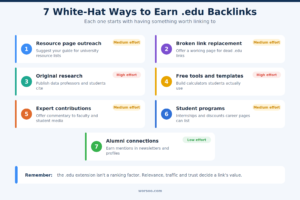
There is no guaranteed method for earning a university backlink. Each opportunity depends on whether your content is genuinely useful to that university’s audience.
These are seven practical approaches worth considering.
| Tactic | How it works | Effort |
|---|---|---|
| Resource page outreach | Suggest a useful resource for a relevant university page | Medium |
| Broken-link building | Find an outdated or dead resource and offer a suitable replacement | Medium |
| Original research | Publish data or research that educators and students can reference | High |
| Free tools and templates | Create something useful for students, researchers, or faculty | High |
| Expert contributions | Provide useful expertise for university publications or projects | Medium |
| Student programs | Offer legitimate internships, educational programs, or resources | Medium |
| Alumni relationships | Use genuine alumni connections when relevant | Low |
Let’s look at each method in more detail.
1. Find University Resource Pages
Many universities maintain resource pages for students, faculty, researchers, and the public.
If you have a genuinely useful guide that fits one of these pages, you can contact the person responsible for the resource list.
For example, imagine you have created an in-depth guide about personal finance for college students.
You could look for university pages related to:
- Student financial resources
- Financial literacy
- Personal finance education
- Student support
- Business education
- Economics resources
- Career planning
The important part is relevance.
Do not email a university simply because its domain ends in .edu. Find a specific page where your resource would actually help its readers.
A simple outreach message can explain what your resource covers and why it may be useful to the university’s audience.
2. Use Broken-Link Building
Broken-link building involves finding an outdated or unavailable resource on a relevant page and suggesting a useful replacement.
For example, suppose a university department has a resource page containing a link to an article that no longer exists.
You could:
- Find the broken link.
- Check what the original resource was about.
- Create or identify a useful replacement on your own website.
- Contact the person responsible for the page.
- Explain that one of their resources is no longer available.
- Suggest your page only if it is a genuine replacement.
This approach works best when your page actually solves the problem created by the broken link.
Ahrefs’ research has found that a large share of links eventually become dead, showing why link maintenance and broken-link opportunities can be useful areas to investigate.
However, do not create a poor-quality page simply to replace a broken link. The replacement should be useful on its own.
3. Publish Original Research
Original research can give universities a strong reason to reference your website.
Instead of writing another general article that already exists on hundreds of websites, collect and publish your own data.
Examples include:
- Industry surveys
- Original statistics
- Consumer research
- Market analysis
- Educational surveys
- Case studies
- Data visualizations
- Original experiments
For example, a website covering technology could conduct a survey of small businesses about their cybersecurity practices and publish the results.
Researchers, students, journalists, and industry websites may then have a reason to reference the data.
The key is originality. Your research should provide information that other websites cannot simply copy from an existing article.
4. Create Free Tools and Templates
Useful tools can attract links because they solve a specific problem.
Depending on your niche, you could create:
- Calculators
- Checklists
- Worksheets
- Templates
- Planning tools
- Study resources
- Research spreadsheets
- Industry comparison tools
For example, an education website could create a free study-planning template.
A business website could create a break-even calculator.
A finance website could create a budgeting worksheet.
The tool does not need to be complicated. It needs to be useful.
If the resource genuinely helps students or educators, university websites may have a legitimate reason to reference it.
5. Offer Expert Contributions
Universities sometimes publish interviews, expert commentary, educational material, research announcements, newsletters, and other content.
If you have genuine expertise in a relevant field, you can look for opportunities to contribute useful information.
Possible opportunities include:
- Expert interviews
- Faculty discussions
- Educational webinars
- Industry commentary
- Research collaboration
- Student events
- Educational articles
The important distinction is that you should be offering real expertise, not using a university connection simply as a way to obtain a backlink.
A backlink should be a natural result of the contribution rather than the only reason for participating.
6. Build Legitimate Student Programs
Businesses can sometimes earn university mentions by providing something genuinely useful to students.
Examples include:
- Internships
- Scholarships run through legitimate programs
- Student discounts
- Career resources
- Educational workshops
- Training programs
- Student competitions
- Research opportunities
The program needs to be real and useful.
Do not create a fake scholarship or student program solely to obtain a backlink. Google specifically warns against link schemes designed to manipulate Search rankings.
The goal should be to create a real relationship with the university or its students. Any backlink should be secondary.
7. Use Genuine Alumni Connections
If you or someone on your team is an alumnus of a university, there may be legitimate opportunities to contribute to alumni publications, newsletters, events, interviews, or other university resources.
For example, a university might feature alumni who have started businesses, published research, entered a particular industry, or contributed to their community.
This is much stronger than sending mass emails to hundreds of universities.
A genuine relationship gives you a reason to reach out.
Just make sure the connection is real and that the resulting mention or link is editorially appropriate.
How to Find .Edu Backlink Opportunities
Finding the right opportunities is often more important than sending hundreds of emails.
Start by searching for university pages related to your topic.
You can use searches such as:
site:.edu "resources" "your topic"site:.edu "useful resources" "your topic"site:.edu "student resources" "your topic"site:.edu "library" "your topic"site:.edu "research" "your topic"site:.edu "recommended resources" "your topic"
Replace “your topic” with the subject of your website or resource.
For example, if your website publishes cybersecurity content, you might search for university pages related to:
cybersecurity resources
cybersecurity research
student cybersecurity resources
information security resources
Then review each page manually.
Look for:
- Relevant topics
- Active pages
- Real editorial content
- Useful resource lists
- Broken or outdated references
- Pages maintained by departments or libraries
- Opportunities where your content genuinely adds value
Do not build a prospect list based only on domain authority or the .edu extension.
What to Avoid When Building .Edu Links
Some .edu link-building tactics are repeatedly promoted online but can create low-quality links or violate Google’s guidelines.
Buying .Edu Links
Buying links specifically to manipulate rankings is against Google’s spam policies. Google lists buying or selling links for ranking purposes as an example of link spam.
If someone promises hundreds of .edu links for a fixed price, investigate where those links will actually come from.
Fake Scholarship Campaigns
Creating a scholarship primarily to obtain university backlinks is not a good link-building strategy.
If you genuinely want to support students, create a legitimate program with clear requirements and real value.
Student Profile Spam
Creating accounts or profiles on university websites just to place links is unlikely to provide meaningful value.
A profile should exist for a genuine reason, not simply to create a backlink.
Blog Comment Spam
Leaving comments containing links on university websites is another poor strategy.
Comments should contribute to the discussion rather than exist primarily for SEO.
Mass Outreach
Sending the same generic message to hundreds of professors and university departments is unlikely to produce strong results.
A relevant, personalized message is more useful than a large volume of generic emails.
How to Evaluate an .Edu Backlink Opportunity
Before spending time pursuing a link, evaluate the actual page.
| Check | What to look for |
|---|---|
| Relevance | The page is closely related to your topic |
| Page quality | The page provides useful information |
| Editorial context | Your link would make sense within the content |
| Real audience | The page appears intended for students, faculty, researchers, or the public |
| Indexability | The page is accessible to search engines |
| Outbound links | The page is not simply a huge collection of unrelated links |
| Traffic | The page or website has signs of genuine audience activity |
| Link purpose | The link helps users rather than existing only for SEO |
Do not judge the opportunity by domain extension alone.
A relevant university library page can be a useful opportunity. But a random, abandoned profile page on the same university domain may not be.
What About Nofollow .Edu Links?
Not every useful link needs to be followed.
A relevant nofollow link can still send referral traffic and help people discover your content.
Google also provides different ways for site owners to qualify links, including nofollow, ugc, and sponsored, depending on the relationship between the linking site and the destination.
So do not reject an otherwise useful university opportunity simply because the link is nofollow.
The primary question should be:
Does this link make sense for the audience?
If the answer is yes, the link can still have value beyond a direct ranking signal.
How to Get Backlinks From High-Authority Websites
The same principle applies beyond universities.
If you want backlinks from respected publications, organizations, industry websites, or other authoritative sources, create something those websites have a reason to reference.
Good linkable assets include:
- Original research
- Industry statistics
- Expert analysis
- Unique case studies
- Useful tools
- Original datasets
- Detailed guides
- Visual resources
Google’s guidance recommends creating unique and compelling content that people want to link to naturally.
Instead of asking:
“How can I get a link from this website?”
Ask:
“What can I create that would make this website want to reference me?”
That change in approach can make your link-building strategy much more sustainable.
How to Get More Links to Your Website
Getting one good backlink is useful, but building a consistent link acquisition process is more valuable.
A simple system looks like this:
1. Create something worth linking to
Start with a useful resource, research project, tool, guide, or dataset.
2. Find relevant websites
Build a prospect list based on topic and audience rather than domain metrics alone.
3. Check the actual page
Make sure your resource genuinely fits the page before contacting the website owner.
4. Personalize your outreach
Explain why your resource could help their readers.
5. Follow up politely
If you do not receive a response, one follow-up is usually enough.
6. Track your results
Record which resources earn links and which outreach methods generate responses.
7. Keep your best resources updated
A resource that remains accurate and useful has a better chance of earning references over time.
Do .Edu Backlinks Still Matter for SEO?
The important point is not that a backlink comes from a .edu domain.
Google’s own documentation says the top-level domain itself does not determine a site’s performance in Search.
A university backlink can still be useful when it comes from a relevant page and exists because the content genuinely helps that page’s audience.
In other words:
Relevant + useful + legitimate is more important than .edu.
That is also why chasing hundreds of university links is usually less useful than building a small number of genuine relationships and creating resources worth referencing.
Do Backlinks Matter for AI Search?
Search is increasingly including AI-generated experiences such as Google’s AI Overviews and AI Mode.
However, Google says there are no additional SEO requirements or special optimizations needed for these features. The same foundational SEO practices remain important, including creating helpful content, making pages crawlable, using internal links, and providing a good page experience.
That means there is no need to create a special “.edu backlink strategy” just for AI search.
Focus on the same fundamentals:
- Publish useful content
- Provide original information
- Earn relevant references
- Keep important pages accessible to search engines
- Build a clear internal linking structure
- Keep content accurate and updated
Final Thoughts
So, how do you get .edu backlinks?
You do not need to chase every website with a .edu domain.
Instead, create something that a university would genuinely want to recommend. That could be original research, a useful guide, a free tool, a student resource, or another piece of content that solves a real problem.
Then find the university pages where that resource belongs.
The best opportunities are usually based on relevance and usefulness, not the domain extension alone.
A legitimate university resource page that naturally references your content can be much more meaningful than a collection of random .edu profile, comment, or directory links.
Most importantly, do not build your strategy around shortcuts. Google’s spam policies specifically address manipulative link-building practices, including buying or selling links for ranking purposes.
Build useful resources, find the right audiences, and earn links because your content deserves to be referenced.
That’s the sustainable way to approach .edu link building.
1 comment on “How to Get .Edu Backlinks: 7 White-Hat Tactics That Actually Work”