

Every day, people use Google to find answers, discover businesses, compare products, learn new skills, and solve problems.
A person types a search query, clicks a result, and gets an answer within seconds. Although the process looks simple from the user’s side, Google performs many complex steps before showing those results.
Understanding how Google Search works is important for website owners, marketers, and anyone learning SEO. When you understand how Google discovers, understands, and ranks content, you can create websites that are easier for search engines and users to understand.
Google Search is not a simple list of websites. It is a system that analyzes billions of pages, understands user questions, and tries to provide the most useful results.
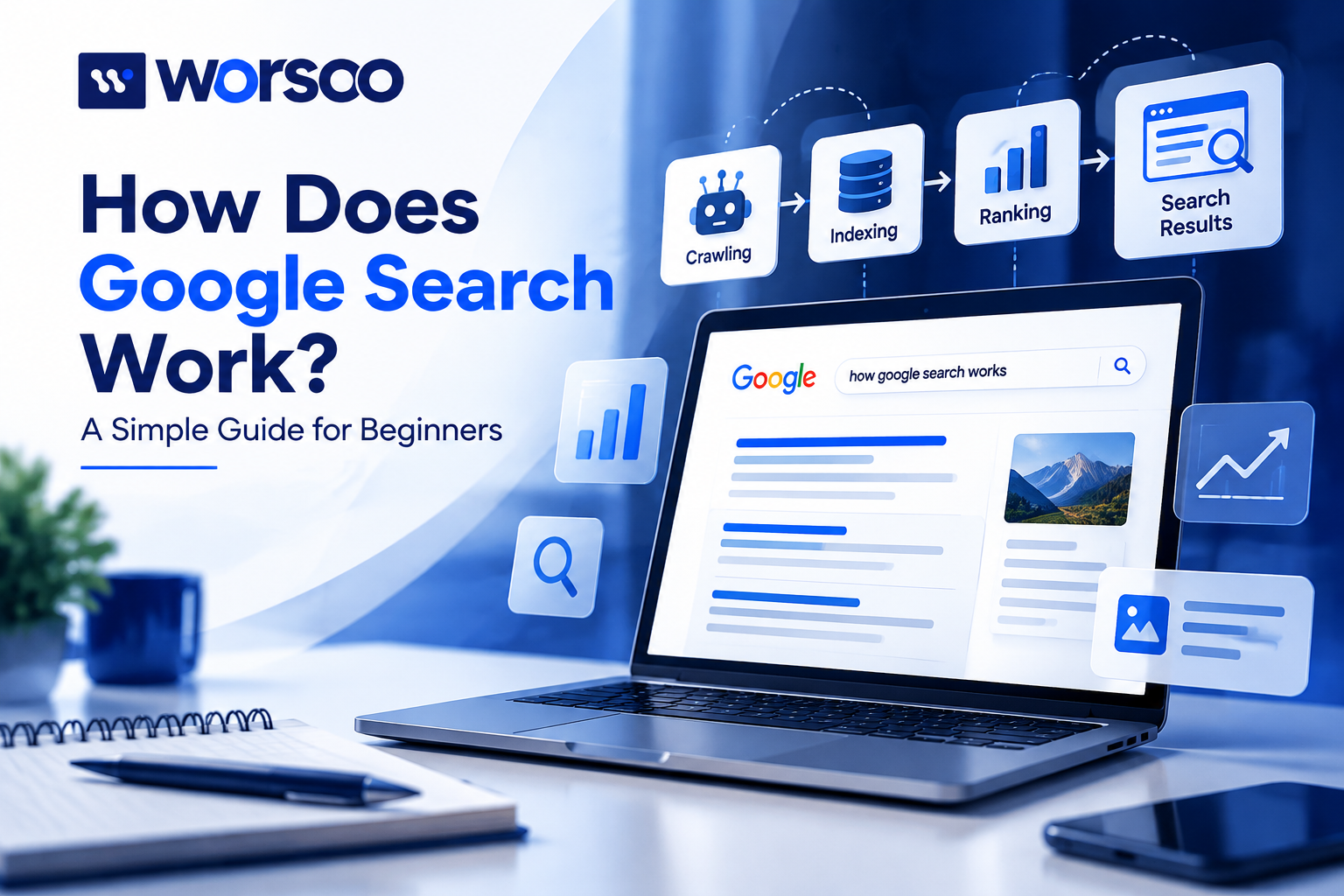
In simple terms, Google Search works through three main stages:
- Crawling
- Indexing
- Ranking
Let’s understand each step.
Quick Answer: How Does Google Search Work?
Google Search works by discovering web pages, analyzing their information, storing useful pages in its index, and ranking those pages when someone searches for information.
The process looks like this:
Website → Crawling → Indexing → Search Query → Ranking → Search Results
When a user searches something on Google:
- Google understands the meaning behind the search
- Finds relevant pages from its index
- Evaluates different ranking signals
- Shows the results that are most useful for that search
SEO helps websites improve their chances of appearing in these search results.
What Happens When You Search on Google?
Many beginners think Google searches the entire internet every time someone types a query.
That is not how it works.
Google already has a huge database of discovered and processed web pages called an index.
When someone searches:
“how to improve website speed”
Google does not start looking at every website from zero.
Instead, it searches through its existing index and selects pages that match the user’s needs.
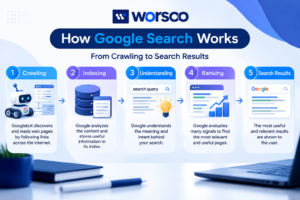
A simplified process:
| Step | What Happens |
|---|---|
| 1 | Google discovers website pages |
| 2 | Google analyzes and stores information |
| 3 | User enters a search query |
| 4 | Google understands search intent |
| 5 | Google selects relevant pages |
| 6 | Results are displayed |
What Is Crawling in Google Search?
Crawling is the first step of how Google discovers websites.
Google uses automated programs called crawlers or bots to find and read web pages.
These crawlers move through the web by following links from one page to another.
For example:
A website publishes a new article:
example.com/seo-guide/If another page links to this article, Google’s crawler may discover the new URL while visiting that page.
Google can discover pages through:
- Internal links
- External links
- XML sitemaps
- Previously discovered URLs
- Website updates
Crawling helps Google find new content and understand what pages exist on a website.
What Is Googlebot?
Googlebot is the crawler used by Google to discover web pages.
Its job is to:
- Visit websites
- Read page content
- Follow links
- Collect information
- Send data for processing
For SEO, making your website easy for Googlebot to crawl is important.
A website may have great content, but if search engines cannot access it properly, it may struggle to appear in search results.
What Can Prevent Google From Crawling a Website?
Several technical issues can stop Google from discovering pages.
Common problems include:
| Problem | Impact |
|---|---|
| Blocked robots.txt file | Google may not access pages |
| Broken links | Pages become difficult to discover |
| Server errors | Crawling problems |
| Poor website structure | Important pages may be hidden |
| Incorrect redirects | Search engines may struggle to reach content |
Technical SEO helps identify and fix these issues.
What Is Indexing in Google Search?
After crawling a page, Google decides whether it should store information about that page in its index.
This process is called indexing.
Think of Google’s index like a massive library.
A library does not randomly place every book everywhere. It organizes information so people can quickly find what they need.
Google does something similar with websites.
During indexing, Google analyzes things such as:
- Page content
- Keywords
- Images
- Videos
- Website structure
- Links
- Page relationships
A page that is indexed has the possibility of appearing in search results.
However, indexing does not guarantee high rankings.
Crawling vs Indexing: What Is The Difference?
Many beginners confuse crawling and indexing.
Here is the simple difference:
| Crawling | Indexing |
|---|---|
| Google discovers a page | Google stores information about a page |
| Happens through bots | Happens after analysis |
| Finds URLs | Understands content |
| First step | Second step |
Example:
Google discovers your new blog post.
That is crawling.
Google understands the topic and stores it.
That is indexing.
Is Every Website Page Indexed by Google?
No.
A website can have pages that Google crawls but does not index.
Common reasons include:
- Low-quality content
- Duplicate pages
- Technical problems
- Poor website structure
- Pages with little value
Creating content is not enough.
The content needs to provide useful information and clearly satisfy what users are searching for.
How Does Google Understand Search Queries?
When someone searches on Google, the search engine tries to understand the meaning behind the words.
For example:
Search:
“best running shoes”
Google understands that the user may want:
- Product recommendations
- Reviews
- Comparisons
- Buying advice
Search:
“what are running shoes”
Google understands that the user wants an explanation.
The words are similar, but the purpose is different.
This is called search intent.
What Is Search Intent?
Search intent is the reason behind a search.
There are four common types:
| Search Intent | Example |
|---|---|
| Informational | What is SEO? |
| Navigational | Facebook login |
| Commercial | Best SEO tools |
| Transactional | Buy SEO software |
A successful SEO strategy creates content that matches search intent.
If someone wants information, a product page may not satisfy them.
If someone wants to buy something, a basic educational article may not be enough.
How Does Google Rank Websites?
After crawling and indexing, the next important step is ranking.
Ranking means deciding which pages should appear first when someone searches for something.
For example, if someone searches:
“best SEO tools for beginners”
Google may find thousands or millions of pages related to that topic.
The ranking system decides:
- Which pages are most useful
- Which pages answer the question better
- Which websites are trustworthy
- Which results provide the best experience
Google does not rank pages randomly. It analyzes many signals to determine which results are most relevant.
Important Factors That Influence Google Rankings
Google uses many different signals when ranking websites.
No single factor guarantees a top position.
A successful SEO strategy focuses on improving multiple areas together.
1. Content Relevance
The first question Google tries to answer is:
Does this page actually solve the user’s problem?
A page should clearly explain the topic and provide useful information.
For example:
Someone searches:
“how to start SEO”
A helpful article should cover:
- SEO basics
- Keyword research
- Website optimization
- Content creation
- Link building
A page that only explains one small part may not fully satisfy the search.
2. Content Quality
High-quality content is one of the most important parts of SEO.
Good content should:
- Answer user questions
- Provide accurate information
- Be easy to understand
- Include useful examples
- Show expertise
- Provide real value
Search engines want users to find helpful answers, not pages created only to attract clicks.
A longer article is not automatically better.
A 1,000-word article that solves a problem can perform better than a 3,000-word article filled with unnecessary information.
3. Search Experience
Google wants users to have a positive experience after clicking a result.
Important website experience factors include:
| Factor | Why It Matters |
|---|---|
| Page speed | Users prefer fast websites |
| Mobile usability | Most searches happen on mobile devices |
| Easy navigation | Helps visitors find information |
| Clear design | Improves readability |
| Security | Builds user trust |
A website that is difficult to use can lose visitors quickly.
4. Website Authority
Authority refers to how trustworthy and recognized a website is within a topic.
Search engines use different signals to understand authority.
Examples include:
- Quality backlinks
- Brand mentions
- Expert content
- Industry reputation
A new website can build authority by consistently publishing useful content and earning mentions from relevant sources.
How Do Links Affect Google Search?
Links are an important part of how search engines understand the web.
A link from one website to another can act like a recommendation.
For example:
A marketing website links to your SEO guide.
This tells search engines:
“This page may contain useful information about SEO.”
However, not all links have equal value.
A quality backlink usually comes from:
- Relevant websites
- Trusted sources
- Pages related to your topic
- Real editorial mentions
A large number of low-quality links does not create the same value as a few strong, relevant links.
Internal Links and Google Search
Many website owners focus only on external backlinks and ignore internal links.
Internal links connect pages within the same website.
Example:
Your article:
What Is SEO?
can link to:
- SEO audit guide
- Keyword research article
- Backlink guide
Internal links help:
- Users discover more content
- Search engines understand website structure
- Important pages receive more visibility
A well-organized website makes it easier for Google to understand the relationship between different topics.
Why Does Fresh Content Matter?
Some searches need updated information.
For example:
Search:
latest SEO updates
requires fresh content.
Search:
what is SEO
may not change as frequently.
Updating content helps websites:
- Maintain accuracy
- Improve outdated sections
- Add new information
- Improve user experience
Regular updates are especially important for industries that change quickly, including SEO, technology, and digital marketing.
What Are Google Search Features?
Google results are not limited to traditional website listings.
Depending on the search, users may see different features.
Examples include:
| Search Feature | Purpose |
|---|---|
| Featured snippets | Quick answers |
| People Also Ask | Related questions |
| Images | Visual results |
| Videos | Video content |
| Local results | Nearby businesses |
| Shopping results | Product information |
SEO today is about improving visibility across different search experiences.
How Does SEO Help Google Understand Your Website?
SEO improves communication between your website and search engines.
Without SEO, Google may struggle to understand:
- What your page is about
- Which searches it matches
- Which users should see it
SEO helps through:
Clear Website Structure
A logical structure makes navigation easier.
Example:
Website:
SEO Guide
→ Keyword Research
→ Content SEO
→ Technical SEO
→ Link Building
This organization helps search engines understand your expertise.
Optimized Titles and Headings
Titles and headings tell users and search engines what a page covers.
Example:
Weak title:
“Important Information About Websites”
Better title:
“What Is SEO? Complete Beginner Guide”
The second title clearly explains the topic.
Helpful Content
Content should answer real questions.
Instead of writing only for search engines, focus on helping readers.
Ask:
- Does this answer the user’s question?
- Does it explain the topic clearly?
- Does it provide useful examples?
Common Mistakes That Prevent Websites From Ranking
Many websites struggle because of avoidable SEO mistakes.
1. Creating Content Without Research
Publishing articles without understanding what people search for can waste time.
Before creating content, understand:
- Keyword demand
- Search intent
- Competition
- User questions
2. Keyword Stuffing
Some websites repeat keywords unnaturally.
Example:
“SEO services help SEO because SEO improves SEO rankings.”
This creates a poor reading experience.
Modern SEO focuses on meaning, not repetition.
3. Ignoring Technical Problems
A website can have excellent content but still struggle because of:
- Slow speed
- Broken pages
- Poor mobile experience
- Indexing issues
Technical SEO creates a strong foundation.
4. Publishing Low-Value Content
Publishing many weak articles does not automatically improve rankings.
Focus on creating fewer but better resources.
Quality, usefulness, and expertise matter more than quantity.
How Long Does It Take Google To Rank a Website?
There is no fixed timeline.
Ranking depends on:
- Website authority
- Competition
- Content quality
- SEO strategy
- Website history
A new website may take longer because it needs to build trust and visibility.
A website with existing authority may see improvements faster.
SEO is a long-term investment, not an instant solution.
How Businesses Can Use Google Search To Grow
For businesses, Google Search is more than a traffic source.
It can help generate:
- Brand awareness
- Customer inquiries
- Leads
- Sales opportunities
A business that appears when customers are searching has a better chance of being chosen.
For example:
A person searching:
“SEO company near me”
already has interest in SEO services.
Appearing at that moment creates a valuable opportunity.
How Worsoo Approaches SEO
At Worsoo, we focus on building websites that search engines and users both understand.
A strong SEO strategy combines:
- Keyword research
- Technical optimization
- Content development
- Internal linking
- Authority building
- Performance improvement
SEO is not about chasing short-term tricks.
It is about creating a website that provides value, earns trust, and grows consistently.
Frequently Asked Questions About Google Search
How does Google Search work in simple words?
Google discovers websites, analyzes their content, stores useful information, and shows the most relevant pages when users search.
What is the Google Search algorithm?
The Google Search algorithm is a collection of systems that help Google understand searches and decide which pages should appear in results.
Does Google search every website when I search?
No. Google uses its existing index of discovered pages to find relevant results.
Does indexing guarantee rankings?
No. A page can be indexed but still rank poorly if it does not provide enough value or relevance.
How can I help Google find my website?
You can help Google by:
- Creating quality content
- Using internal links
- Submitting a sitemap
- Fixing technical SEO problems
- Building a clear website structure
Why is my website not showing on Google?
Common reasons include:
- Website is new
- Pages are not indexed
- Technical issues exist
- Content does not match search intent
- Competition is high
Final Thoughts
Understanding how Google Search works is the foundation of successful SEO.
Google follows a simple purpose:
Help users find the most useful and relevant information.
The process starts with crawling websites, continues with indexing pages, and ends with ranking the best results for each search.
For website owners, the lesson is simple:
Create helpful content. Build a technically healthy website. Organize your information clearly. Focus on your audience.
SEO is not about finding shortcuts.
It is about creating a website that deserves to rank.
If you want to understand how your website performs in Google Search, Worsoo can help you identify SEO opportunities and create a strategy for long-term organic growth.
Get a free SEO audit from Worsoo and discover how your website can improve its search visibility.