

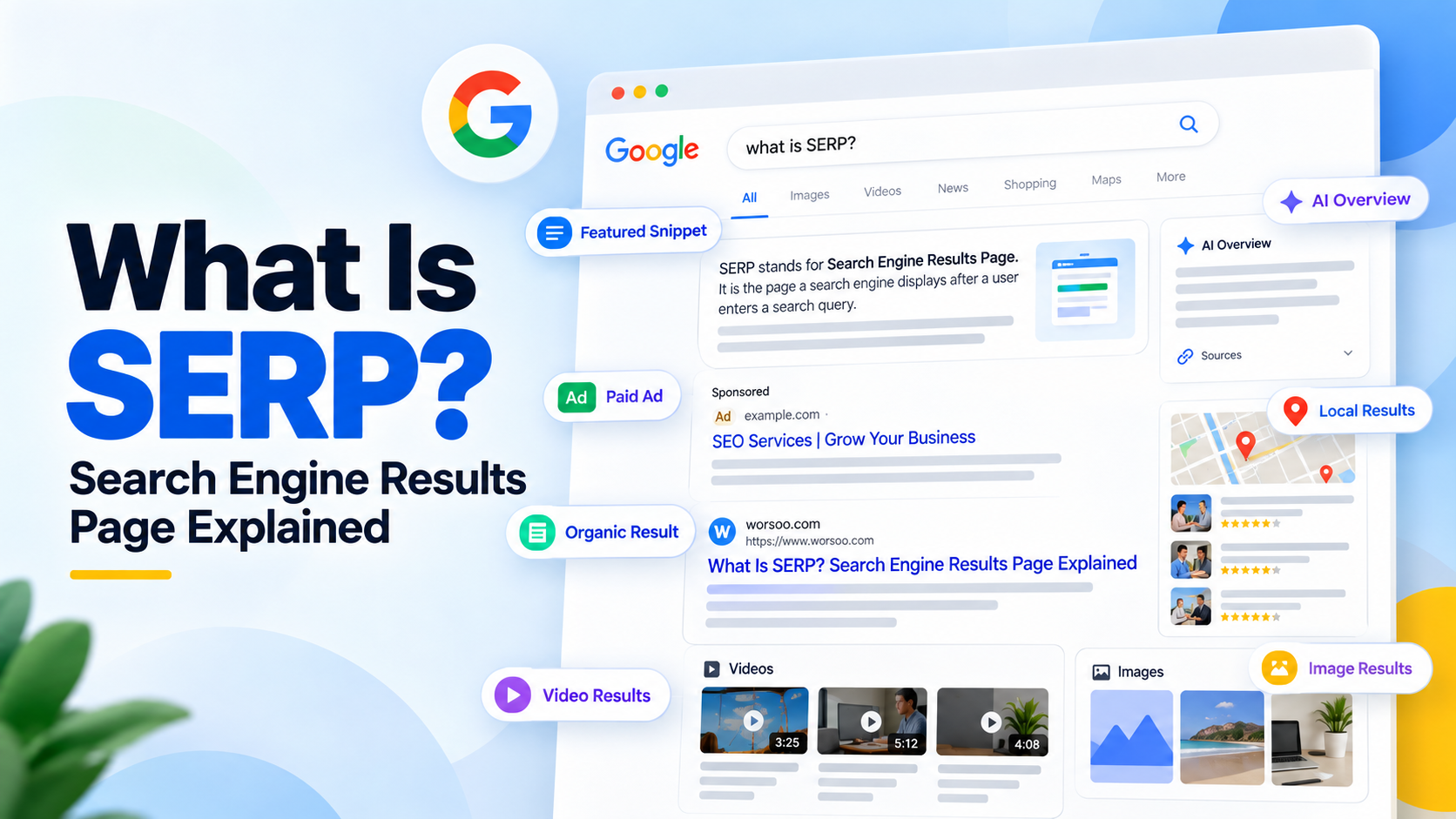
Search for anything on Google, whether it is a question, product, service, business, or nearby restaurant, and Google shows you a page filled with possible answers.
That page is called a SERP.
SERP stands for Search Engine Results Page. It is the page a search engine displays after a user enters a search query.
A SERP can include traditional website listings, advertisements, images, videos, maps, featured snippets, local businesses, shopping results, and AI-powered search experiences.
For businesses, SERPs matter because this is where potential customers discover websites, compare options, look for answers, and often decide which company to trust.
In this guide, you will learn what SERP means, how Google search results work, the most common SERP features, how SERP analysis supports SEO, and how businesses can improve their search visibility.
What Does SERP Mean?
SERP means Search Engine Results Page.
It is the results page displayed after someone enters a search query into a search engine such as Google.
For example, if you search:
“best SEO agency for small business”
Google may show:
- Organic website results
- Sponsored advertisements
- AI-generated answers
- Business listings
- Videos
- Images
- Related searches
- Other search features
All of these elements together make up the search engine results page.
SERP Definition
A SERP is the page generated by a search engine in response to a user’s search query.
Modern SERPs are no longer limited to ten blue website links.
Search engines can display different formats depending on what they believe will help the user answer their query quickly and accurately.
Why Are SERPs Important for SEO?
SERPs are important because this is where the results of your SEO efforts become visible.
You can improve your website, publish useful content, optimize pages, build backlinks, strengthen technical SEO, and improve your site structure, but your main goal is still to become visible when your target audience searches.
That visibility happens on the search engine results page.
Better SERP visibility can help a business generate:
- Organic website traffic
- Brand awareness
- Qualified leads
- Phone calls
- Sales
- Local inquiries
- Newsletter signups
- Service bookings
However, ranking position is only part of the picture.
Modern Google results include many different search features.
Your website may gain visibility through a standard organic result, image result, video result, local listing, featured answer, or a supporting link within an AI-powered search experience.
That is why modern SEO should focus on overall search visibility, not just one ranking position.
What Does a Google SERP Look Like?
There is no single Google SERP layout.
The results can change depending on the search.
For example, search for:
“what is SEO?”
and Google will likely show informational content.
Search for:
“SEO agency near me”
and local businesses and maps may become more important.
Search for:
“buy running shoes”
and product-focused results may appear.
Search for:
“how to tie a tie”
and videos may receive greater visibility.
The important lesson is simple:
Google tries to match the search results with the user’s search intent.
That is why understanding search intent should come before creating SEO content.
What Are SERP Features?
SERP features are special elements that appear on a search engine results page in addition to standard organic website listings.
They help users find information faster and interact with search results in different ways.
Some of the most common SERP features include organic results, advertisements, featured snippets, images, videos, local listings, sitelinks, rich results, and AI-powered search experiences.
Let’s look at them in more detail.
1. Organic Search Results
Organic search results are unpaid website listings.
Google displays these pages because its search systems consider them relevant and useful for the user’s query.
A standard organic result can include:
- Website name
- Page URL
- Clickable title
- Search snippet
For most businesses, earning strong organic visibility is one of the main goals of SEO.
Unlike advertising, businesses cannot simply pay Google for a higher organic ranking.
They need to earn visibility by improving their website’s relevance, usefulness, authority, technical accessibility, and overall user experience.
2. Paid Search Ads
Paid search results are advertisements that can appear on Google SERPs.
Businesses can use platforms such as Google Ads to pay for visibility on selected searches.
Paid search and SEO are different strategies.
With paid advertising, businesses pay for exposure.
With SEO, businesses work to earn organic visibility over time.
Both can appear on the same search engine results page.
For many companies, SEO and paid search can support each other, but they should not be confused.
3. Featured Snippets
A featured snippet is a short answer that Google may display prominently for certain searches.
It can appear as:
- A short paragraph
- A list
- A table
- Another concise answer format
For example, someone searching:
“What does SERP stand for?”
may receive a direct answer explaining that SERP stands for Search Engine Results Page.
This is why clear and direct answers are useful in modern content.
Instead of hiding a simple answer beneath several paragraphs, answer the main question first and then provide more detail.
That approach is good for readers and can also make your content easier for search and answer systems to understand.
4. AI Overviews and AI Search Experiences
Search engines are increasingly using generative AI to answer complex questions.
Google can display AI-generated summaries for some searches and provide links to relevant websites as supporting sources.
This means SEO is no longer only about competing for a traditional blue-link position.
Useful, accurate, and well-structured content may also gain visibility as a supporting source within AI-powered search experiences.
However, AI search does not eliminate the need for traditional SEO.
Strong fundamentals still matter.
Websites should focus on:
- Helpful content
- Clear site structure
- Crawlable pages
- Original information
- Strong topical relevance
- Accurate facts
- Good user experience
- Logical internal links
- Clear entities and relationships
AEO and GEO should support good SEO, not replace it.
5. Image Results
Google may show images when visual information can help answer the query.
Image-heavy SERPs are common for topics such as:
- Fashion
- Food
- Interior design
- Travel
- Landscaping
- Products
- Tutorials
- Infographics
This gives website owners another opportunity to gain organic visibility.
Good image SEO includes:
- Descriptive file names
- Useful alt text
- Relevant surrounding content
- High-quality images
- Fast-loading image formats
Avoid forcing keywords into image alt text.
Describe the image naturally and accurately.
6. Video Results
Videos can appear when Google believes video content will help answer the query.
Tutorial searches are a good example.
Someone searching:
“how to install WordPress”
may find a visual demonstration more useful than text alone.
If video results repeatedly appear for your target keyword, that is an important SERP signal.
It may mean that adding a useful video to your article could improve the user experience and increase your chances of gaining additional search visibility.
7. Local Search Results
Searches with local intent can produce maps and local business listings.
Examples include:
- SEO company near me
- dentist near me
- plumber in London
- digital marketing agency near me
- restaurant in Manchester
Local results may contain information such as:
- Business name
- Customer reviews
- Address
- Opening hours
- Phone number
- Website
- Directions
For local service businesses, ranking a normal website page may not be enough.
Local SEO, accurate business information, customer reviews, relevant service pages, and a well-optimized Google Business Profile can all play an important role.
8. Sitelinks
Sitelinks are additional links that can appear below a website’s main search listing.
They may direct users to important sections such as:
- Services
- About Us
- Contact
- Blog
- Pricing
- Important categories
Sitelinks make it easier for searchers to navigate directly to useful sections of a website.
A clear website structure, descriptive page titles, logical navigation, and strong internal linking can help search engines understand the relationship between your pages.
9. Rich Results
Some search listings contain additional information beyond a normal title and description.
These enhanced search appearances are often known as rich results.
Depending on the content type, structured data may help search engines understand information such as:
- Articles
- Products
- Events
- Videos
- Breadcrumbs
- Local businesses
Structured data can improve search engines’ understanding of a page.
However, adding schema markup does not guarantee higher rankings or a special search appearance.
It should accurately describe what is already visible on the page.
SERP vs SEO: What Is the Difference?
SERP and SEO are closely related, but they do not mean the same thing.
SERP stands for Search Engine Results Page.
SEO stands for Search Engine Optimization.
SEO is the process of improving a website’s ability to compete for organic search visibility.
The SERP is where that visibility appears.
An easy way to remember the difference is:
SEO is the work. The SERP is where you see the results.
SEO activities can include:
- Keyword research
- Search intent analysis
- On-page SEO
- Technical SEO
- Content creation
- Internal linking
- Link building
- Competitor research
- Website optimization
Together, these activities can improve a website’s ability to compete for relevant searches.
What Is SERP Analysis?
SERP analysis is the process of studying the existing search results for a keyword before creating or optimizing content.
It is one of the most useful steps in keyword research.
Imagine you want to target the keyword:
“SEO audit”
A keyword research tool may tell you the search volume and keyword difficulty.
That information is useful, but it does not tell you everything.
Search the keyword on Google.
Then look at the results.
Ask:
- Are service pages ranking?
- Are blog posts ranking?
- Are SEO tools ranking?
- Are videos appearing?
- Is there an AI-generated answer?
- Is the search intent informational or commercial?
- Which brands dominate the results?
- What problems are users trying to solve?
Now you understand the keyword more clearly.
Keyword tools give you numbers.
SERP analysis gives you context.
How to Analyze a SERP for SEO
SERP analysis does not need to be complicated.
Follow these steps.
Step 1: Search Your Primary Keyword
Start with the keyword you want to target.
Study the first page carefully.
Do not only look at the number-one ranking result.
Look at the entire search page.
Step 2: Identify Search Intent
Determine what type of content appears most often.
Search intent generally falls into several categories.
Informational Intent
The user wants to learn something.
Example:
“what is SERP”
Commercial Intent
The user is researching before making a decision.
Example:
“best SEO agencies”
Transactional Intent
The user is ready to take action.
Example:
“hire SEO consultant”
Navigational Intent
The user wants to reach a specific website or brand.
Example:
“Google Search Console login”
Matching the dominant search intent gives your content a much stronger foundation.
Step 3: Check the SERP Features
Look for features such as:
- AI answers
- Featured snippets
- Videos
- Images
- Maps
- Advertisements
- Sitelinks
- Local listings
- Shopping results
These features help you understand how Google is presenting information for that search.
Step 4: Study the Ranking Pages
Open several of the strongest results.
Evaluate:
- Content quality
- Page structure
- Expertise
- Examples
- Visuals
- Sources
- Freshness
- User experience
- Internal links
- Topic coverage
Do not copy competitors.
Your goal is to understand the existing standard and find opportunities to improve on it.
Step 5: Find the Content Gap
Ask yourself:
What could my page explain better than the current results?
Maybe existing pages:
- Use outdated information
- Ignore beginners
- Lack practical examples
- Explain the topic poorly
- Have confusing layouts
- Do not answer common questions
- Provide no original experience
- Repeat generic information
Those weaknesses create opportunities.
Your job is not to publish another version of the same article.
Your job is to provide something more useful.
Why SERP Analysis Matters for Businesses
Many businesses choose keywords based only on search volume.
That can lead to wasted time and money.
Imagine spending weeks creating a service page for a keyword where Google mainly ranks informational blog posts.
Your page and the search intent do not match.
SERP analysis helps businesses understand:
- What searchers expect
- What type of content Google currently displays
- Who the real competitors are
- Which content format makes sense
- Which SERP features matter
- Whether a keyword supports the business goal
That can make an SEO strategy more focused and efficient.
Is Your Website Getting Traffic but Not Enough Leads?
Ranking for the wrong keywords or targeting the wrong search intent can limit your results even when your website receives impressions.
Worsoo provides on-page and off-page SEO services focused on improving search visibility, content relevance, keyword targeting, website authority, and organic growth.
Whether the issue involves content gaps, poor page optimization, technical problems, competitor strength, or weak backlinks, the first step is understanding what is actually limiting your website.
Explore Worsoo’s SEO Services
How Can You Improve Your Visibility in SERPs?
There is no guaranteed shortcut to the number-one position.
Strong search visibility usually comes from improving several areas together.
Create Helpful Content
Create content that completely satisfies the user’s reason for searching.
Do not add unnecessary paragraphs just to increase the word count.
A 3,000-word article is not automatically better than a 1,500-word article.
Write enough to solve the user’s problem.
Then stop.
Demonstrate Real Expertise
Generic information is easy to reproduce.
Content based on genuine expertise is harder to replace.
Where appropriate, add:
- Original examples
- Screenshots
- First-hand observations
- Expert commentary
- Case studies
- Original research
- Real processes
- Useful comparisons
These elements can make your content more useful to readers and more distinctive from generic AI-generated or copied content.
Optimize Titles Naturally
Your page title should clearly explain what the user will find.
For example:
What Is SERP? Search Engine Results Page Explained
is clear and natural.
Avoid titles such as:
What Is SERP | SERP Meaning | SERP SEO | SERP Features | Google SERP
Repeating a keyword several times does not make the page more useful.
It simply makes the title harder to read.
Use a Clear Heading Structure
Organize your content logically.
Use one H1 for the main topic.
Then use H2 and H3 headings to divide related sections.
A clear heading structure helps visitors scan your article and makes topic relationships easier for search systems to understand.
Answer Important Questions Directly
When a heading asks a direct question, answer it immediately.
For example:
What does SERP stand for?
SERP stands for Search Engine Results Page.
Then provide additional context.
Do not hide a simple answer underneath several paragraphs.
Direct answers support readers, featured answers, voice search, answer engines, and AI-powered search systems.
Build Strong Internal Links
Internal links help users discover related pages and help search engines understand your website structure.
This article can naturally link to content about:
- What is SEO?
- How search engines work
- Search intent
- Keyword research
- On-page SEO
- Technical SEO
- Link building
- SEO services
Build topic clusters instead of publishing isolated articles.
Make Important Pages Crawlable
Even excellent content cannot perform well if search engines cannot properly crawl or index it.
Check important technical elements such as:
- Robots.txt
- XML sitemap
- Canonical URLs
- Internal links
- Indexing status
- Server errors
- Redirects
- JavaScript rendering
Google Search Console can help identify many crawling and indexing issues.
Improve Page Experience
Your page should work well for real visitors.
Pay attention to:
- Mobile usability
- Page speed
- Readable typography
- Navigation
- Intrusive popups
- Clear CTAs
- Layout stability
Do not optimize a page so aggressively for search engines that it becomes unpleasant for humans.
Search traffic has little value if visitors immediately leave.
SEO, AEO and GEO: How Do They Work Together?
Search is changing, and three terms are now commonly discussed:
SEO: Search Engine Optimization
SEO focuses on improving visibility in traditional organic search results.
AEO: Answer Engine Optimization
AEO focuses on making information clear and easy for systems that provide direct answers to understand.
GEO: Generative Engine Optimization
GEO focuses on making useful website information easier for generative search systems to discover, understand, and potentially reference.
These areas overlap significantly.
For most websites, you do not need three completely separate content strategies.
A strong modern search strategy should:
- Answer questions clearly
- Use logical headings
- Cover topics accurately
- Demonstrate real expertise
- Provide unique value
- Use consistent terminology
- Build clear entity relationships
- Include relevant internal links
- Cite reliable sources when needed
- Maintain strong technical SEO
- Keep pages crawlable and indexable
Good SEO provides much of the foundation needed for AEO and GEO visibility.
What Makes Content Easier for AI and Search Engines to Understand?
Start by making the content easy for humans to understand.
Useful practices include:
- Clear definitions
- Short paragraphs
- Descriptive headings
- Direct answers
- Relevant examples
- Accurate facts
- Consistent terminology
- Logical topic relationships
- Real expertise
- Reliable supporting sources
For example:
What is SERP analysis?
SERP analysis is the process of reviewing search results for a keyword to understand search intent, ranking competitors, content formats, and search features.
That answer is clear without unnecessary wording.
Readers benefit first.
Search and AI systems benefit as a result.
Is AI Search Replacing Traditional SERPs?
AI is changing the way search results are presented, but traditional search remains important.
People still use search engines to:
- Research companies
- Compare services
- Find local businesses
- Visit websites
- Buy products
- Watch videos
- View images
- Read detailed guides
AI-powered search adds another layer to the search experience.
It does not remove the need for trustworthy websites and useful content.
AI systems also depend on information published across the web.
For businesses, the best strategy is therefore to improve overall search visibility instead of focusing on only one search format.
Do You Need to Rank Number One to Get Results?
No.
Higher rankings can certainly increase visibility, but modern search provides several ways to appear in front of users.
A business may gain exposure through:
- Standard organic results
- Local search results
- Image results
- Video results
- Featured answers
- Branded searches
- AI-generated results
- Supporting citations
Instead of focusing only on position one, aim to become a trustworthy source wherever your audience is searching.
That is a more sustainable long-term strategy.
Frequently Asked Questions
What is SERP in simple words?
A SERP is the page a search engine shows after someone performs a search. SERP stands for Search Engine Results Page.
What does SERP stand for?
SERP stands for Search Engine Results Page.
What is SERP in SEO?
In SEO, a SERP is the search results page where websites compete for organic visibility. SEO professionals analyze SERPs to understand search intent, ranking competitors, content formats, and available search features.
What are SERP features?
SERP features are special elements that appear within search results. Examples include featured snippets, images, videos, local listings, advertisements, sitelinks, rich results, and AI-powered search experiences.
What is SERP analysis?
SERP analysis is the process of studying current search results for a target keyword to understand search intent, competitors, content formats, and ranking opportunities.
Why is SERP analysis important?
SERP analysis helps you understand what users expect and what type of content currently performs for a keyword. It can prevent you from creating content that does not match search intent.
Is SERP ranking the same as SEO?
No. SEO is the process used to improve organic search visibility. A SERP is the page where search results appear.
Can SEO guarantee a number-one Google ranking?
No reputable SEO professional can guarantee a specific organic Google ranking. SEO improves a website’s ability to compete by strengthening relevance, content quality, technical performance, authority, and user experience.
Final Thoughts
SERP stands for Search Engine Results Page.
It is the page a search engine displays after someone enters a query.
Modern SERPs can contain much more than traditional website links. They may include organic results, paid ads, images, videos, local businesses, featured answers, sitelinks, rich results, and AI-powered search experiences.
For website owners and businesses, understanding SERPs is important because they reveal what users are looking for and how search engines are presenting information for a particular query.
Do not choose a keyword and start creating content blindly.
Study the SERP.
Understand the search intent.
Analyze competing pages.
Identify content gaps.
Then build a page that genuinely helps the user better.
That approach creates a stronger foundation for SEO, AEO, GEO, and long-term organic search visibility.
Want to Improve Your Website’s Search Visibility?
If your website is not attracting enough qualified organic traffic, the problem could involve keyword targeting, content quality, search intent, technical SEO, website structure, internal linking, or backlinks.
Worsoo helps businesses identify SEO weaknesses and build practical strategies focused on sustainable organic growth.
Whether you need better rankings, stronger content, improved on-page SEO, off-page authority, or a clearer search strategy, we can help you understand what your website actually needs.
Get an SEO Consultation With Worsoo
No unrealistic ranking promises. No one-size-fits-all SEO packages. Start with the problems that are actually limiting your website.