

Every search on Google has a purpose behind it.
When someone searches:
- “what is SEO”
- “best SEO tools”
- “buy SEO software”
- “Worsoo SEO services”
they are not looking for the same type of information.
The words may be different, but the biggest difference is the reason behind the search.
This reason is called search intent.
Search intent is one of the most important concepts in modern SEO because search engines focus on showing results that match what users actually want.
A website can have excellent content, strong backlinks, and good technical SEO, but if the content does not match search intent, ranking becomes difficult.
Understanding search intent helps businesses create better content, attract the right visitors, and improve their chances of appearing in search results.
Quick Answer: What Is Search Intent in SEO?
Search intent in SEO is the reason why a person searches for something on Google. It explains what information, solution, product, or action the user wants when they type a query.
For example:
Search query:
“how to improve website speed”
Intent:
The user wants to learn.
Search query:
“best SEO agency for startups”
Intent:
The user is comparing service providers.
Search query:
“buy SEO software”
Intent:
The user wants to purchase something.
SEO success depends on creating content that matches the user’s goal behind the search.
Why Is Search Intent Important in SEO?
In the past, SEO was heavily focused on keywords.
Many websites tried to rank by placing keywords repeatedly on pages.
Today, search engines understand topics, meanings, and user behavior much better.
Google wants to answer the user’s question, not just match words.
For example:
Someone searches:
“best running shoes for beginners”
A page that only explains:
“What are running shoes?”
may contain similar words, but it does not satisfy the user.
The user wants:
- Recommendations
- Comparisons
- Reviews
- Buying advice
A page that provides these answers has a better chance of ranking.
Search intent helps businesses understand:
| Benefit | How It Helps |
|---|---|
| Better Rankings | Content matches what users need |
| Higher Engagement | Visitors find useful information |
| More Conversions | Visitors are closer to taking action |
| Better Content Planning | Topics are created with purpose |
| Improved User Experience | Users get relevant answers |
How Search Intent Works
When someone enters a query into Google, the search engine tries to understand:
- What does the user want?
- Why did they search this?
- What type of content would help them?
For example:
Keyword:
SEO audit
Possible intentions:
A beginner may want:
“What is an SEO audit?”
A business owner may want:
“SEO audit service pricing”
An SEO professional may want:
“SEO audit checklist”
The same keyword can have different meanings depending on context.
This is why SEO professionals analyze intent before creating content.
The Four Main Types of Search Intent
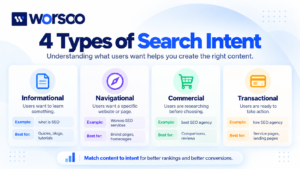
Most searches can be divided into four main categories:
- Informational intent
- Navigational intent
- Commercial intent
- Transactional intent
Understanding these categories helps you create the right type of content.
1. Informational Search Intent
Informational intent happens when users want to learn something.
They are looking for answers, explanations, guides, or tutorials.
Examples:
- what is SEO
- how does Google Search work
- how to find keywords
- what are backlinks
The user is not necessarily ready to buy.
They are researching and learning.
Best Content Types for Informational Intent
| Content Type | Example |
|---|---|
| Blog posts | What is SEO? |
| Guides | Complete keyword research guide |
| Tutorials | How to improve website speed |
| FAQs | Common SEO questions |
For informational keywords, focus on education and providing complete answers.
2. Navigational Search Intent
Navigational intent happens when users want to find a specific website, brand, or page.
Examples:
- Facebook login
- Ahrefs dashboard
- Worsoo SEO services
- Google Search Console
The user already knows what they want.
They are searching for a specific destination.
How Businesses Benefit From Navigational Searches
Strong brand visibility helps businesses appear when people search for them.
Companies should optimize:
- Brand name pages
- About pages
- Service pages
- Google Business Profile
A person searching your brand name is already familiar with your business.
3. Commercial Search Intent
Commercial intent happens when users are researching before making a decision.
They are not ready to buy immediately, but they are considering options.
Examples:
- best SEO agency
- Ahrefs vs Semrush
- best SEO tools for small business
- SEO company reviews
These users often compare:
- Features
- Pricing
- Reviews
- Benefits
- Alternatives
Best Content Types for Commercial Intent
| Content Type | Example |
|---|---|
| Comparison articles | Ahrefs vs Semrush |
| Review pages | Best SEO tools |
| Case studies | SEO results examples |
| Service comparisons | SEO agency options |
Commercial content should build trust and help users make decisions.
4. Transactional Search Intent
Transactional intent happens when users are ready to take action.
The action may include:
- Buying
- Booking
- Signing up
- Requesting a quote
Examples:
- hire SEO agency
- buy SEO software
- SEO services pricing
- SEO consultant near me
These searches usually have the highest business value.
Best Content Types for Transactional Intent
| Content Type | Example |
|---|---|
| Service pages | SEO services |
| Landing pages | Free SEO audit |
| Pricing pages | SEO packages |
| Contact pages | Request consultation |
Businesses should optimize these pages for conversions.
Search Intent Examples
Let’s compare different keywords around SEO.
| Keyword | Search Intent | Best Content |
|---|---|---|
| What is SEO | Informational | Beginner guide |
| SEO tools list | Commercial | Comparison article |
| Worsoo SEO services | Navigational | Brand page |
| Hire SEO agency | Transactional | Service page |
The keyword alone is not enough.
The content type must match the user’s goal.
How To Identify Search Intent
Before creating content, analyze the search results.
Google already shows what type of content it believes matches a query.
Follow these steps:
Step 1: Search Your Keyword on Google
Type your target keyword into Google.
Look at the first page.
Ask:
- Are results mostly guides?
- Are they product pages?
- Are they service pages?
- Are they comparison articles?
The ranking pages reveal the likely intent.
Step 2: Analyze Content Types
For example:
Search:
“best SEO tools”
If Google shows:
- Comparison articles
- Reviews
- Tool lists
then the intent is commercial.
Creating a basic definition article would probably not match.
Step 3: Understand User Questions
Look for:
- People Also Ask questions
- Related searches
- Common customer problems
These reveal what users want to know.
How To Optimize Content for Search Intent
Creating intent-focused content requires more than adding keywords.
Follow these practices.
1. Choose the Right Content Format
Match your content type with user needs.
Examples:
Informational query:
Create:
- Guide
- Tutorial
- Educational article
Commercial query:
Create:
- Comparison
- Review
- Case study
Transactional query:
Create:
- Landing page
- Service page
- Offer page
2. Answer the Main Question Early
Users want quick answers.
For example:
If your article targets:
“What is search intent?”
Start with a clear definition.
This improves:
- User experience
- Featured snippet opportunities
- AI search understanding
3. Cover Related Questions
A strong article answers multiple related questions.
For search intent content, include:
- Definition
- Examples
- Benefits
- Types
- How to use it
- Common mistakes
This creates topical depth.
4. Use Natural Keywords
Do not force keywords.
Instead, include related terms naturally.
For example, an article about search intent may include:
- user intent
- SEO strategy
- keyword research
- search behavior
- content optimization
Common Search Intent Mistakes
Targeting Keywords Without Understanding Intent
A common mistake is choosing keywords only based on search volume.
High volume does not always mean high value.
A keyword with fewer searches but stronger buying intent can generate better results.
Creating the Wrong Type of Content
Example:
Keyword:
“SEO services”
Creating:
“What is SEO?”
This does not match user intent.
The user likely wants a service provider, not an educational explanation.
Ignoring SERP Analysis
Google’s results provide clues about what users want.
Ignoring current rankings can lead to creating content that does not match expectations.
How Search Intent Helps Businesses Generate Leads
For service businesses, search intent is directly connected to lead generation.
Consider these searches:
“what is SEO”
The user is learning.
“best SEO agency”
The user is evaluating options.
“hire SEO agency”
The user is ready to contact someone.
A smart SEO strategy creates content for every stage.
| Customer Stage | Content Type |
|---|---|
| Learning | Educational blogs |
| Researching | Comparisons and guides |
| Deciding | Service pages and case studies |
This approach builds trust and captures customers throughout their journey.
How Worsoo Uses Search Intent for SEO Strategy
At Worsoo, we focus on understanding what users actually want before creating content.
Our SEO process includes:
- Keyword research
- Search intent analysis
- Competitor analysis
- Content planning
- On-page optimization
- Conversion-focused strategies
Ranking is not only about getting visitors.
It is about attracting visitors who are interested in your services.
Frequently Asked Questions About Search Intent
What is search intent in SEO?
Search intent in SEO is the reason behind a user’s search query and the type of information they expect to find.
Why is search intent important for SEO?
Search intent helps businesses create content that matches user needs, improves rankings, and attracts more relevant visitors.
What are the four types of search intent?
The four main types are informational, navigational, commercial, and transactional intent.
How do I find search intent?
Analyze Google search results, ranking pages, keyword context, and user questions to understand intent.
Can one keyword have multiple search intents?
Yes. Some keywords can have different meanings depending on the user’s situation.
Does search intent affect rankings?
Yes. Content that better matches user intent usually provides a better experience and has stronger ranking potential.
Final Thoughts
Search intent is one of the most important parts of modern SEO.
Keywords tell you what people search for.
Search intent tells you why they search.
A successful SEO strategy combines both.
When you understand user intent, you can create content that:
- Answers real questions
- Attracts the right audience
- Improves search visibility
- Generates better business results
At Worsoo, we help businesses build SEO strategies based on real user behavior, keyword research, and content optimization.
Want to know which keywords can bring valuable traffic to your website? Get a free SEO audit from Worsoo and discover your growth opportunities.
1 comment on “What Is Search Intent in SEO? A Complete Guide to Understanding User Searches”