

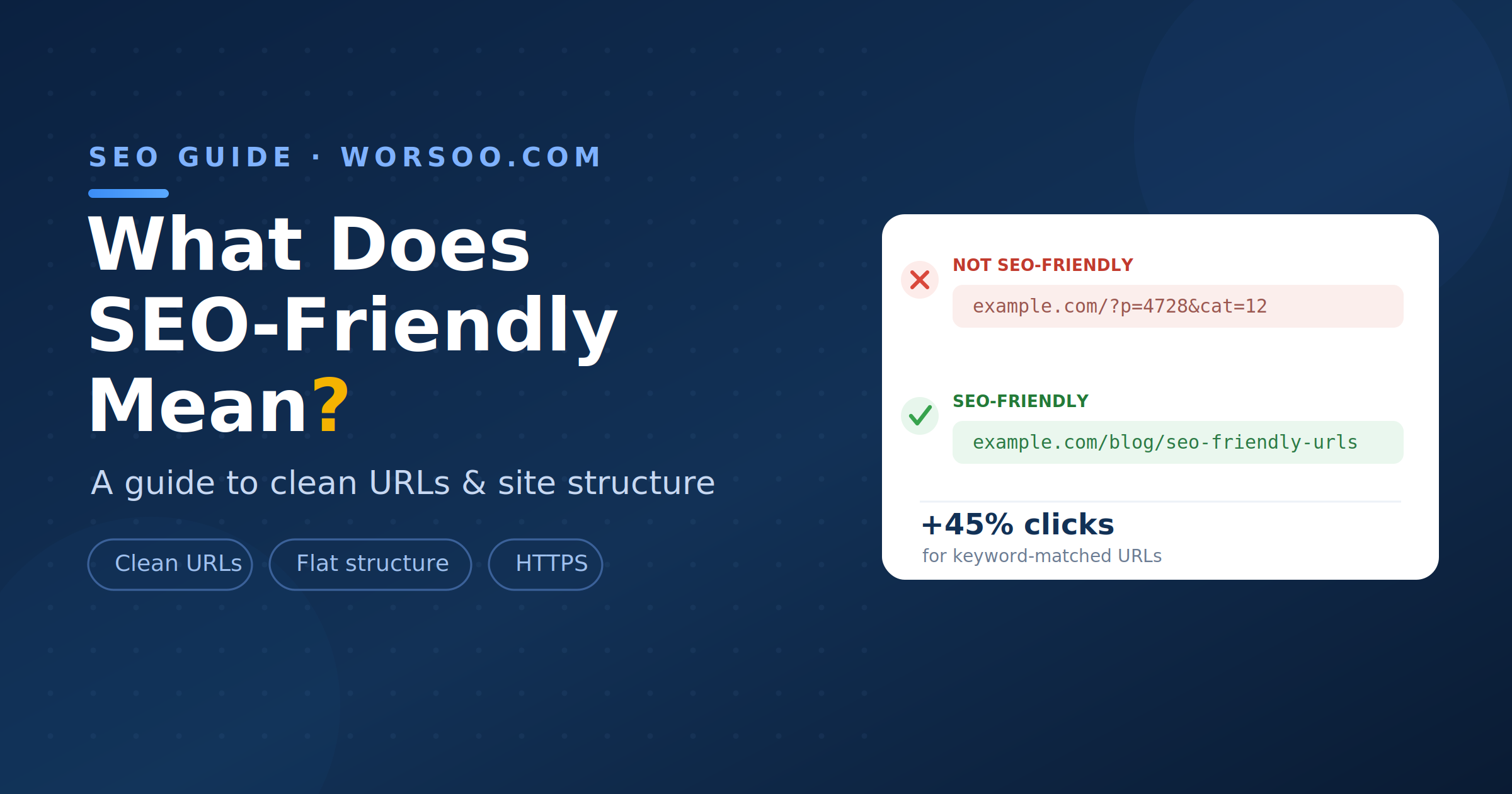
Quick answer: “SEO-friendly” means a website is built so search engines can easily crawl, understand, and rank it, and so people have a good experience using it. It covers everything from content and speed to mobile usability, but two of the most overlooked pieces are your URLs and your site structure. Get those right and you make every other ranking effort work harder.
I bring this up with almost every new client, because it’s the part people skip. They’ll obsess over content while their URLs look like /?p=4728 and their pages sit five clicks deep. Let me explain what SEO-friendly actually means, then show you exactly how to fix the URL and structure side, which is where the quick, lasting wins usually hide.
What does SEO-friendly mean?
At its simplest, SEO-friendly means designed to rank. A page or site is SEO-friendly when it removes the obstacles that stop search engines from finding, reading, and trusting it, while giving humans a clean experience at the same time. Those two goals almost always overlap.
An SEO-friendly page usually has these traits:
| Trait | Why it’s SEO-friendly |
|---|---|
| Crawlable and indexable | Search engines can actually access and store it |
| Fast and mobile-first | Meets Core Web Vitals and works on any device |
| Clear, useful content | Matches search intent and answers the query |
| Logical structure | Organized so both users and crawlers navigate easily |
| Clean URLs | Readable web addresses that describe the page |
| Secure (HTTPS) | Encrypted, and a confirmed Google ranking factor since 2014 |
This guide focuses on the last three, structure and URLs, because they’re the most commonly botched and the easiest to fix well.
Anatomy of an SEO-friendly URL
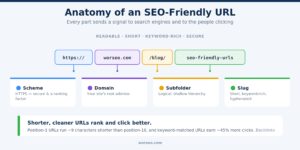
A URL is just your page’s web address, but its parts each send signals. Compare these two:
| Not SEO-friendly | SEO-friendly |
|---|---|
example.com/?p=4728&cat=12 |
example.com/blog/seo-friendly-urls |
| Tells users and Google nothing | Instantly describes the page |
| Auto-generated, full of parameters | Clean, readable, keyword-bearing |
The second one wins on every front: a searcher can guess what’s on the page before clicking, and Google can read the topic straight from the address. That readability is the whole point.
How to use friendly URLs
So how to use friendly URLs in practice? Follow a short set of rules, and apply them from the start rather than fixing them later. Here’s the checklist I use:
| Rule | Do this |
|---|---|
| Keep it short | Aim for under about 60–75 characters; a 3–5 word slug |
| Use hyphens | Separate words with hyphens, never underscores or spaces |
| Lowercase only | Avoid capitals, which can create duplicate-URL issues |
| Include one keyword | Put the page’s main keyword in the slug, naturally |
| Drop stop words | Cut “a,” “the,” “and,” and other filler |
| Avoid parameters | Skip session IDs and tracking junk where you can |
| Match the topic | Let the URL mirror the page title and content |
The payoff is measurable. Backlinko’s analysis of 4 million results found that URLs containing a keyword that matches the query earn around 45% more clicks than those without one. In a separate study of 11.8 million results, they found the page ranking first tends to have a URL about 9.2 characters shorter than the page ranking tenth. To be clear about the mechanism, Google’s John Mueller has said words in URLs are only a very minor ranking signal, so the real benefit isn’t magic ranking power. It’s higher click-through, easier crawling, and cleaner internal linking, which together support rankings.
How to optimize your website’s URL structure for SEO
Individual URLs matter, but their arrangement matters just as much. Here’s how to optimize your website’s URL structure for SEO at the site level.
Keep your hierarchy shallow. Your folder structure should reflect a logical order, like /services/web-design, but two to three levels is the practical maximum. A URL like /services/design/residential/kitchens/modern/portfolio is a red flag that your structure has gotten too deep.
Mind your click depth, not just your folders. Google clarified back in 2018 that the number of folders in a URL doesn’t directly hurt rankings, but page depth, how many clicks it takes to reach a page from the homepage, does matter. Flat architectures, where most pages sit one or two clicks from home, get crawled and discovered more efficiently. If an important page is buried five clicks deep, it’s effectively hidden from both users and Google.
Support the structure with internal links and breadcrumbs. Descriptive internal links and breadcrumb navigation reinforce your hierarchy, spread link equity to your key pages, and give crawlers clear paths to follow. A logical structure isn’t just tidy, it’s how authority flows through your site.
What about changing existing URLs?
A word of caution, because this is where people cause self-inflicted damage. If your current URLs are functional but not perfect, leave them alone. Every URL change risks a temporary ranking dip. Only overhaul URLs that are genuinely broken, random numbers, session IDs, or extreme length. And when you do change one, always set up a 301 redirect from the old address to the new one, update your internal links, and resubmit your sitemap. Skip the redirect and you throw away every bit of ranking authority that URL had built.
SEO-friendly in the AI era
One modern reason clean structure matters more than ever: AI answer engines. Systems like Google’s AI Overviews and ChatGPT use signals including your URL and site structure to assess what a page is about and how confidently they can cite it. A clear, descriptive URL and a logical hierarchy help these tools understand and trust your content, making an SEO-friendly setup part of getting cited in AI answers, not just ranked in traditional results.
Final thoughts
So, what does SEO-friendly mean? It means your site is built to be found, understood, and trusted, by search engines and people alike. Content and speed get most of the attention, but clean URLs and a shallow, logical structure are the quiet foundations that make everything else pay off. They’re also among the easiest wins available: readable slugs, shallow hierarchy, HTTPS, and smart internal linking cost little and compound over time.
If your site is running on messy auto-generated URLs or a tangled structure and you’re not sure how to fix it without wrecking your rankings, that’s exactly the kind of technical cleanup we handle carefully for clients at Worsoo.